
88 citations
Cite
SaveGo to paper →
Frontiers
Frontiers in Neuroergonomics Template
Write in a clean editor, then format for Frontiers in Neuroergonomics in one click — DocuGuru applies the official Frontiers template with author–year references and exports a submission-ready PDF plus the editable LaTeX source. Free to start.
About the Frontiers in Neuroergonomics format
Frontiers in Neuroergonomics is a peer-reviewed journal published by Frontiers, covering EEG and Brain-Computer Interfaces, Human-Automation Interaction and Safety, Neural and Behavioral Psychology Studies. Over its lifetime it has published 208 papers, which have received 1,817 citations.
| Publisher | Frontiers |
|---|---|
| Reference style | Author–year (Harvard) Author–year — (Smith, 2023) in the text Smith, A., Jones, B. and Lee, C. (2023) 'A representative article title', Frontiers in Neuroergonomics, 12(3), pp. 45–58.
Formats any DOI in Frontiers in Neuroergonomics style. No sign-up. |
| Publishes research in | EEG and Brain-Computer Interfaces Human-Automation Interaction and Safety Neural and Behavioral Psychology Studies Functional Brain Connectivity Studies Optical Imaging and Spectroscopy Techniques |
| ISSN | 2673-6195 |
| Citation impact (2-yr) | 4.3 |
| h-index | 22 |
| i10-index | 58 |
| Article processing charge | $1,900 |
| Open access | Yes — indexed in DOAJ |
| Top institutions publishing here | Institut Supérieur de l'Aéronautique et de l'Espace (ISAE-SUPAERO) |
| Journal website | www.frontiersin.org |
| You get | A submission-ready PDF and the editable LaTeX source — ready to submit. |
Papers published in Frontiers in Neuroergonomics per year
Citation impact of Frontiers in Neuroergonomics by publication year
Citations each year’s papers have accumulated so far — the most recent years are still building up.
Most-cited papers in Frontiers in Neuroergonomics
Eye tracking (ET) has been used extensively in driver attention research. Amongst other findings, ET data have increased our knowledge about what drivers look at in different traffic environments and how they distribute their glances when interacting with non-driving related tasks. Eye tracking is also the go-to method when determining driver distraction via glance target…
57 citations
Cite
SaveGo to paper →
The optical brain imaging method functional near-infrared spectroscopy (fNIRS) is a promising tool for real-time applications such as neurofeedback and brain-computer interfaces. Its combination of spatial specificity and mobility makes it particularly attractive for clinical use, both at the bedside and in patients' homes. Despite these advantages, optimizing fNIRS for real-time use requires careful attention…
50 citations
Cite
SaveGo to paper →
As a measure of the brain's electrical activity, electroencephalography (EEG) is the primary signal of interest for brain-computer-interfaces (BCI). BCIs offer a communication pathway between a brain and an external device, translating thought into action with suitable processing. EEG data is the most common signal source for such technologies. However, artefacts induced in BCIs in…
47 citations
Cite
SaveGo to paper →
41 citations
Cite
SaveGo to paper →
Related journal templates

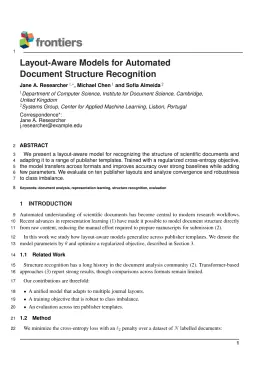

Frontiers in Neuroergonomics template — frequently asked questions
How do I write a paper in the Frontiers in Neuroergonomics format?
In DocuGuru you write your manuscript in a normal editor — no LaTeX setup required — and select the Frontiers in Neuroergonomics template. When you export, DocuGuru compiles the paper into the official Frontiers format and hands you a submission-ready PDF along with the editable LaTeX source.
What reference style does Frontiers in Neuroergonomics use?
Frontiers in Neuroergonomics uses Author–year (Harvard) references, shown as author–year markers such as (Smith, 2023) in the text. DocuGuru formats every in-text citation and the reference list in this exact style automatically. A reference appears like this: Smith, A., Jones, B. and Lee, C. (2023) 'A representative article title', Frontiers in Neuroergonomics, 12(3), pp. 45–58.
Do I need to know LaTeX to submit to Frontiers in Neuroergonomics?
No. DocuGuru generates the FrontiersinHarvard LaTeX class and compiles the PDF for you in the background, so you get a Frontiers-ready Frontiers in Neuroergonomics document without writing any LaTeX. If you do want it, the LaTeX source is included in the export.
Can I import an existing draft into the Frontiers in Neuroergonomics template?
Yes. Paste or upload your current manuscript — Word, LaTeX, Markdown, or plain text — and DocuGuru reflows it into the Frontiers in Neuroergonomics format with correct headings, figures, tables, and author–year citations.
What is Frontiers in Neuroergonomics?
Frontiers journal. It is a life sciences and medicine journal, published by Frontiers.
Can I export a submission-ready Frontiers in Neuroergonomics PDF?
Yes — DocuGuru produces a PDF built with the official Frontiers in Neuroergonomics template (the FrontiersinHarvard class) that is ready to submit to Frontiers, together with the matching LaTeX source files.
How much does the Frontiers in Neuroergonomics template cost?
You can start writing in the Frontiers in Neuroergonomics template for free. Exporting the final submission-ready Frontiers in Neuroergonomics PDF and LaTeX source is part of DocuGuru's paid plans — see the app for current pricing.