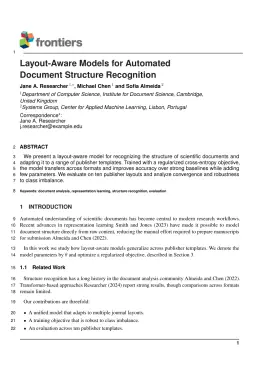
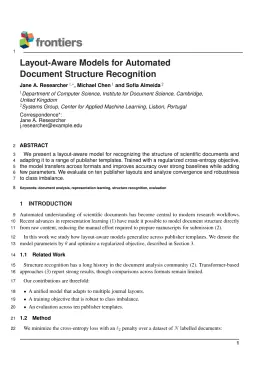
About the Frontiers in Materials format
Frontiers in Materials is a peer-reviewed journal published by Frontiers, covering Concrete and Cement Materials Research, Innovative concrete reinforcement materials, Structural Behavior of Reinforced Concrete. Over its lifetime it has published 4,016 papers, which have received 62,685 citations.
| Publisher | Frontiers |
|---|
| Reference style | Author–year (Harvard) Author–year — (Smith, 2023) in the text
Smith, A., Jones, B. and Lee, C. (2023) 'A representative article title', Frontiers in Materials, 12(3), pp. 45–58.
Formats any DOI in Frontiers in Materials style. No sign-up.
|
|---|
| Publishes research in | Concrete and Cement Materials Research Innovative concrete reinforcement materials Structural Behavior of Reinforced Concrete Bone Tissue Engineering Materials Asphalt Pavement Performance Evaluation |
|---|
| ISSN | 2296-8016 |
|---|
| Citation impact (2-yr) | 3.94 |
|---|
| h-index | 87 |
|---|
| i10-index | 1,693 |
|---|
| Article processing charge | $3,225 |
|---|
| Open access | Yes — indexed in DOAJ |
|---|
| Top institutions publishing here | Chinese Academy of Sciences |
|---|
| Journal website | www.frontiersin.org |
|---|
| You get | A submission-ready PDF and the editable LaTeX source — ready to submit. |
|---|
Papers published in Frontiers in Materials per year
Citation impact of Frontiers in Materials by publication year
Citations each year’s papers have accumulated so far — the most recent years are still building up.
Most-cited papers in Frontiers in Materials
Natural Fibers as Sustainable and Renewable Resource for Development of Eco-Friendly Composites: A Comprehensive Review
Yashas Gowda Thyavihalli Girijappa, Sanjay Mavinkere Rangappa, Jyotishkumar Parameswaranpillai et al. · 27 Sep 2019
The increase in awareness of the damage caused by synthetic materials on the environment has led to the development of eco-friendly materials. The researchers have shown a lot of interest in developing such materials which can replace the synthetic materials. As a result, there is an increase in demand for commercial use of the natural…
Microbially Induced Calcium Carbonate Precipitation (MICP) and Its Potential in Bioconcrete: Microbiological and Molecular Concepts
María José Castro-Alonso, Lilia Ernestina Montañez-Hernández, María Alejandra Sánchez-Muñoz et al. · 10 Jun 2019
In this review, microbiological and molecular concepts of Microbially induced Calcium Carbonate Precipitation (MICP) and their role in bioconcrete are discussed. MICP is a widespread biochemical process in soils, caves, freshwater, marine sediments and hypersaline habitats. MICP is an outcome of metabolic interactions between diverse microbial communities with organic and/or inorganic compounds present in environment.…
A Review of the Application of Machine Learning and Data Mining Approaches in Continuum Materials Mechanics
Frederic E. Bock, Roland C. Aydin, Christian J. Cyron et al. · 15 May 2019
Machine learning tools represent key enablers for empowering material scientists and engineers to accelerate the development of novel materials, processes and techniques. One of the aims of using such approaches in the field of materials science is to achieve high-throughput identification and quantification of essential features along the process-structure-property-performance chain. In this contribution, machine learning…
Carbon Quantum Dots for Biomedical Applications: Review and Analysis
Nayab Azam, Murtaza Najabat Ali, Tooba Javaid Khan · 24 Aug 2021
Carbon quantum dots (CQDs) are a new type of nano-carbons that are currently favored over semiconductor quantum dots (QDs) because of their solubility, low toxicity, eco-friendliness, and cheap and facile synthesis giving desired optical characteristics. Moreover, their physiochemical properties can be controlled by their synthetic route. CQDs can emit fluorescence in the range from the…
A Comprehensive Review of Magnetic Nanomaterials Modern Day Theranostics
Saima Gul, Sher Bahadar Khan, Inayat Ur Rehman et al. · 31 Jul 2019
Substances at nanoscale commonly known as “nanomaterials” have always grabbed the attention of the researchers for hundreds of years. Among these different types of nanomaterials, magnetic nanomaterials have been the focus of overwhelming attention during the last two decades as evidenced by an extraordinary increase in number of research papers. Iron oxide magnetic nanoparticles have…