Frontiers

Frontiers in Ecology and Evolution Template

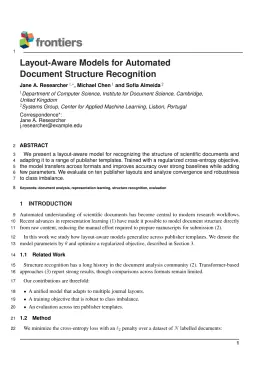
Write in a clean editor, then format for Frontiers in Ecology and Evolution in one click — DocuGuru applies the official Frontiers template with author–year references and exports a submission-ready PDF plus the editable LaTeX source. Free to start.

About the Frontiers in Ecology and Evolution format

Frontiers in Ecology and Evolution is a peer-reviewed journal published by Frontiers, covering Plant and animal studies, Ecology and Vegetation Dynamics Studies, Wildlife Ecology and Conservation. Over its lifetime it has published 6,150 papers, which have received 112,548 citations.

PublisherFrontiers
Reference styleAuthor–year (Harvard)
Author–year — (Smith, 2023) in the text
Smith, A., Jones, B. and Lee, C. (2023) 'A representative article title', Frontiers in Ecology and Evolution, 12(3), pp. 45–58.

Formats any DOI in Frontiers in Ecology and Evolution style. No sign-up.

Publishes research inPlant and animal studies Ecology and Vegetation Dynamics Studies Wildlife Ecology and Conservation Species Distribution and Climate Change Animal Behavior and Reproduction
ISSN2296-701X
Citation impact (2-yr)3.09
h-index107
i10-index3,120
Article processing charge$2,490
Open accessYes — indexed in DOAJ
Top institutions publishing hereChinese Academy of Sciences
Journal websitewww.frontiersin.org
You getA submission-ready PDF and the editable LaTeX source — ready to submit.

Papers published in Frontiers in Ecology and Evolution per year

85
2014
160
2015
163
2016
168
2017
239
2018
503
2019
501
2020
1K
2021
1.3K
2022
1.1K
2023
399
2024
272
2025

Citation impact of Frontiers in Ecology and Evolution by publication year

3.7K
2014
5.8K
2015
6.4K
2016
6K
2017
10.3K
2018
18.7K
2019
13.4K
2020
19.1K
2021
15.6K
2022
9.3K
2023
2.2K
2024
410
2025

Citations each year’s papers have accumulated so far — the most recent years are still building up.

Most-cited papers in Frontiers in Ecology and Evolution

Modelling Palaeoecological Time Series Using Generalised Additive Models

Gavin L. Simpson · 26 Oct 2018

In the absence of annual laminations, time series generated from lake sediments or other similar stratigraphic sequences are irregularly spaced in time, which complicates formal analysis using classical statistical time series models. In lieu, statistical analyses of trends in palaeoenvironmental time series, if done at all, have typically used simpler linear regressions or (non-) parametric…

Factors Influencing Leaf Chlorophyll Content in Natural Forests at the Biome Scale

Ying Li, Nianpeng He, Jihua Hou et al. · 4 Jun 2018

Chlorophyll (Chl) is an important photosynthetic pigment to the plant, largely determining photosynthetic capacity and hence plant growth. However, this concept has not been verified in natural forests, especially at a large scale. Furthermore, how Chl varies in natural forests remains unclear. In this study, the leaves of 823 plant species were collected from nine…

Genetic Diversity and Conservation Units: Dealing With the Species-Population Continuum in the Age of Genomics

David Coates, Margaret Byrne, Craig Moritz · 23 Oct 2018

Current approaches to biodiversity conservation are largely based on geographic areas, ecosystems, ecological communities and species, with less attention ongenetic diversity and the evolutionary continuum from populations to species. Conservation management generally rests on discrete categories, such as identified species, and, for threated taxa, intraspecific units. Species, in particular, provide a common measure of biodiversity…

Linking Movement Ecology with Wildlife Management and Conservation

Andrew M. Allen, Navinder J. Singh · 12 Jan 2016

A common challenge in species conservation and management is how to incorporate species movements into management objectives. There often is a lack of knowledge of where, when and why species move. The field of movement ecology has grown rapidly in the last decade and is now providing the knowledge needed to incorporate movements of species…

Climate-adjusted provenancing: a strategy for climate-resilient ecological restoration

Suzanne M. Prober, Margaret Byrne, Elizabeth H. McLean et al. · 23 Jun 2015

<p class="mb15">Investments in ecological restoration are estimated at $US 2 trillion per annum worldwide and are increasing rapidly (<a href="#B9">Cunningham, 2008</a>; <a href="#B29">Williams et al., 2014</a>). These investments are occurring in an environment of accelerated climate change that is projected to continue into the next century, yet they currently take little account of such change.…

Frontiers in Ecology and Evolution template — frequently asked questions

How do I write a paper in the Frontiers in Ecology and Evolution format?
In DocuGuru you write your manuscript in a normal editor — no LaTeX setup required — and select the Frontiers in Ecology and Evolution template. When you export, DocuGuru compiles the paper into the official Frontiers format and hands you a submission-ready PDF along with the editable LaTeX source.
What reference style does Frontiers in Ecology and Evolution use?
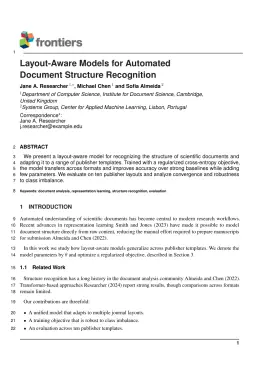
Frontiers in Ecology and Evolution uses Author–year (Harvard) references, shown as author–year markers such as (Smith, 2023) in the text. DocuGuru formats every in-text citation and the reference list in this exact style automatically. A reference appears like this: Smith, A., Jones, B. and Lee, C. (2023) 'A representative article title', Frontiers in Ecology and Evolution, 12(3), pp. 45–58.
Do I need to know LaTeX to submit to Frontiers in Ecology and Evolution?
No. DocuGuru generates the FrontiersinHarvard LaTeX class and compiles the PDF for you in the background, so you get a Frontiers-ready Frontiers in Ecology and Evolution document without writing any LaTeX. If you do want it, the LaTeX source is included in the export.
Can I import an existing draft into the Frontiers in Ecology and Evolution template?
Yes. Paste or upload your current manuscript — Word, LaTeX, Markdown, or plain text — and DocuGuru reflows it into the Frontiers in Ecology and Evolution format with correct headings, figures, tables, and author–year citations.
What is Frontiers in Ecology and Evolution?
Frontiers journal. It is a life sciences and medicine journal, published by Frontiers.
Can I export a submission-ready Frontiers in Ecology and Evolution PDF?
Yes — DocuGuru produces a PDF built with the official Frontiers in Ecology and Evolution template (the FrontiersinHarvard class) that is ready to submit to Frontiers, together with the matching LaTeX source files.
How much does the Frontiers in Ecology and Evolution template cost?
You can start writing in the Frontiers in Ecology and Evolution template for free. Exporting the final submission-ready Frontiers in Ecology and Evolution PDF and LaTeX source is part of DocuGuru's paid plans — see the app for current pricing.
Use the Frontiers in Ecology and Evolution template