Frontiers

Frontiers in Developmental Psychology Template

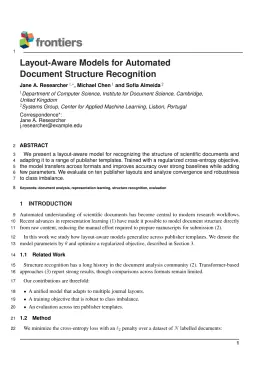
Write in a clean editor, then format for Frontiers in Developmental Psychology in one click — DocuGuru applies the official Frontiers template with author–year references and exports a submission-ready PDF plus the editable LaTeX source. Free to start.

About the Frontiers in Developmental Psychology format

Frontiers in Developmental Psychology is a peer-reviewed journal published by Frontiers, covering Child and Animal Learning Development, Early Childhood Education and Development, Child Development and Digital Technology. Over its lifetime it has published 186 papers, which have received 379 citations.

PublisherFrontiers
Reference styleAuthor–year (Harvard)
Author–year — (Smith, 2023) in the text
Smith, A., Jones, B. and Lee, C. (2023) 'A representative article title', Frontiers in Developmental Psychology, 12(3), pp. 45–58.

Formats any DOI in Frontiers in Developmental Psychology style. No sign-up.

Publishes research inChild and Animal Learning Development Early Childhood Education and Development Child Development and Digital Technology Child and Adolescent Psychosocial and Emotional Development Impact of Technology on Adolescents
ISSN2813-7779
Citation impact (2-yr)1.83
h-index10
i10-index10
Open accessYes — indexed in DOAJ
Top institutions publishing hereArizona State University
You getA submission-ready PDF and the editable LaTeX source — ready to submit.

Papers published in Frontiers in Developmental Psychology per year

14
2023
53
2024
47
2025

Citation impact of Frontiers in Developmental Psychology by publication year

62
2023
224
2024
65
2025

Citations each year’s papers have accumulated so far — the most recent years are still building up.

Most-cited papers in Frontiers in Developmental Psychology

Screen on = development off? A systematic scoping review and a developmental psychology perspective on the effects of screen time on early childhood development

Fabio Sticca, Valérie Brauchli, Patricia Lannen · 7 Jan 2025

Research on the associations between screen time and child development suggests that various forms of screen time might pose a risk for various aspects of child development. However, data on the impact of exposure to screen media on the development of children under 3 years of age is comparatively scarce. Although the evidence available on…

Measuring parents' regulatory media use for themselves and their children

Bolim Suh, Heather L. Kirkorian, Rachel Barr et al. · 4 Apr 2024

Introduction Parents often use media to manage their own or their child's emotions and behaviors, which is called “regulatory media use.” While the use of media to alleviate negative emotions and behaviors may be helpful in the short-term, there may be negative consequences in the long-term (e.g., for children's development of self-regulatory skills). Research remains…

Friends, followers, peers, and posts: adolescents' in-person and online friendship networks and social media use influences on friendship closeness via the importance of technology for social connection

Elizabeth Al-Jbouri, Anthony A. Volk, Natalie Spadafora et al. · 24 Jul 2024

Introduction With the proliferation of smartphones, social media access and use is ubiquitous. As such, many adolescent friendships now comprise both in-person and online contexts. Our paper explores the relationship between these contexts in two parts: the first is an exploratory comparison of in-person and online friendship networks with peers at school using descriptive social…

Adolescent close friendships, self-perceived social acceptance, and peer-rated likeability as predictors of wellbeing in young adulthood

Emily Shah, David E. Szwedo, Joseph P. Allen · 11 Oct 2024

Introduction Links between interpersonal relationships and physical and psychological functioning have been well-established in the literature. During adolescence, success or distress in peer relationships may have distinct effects on different aspects of wellbeing. The present study aims to examine the ways in which different adolescent peer relationship contexts (i.e., close friendship quality, social acceptance, and…

An agency-based model of executive and metacognitive regulation

Michael Tomasello · 8 Mar 2024

In the context of agentive decision making and action, both executive and metacognitive processes serve self-regulatory functions—just on different hierarchical tiers. In the agency-based model proposed here executive processes monitor and control action and attention from an executive tier of operation, and metacognitive processes monitor and control those executive processes from a second-order metacognitive tier…

Frontiers in Developmental Psychology template — frequently asked questions

How do I write a paper in the Frontiers in Developmental Psychology format?
In DocuGuru you write your manuscript in a normal editor — no LaTeX setup required — and select the Frontiers in Developmental Psychology template. When you export, DocuGuru compiles the paper into the official Frontiers format and hands you a submission-ready PDF along with the editable LaTeX source.
What reference style does Frontiers in Developmental Psychology use?
Frontiers in Developmental Psychology uses Author–year (Harvard) references, shown as author–year markers such as (Smith, 2023) in the text. DocuGuru formats every in-text citation and the reference list in this exact style automatically. A reference appears like this: Smith, A., Jones, B. and Lee, C. (2023) 'A representative article title', Frontiers in Developmental Psychology, 12(3), pp. 45–58.
Do I need to know LaTeX to submit to Frontiers in Developmental Psychology?
No. DocuGuru generates the FrontiersinHarvard LaTeX class and compiles the PDF for you in the background, so you get a Frontiers-ready Frontiers in Developmental Psychology document without writing any LaTeX. If you do want it, the LaTeX source is included in the export.
Can I import an existing draft into the Frontiers in Developmental Psychology template?
Yes. Paste or upload your current manuscript — Word, LaTeX, Markdown, or plain text — and DocuGuru reflows it into the Frontiers in Developmental Psychology format with correct headings, figures, tables, and author–year citations.
What is Frontiers in Developmental Psychology?
Frontiers journal. It is a life sciences and medicine journal, published by Frontiers.
Can I export a submission-ready Frontiers in Developmental Psychology PDF?
Yes — DocuGuru produces a PDF built with the official Frontiers in Developmental Psychology template (the FrontiersinHarvard class) that is ready to submit to Frontiers, together with the matching LaTeX source files.
How much does the Frontiers in Developmental Psychology template cost?
You can start writing in the Frontiers in Developmental Psychology template for free. Exporting the final submission-ready Frontiers in Developmental Psychology PDF and LaTeX source is part of DocuGuru's paid plans — see the app for current pricing.
Use the Frontiers in Developmental Psychology template