Frontiers

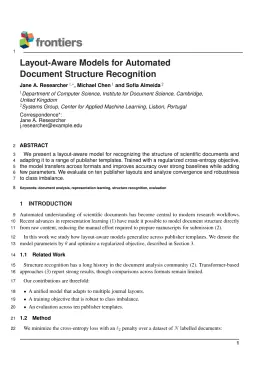
Frontiers in Chemistry Template

Write in a clean editor, then format for Frontiers in Chemistry in one click — DocuGuru applies the official Frontiers template with author–year references and exports a submission-ready PDF plus the editable LaTeX source. Free to start.

About the Frontiers in Chemistry format

Frontiers in Chemistry is a peer-reviewed journal published by Frontiers, covering Advanced biosensing and bioanalysis techniques, Advanced Photocatalysis Techniques, Advancements in Battery Materials. Over its lifetime it has published 8,451 papers, which have received 215,291 citations.

PublisherFrontiers
Reference styleAuthor–year (Harvard)
Author–year — (Smith, 2023) in the text
Smith, A., Jones, B. and Lee, C. (2023) 'A representative article title', Frontiers in Chemistry, 12(3), pp. 45–58.

Formats any DOI in Frontiers in Chemistry style. No sign-up.

Publishes research inAdvanced biosensing and bioanalysis techniques Advanced Photocatalysis Techniques Advancements in Battery Materials Computational Drug Discovery Methods Nanoplatforms for cancer theranostics
ISSN2296-2646
Citation impact (2-yr)6.16
h-index159
i10-index4,869
Article processing charge$2,950
Open accessYes — indexed in DOAJ
Top institutions publishing hereChinese Academy of Sciences
Journal websitejournal.frontiersin.org
You getA submission-ready PDF and the editable LaTeX source — ready to submit.

Papers published in Frontiers in Chemistry per year

122
2014
76
2015
50
2016
126
2017
707
2018
910
2019
1.3K
2020
1.2K
2021
1.7K
2022
795
2023
650
2024
447
2025

Citation impact of Frontiers in Chemistry by publication year

9K
2014
3.9K
2015
3.5K
2016
6.8K
2017
30.7K
2018
36.7K
2019
45.7K
2020
28.7K
2021
27.7K
2022
10.6K
2023
6K
2024
1.7K
2025

Citations each year’s papers have accumulated so far — the most recent years are still building up.

Most-cited papers in Frontiers in Chemistry

Nanocellulose: From Fundamentals to Advanced Applications

Djalal Trache, Ahmed Fouzi Tarchoun, Mehdi Derradji et al. · 6 May 2020

Over the past few years, nanocellulose (NC), cellulose in the form of nanostructures, has been proved to be one of the most prominent green materials of modern times. NC materials have gained growing interests owing to their attractive and excellent characteristics such as abundance, high aspect ratio, better mechanical properties, renewability, and biocompatibility. The abundant…

1,270 citations Cite SaveGo to paper →
Nanomaterials for biosensing applications: a review

Michael Holzinger, Alan Le Goff, Serge Cosnier · 27 Aug 2014

A biosensor device is defined by its biological, or bioinspired receptor unit with unique specificities toward corresponding analytes. These analytes are often of biological origin like DNAs of bacteria or viruses, or proteins which are generated from the immune system (antibodies, antigens) of infected or contaminated living organisms. Such analytes can also be simple molecules…

1,061 citations Cite SaveGo to paper →
Synthetic Polymer Contamination in Bottled Water

Sherri A. Mason, Victoria G. Welch, Joseph Neratko · 11 Sep 2018

Eleven globally sourced brands of bottled water, purchased in 19 locations in nine different countries, were tested for microplastic contamination using Nile Red tagging. Of the 259 total bottles processed, 93% showed some sign of microplastic contamination. After accounting for possible background (lab) contamination, an average of 10.4 microplastic particles >100 um in size per…

1,052 citations Cite SaveGo to paper →
Oxidative stress, free radicals and antioxidants: potential crosstalk in the pathophysiology of human diseases

Priya Chaudhary, Pracheta Janmeda, Anca Oana Docea et al. · 10 May 2023

Introduction: Free radicals are reactive oxygen species that constantly circulate through the body and occur as a side effect of many reactions that take place in the human body. Under normal conditions, they are removed from the body by antioxidant processes. If these natural mechanisms are disrupted, radicals accumulate in excess and contribute to the…

Gold Nanoparticles for Photothermal Cancer Therapy

Jeremy B. Vines, Jee-Hyun Yoon, Na-Eun Ryu et al. · 5 Apr 2019

Gold is a multifunctional material that has been utilized in medicinal applications for centuries because it has been recognized for its bacteriostatic, anticorrosive, and antioxidative properties. Modern medicine makes routine, conventional use of gold and has even developed more advanced applications by taking advantage of its ability to be manufactured at the nanoscale and functionalized…

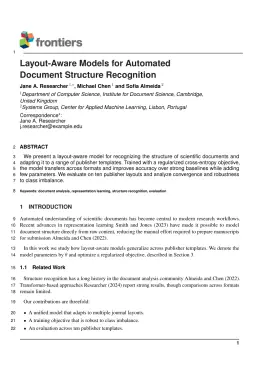
Frontiers in Chemistry template — frequently asked questions

How do I write a paper in the Frontiers in Chemistry format?
In DocuGuru you write your manuscript in a normal editor — no LaTeX setup required — and select the Frontiers in Chemistry template. When you export, DocuGuru compiles the paper into the official Frontiers format and hands you a submission-ready PDF along with the editable LaTeX source.
What reference style does Frontiers in Chemistry use?
Frontiers in Chemistry uses Author–year (Harvard) references, shown as author–year markers such as (Smith, 2023) in the text. DocuGuru formats every in-text citation and the reference list in this exact style automatically. A reference appears like this: Smith, A., Jones, B. and Lee, C. (2023) 'A representative article title', Frontiers in Chemistry, 12(3), pp. 45–58.
Do I need to know LaTeX to submit to Frontiers in Chemistry?
No. DocuGuru generates the FrontiersinHarvard LaTeX class and compiles the PDF for you in the background, so you get a Frontiers-ready Frontiers in Chemistry document without writing any LaTeX. If you do want it, the LaTeX source is included in the export.
Can I import an existing draft into the Frontiers in Chemistry template?
Yes. Paste or upload your current manuscript — Word, LaTeX, Markdown, or plain text — and DocuGuru reflows it into the Frontiers in Chemistry format with correct headings, figures, tables, and author–year citations.
What is Frontiers in Chemistry?
Frontiers journal. It is a life sciences and medicine journal, published by Frontiers.
Can I export a submission-ready Frontiers in Chemistry PDF?
Yes — DocuGuru produces a PDF built with the official Frontiers in Chemistry template (the FrontiersinHarvard class) that is ready to submit to Frontiers, together with the matching LaTeX source files.
How much does the Frontiers in Chemistry template cost?
You can start writing in the Frontiers in Chemistry template for free. Exporting the final submission-ready Frontiers in Chemistry PDF and LaTeX source is part of DocuGuru's paid plans — see the app for current pricing.
Use the Frontiers in Chemistry template