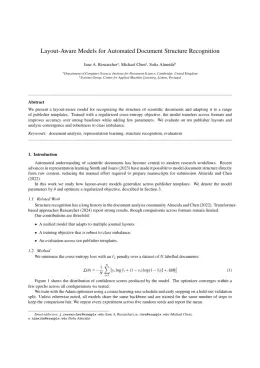
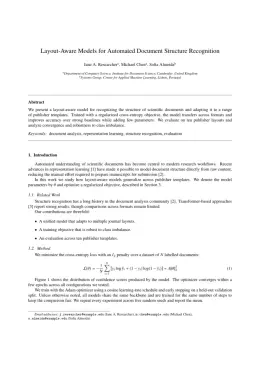
About the Theoretical and Applied Mechanics Letters format
Theoretical and Applied Mechanics Letters is a peer-reviewed journal published by Elsevier, covering Fluid Dynamics and Turbulent Flows, Fluid Dynamics and Vibration Analysis, Model Reduction and Neural Networks.
| Publisher | Elsevier |
|---|
| Reference style | Numbered (Elsevier) Numbered — [1], [2] in the text
[1] A. Smith, B. Jones, C. Lee, A representative article title, Theoretical and Applied Mechanics Letters 12 (2023) 45–58.
Formats any DOI in Theoretical and Applied Mechanics Letters style. No sign-up.
|
|---|
| Publishes research in | Fluid Dynamics and Turbulent Flows Fluid Dynamics and Vibration Analysis Model Reduction and Neural Networks Numerical methods in engineering Computational Fluid Dynamics and Aerodynamics |
|---|
| ISSN | 2095-0349 |
|---|
| Citation impact (2-yr) | 3.17 |
|---|
| h-index | 46 |
|---|
| i10-index | 372 |
|---|
| Total citations | 12,628 |
|---|
| Article processing charge | $1,000 |
|---|
| Open access | Yes |
|---|
| Top institutions publishing here | Institute of Mechanics |
|---|
| Journal website | www.journals.elsevier.com |
|---|
| You get | A submission-ready PDF and the editable LaTeX source — ready to submit. |
|---|
Papers published in Theoretical and Applied Mechanics Letters per year
Citation impact of Theoretical and Applied Mechanics Letters by publication year
Citations each year’s papers have accumulated so far — the most recent years are still building up.
Most-cited papers in Theoretical and Applied Mechanics Letters
Elastic properties of chiral, anti-chiral, and hierarchical honeycombs: A simple energy-based approach
Davood Mousanezhad, Babak Haghpanah, Ranajay Ghosh et al. · 1 Mar 2016
The effects of two geometric refinement strategies widespread in natural structures, chirality and self-similar hierarchy, on the in-plane elastic response of two-dimensional honeycombs were studied systematically. Simple closed-form expressions were derived for the elastic moduli of several chiral, anti-chiral, and hierarchical honeycombs with hexagon and square based networks. Finite element analysis was employed to validate…
Physics-informed deep learning for incompressible laminar flows
Chengping Rao, Hao Sun, Yang Liu · 1 Mar 2020
Physics-informed deep learning has drawn tremendous interest in recent years to solve computational physics problems, whose basic concept is to embed physical laws to constrain/inform neural networks, with the need of less data for training a reliable model. This can be achieved by incorporating the residual of physics equations into the loss function. Through minimizing…
Physics-constrained bayesian neural network for fluid flow reconstruction with sparse and noisy data
Luning Sun, Jianxun Wang · 1 Mar 2020
In many applications, flow measurements are usually sparse and possibly noisy. The reconstruction of a high-resolution flow field from limited and imperfect flow information is significant yet challenging. In this work, we propose an innovative physics-constrained Bayesian deep learning approach to reconstruct flow fields from sparse, noisy velocity data, where equation-based constraints are imposed through…
Current trends and future directions in turbulent thermal convection
Ke‐Qing Xia · 1 Jan 2013
The system of turbulent thermal convection is introduced. Progresses in recent decades in the four major areas of research in turbulent convection are briefly reviewed. Some of the recent trends of the field are then discussed, which also serve to point out that the future directions in this important field of fluid mechanics lie in…
Entropy analysis in electrical magnetohydrodynamic (MHD) flow of nanofluid with effects of thermal radiation, viscous dissipation, and chemical reaction
Yahaya Shagaiya Daniel, Zainal Abdul Aziz, Zuhaila Ismail et al. · 22 Jun 2017
The unsteady mixed convection flow of electrical conducting nanofluid and heat transfer due to a permeable linear stretching sheet with the combined effects of an electric field, magnetic field, thermal radiation, viscous dissipation, and chemical reaction have been investigated. A similarity transformation is used to transform the constitutive equations into a system of nonlinear ordinary…