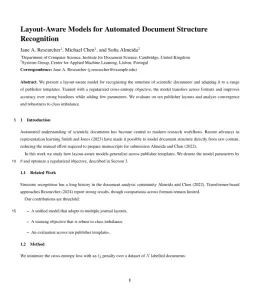
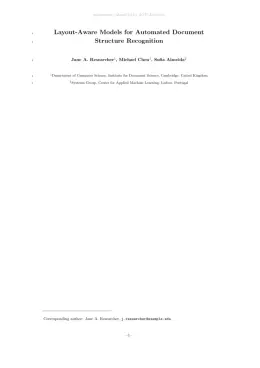
Copernicus Publications

Atmospheric Measurement Techniques Template

Write in a clean editor, then format for Atmospheric Measurement Techniques in one click — DocuGuru applies the official Copernicus Publications template with author–year references and exports a submission-ready PDF plus the editable LaTeX source. Free to start.

About the Atmospheric Measurement Techniques format

Atmospheric Measurement Techniques is a peer-reviewed journal published by Copernicus Publications, covering Atmospheric chemistry and aerosols, Atmospheric Ozone and Climate, Atmospheric and Environmental Gas Dynamics. Over its lifetime it has published 5,411 papers, which have received 214,431 citations.

PublisherCopernicus Publications
Reference styleAuthor–year (Copernicus)
Author–year — (Smith, 2023) in the text
Smith, A., Jones, B., and Lee, C.: A representative article title, Atmospheric Measurement Techniques, 12, 45–58, 2023.

Formats any DOI in Atmospheric Measurement Techniques style. No sign-up.

Publishes research inAtmospheric chemistry and aerosols Atmospheric Ozone and Climate Atmospheric and Environmental Gas Dynamics Atmospheric aerosols and clouds Meteorological Phenomena and Simulations
ISSN1867-1381
Citation impact (2-yr)3.75
h-index171
i10-index3,676
Article processing charge$1,585
Open accessYes — indexed in DOAJ
Top institutions publishing hereCentre National de la Recherche Scientifique
Journal websitewww.atmospheric-measurement-techniques.net
You getA submission-ready PDF and the editable LaTeX source — ready to submit.

Papers published in Atmospheric Measurement Techniques per year

295
2014
344
2015
368
2016
302
2017
386
2018
378
2019
376
2020
426
2021
380
2022
319
2023
379
2024
446
2025

Citation impact of Atmospheric Measurement Techniques by publication year

17.7K
2014
18.9K
2015
18.4K
2016
15.3K
2017
20.6K
2018
16.3K
2019
14.9K
2020
13K
2021
6.8K
2022
3.8K
2023
2.7K
2024
798
2025

Citations each year’s papers have accumulated so far — the most recent years are still building up.

Most-cited papers in Atmospheric Measurement Techniques

The Collection 6 MODIS aerosol products over land and ocean

R. C. Levy, S. Mattoo, L. A. Munchak et al. · 6 Nov 2013

Abstract. The twin Moderate resolution Imaging Spectroradiometer (MODIS) sensors have been flying on Terra since 2000 and Aqua since 2002, creating an extensive data set of global Earth observations. Here, we introduce the Collection 6 (C6) algorithm to retrieve aerosol optical depth (AOD) and aerosol size parameters from MODIS-observed spectral reflectance. While not a major…

2,415 citations Cite SaveGo to paper →
Advancements in the Aerosol Robotic Network (AERONET) Version 3 database – automated near-real-time quality control algorithm with improved cloud screening for Sun photometer aerosol optical depth (AOD) measurements

D. M. Giles, A. Sinyuk, M. G. Sorokin et al. · 11 Jan 2019

Abstract. The Aerosol Robotic Network (AERONET) has provided highly accurate, ground-truth measurements of the aerosol optical depth (AOD) using Cimel Electronique Sun–sky radiometers for more than 25 years. In Version 2 (V2) of the AERONET database, the near-real-time AOD was semiautomatically quality controlled utilizing mainly cloud-screening methodology, while additional AOD data contaminated by clouds or…

1,386 citations Cite SaveGo to paper →
The "dual-spot" Aethalometer: an improved measurement of aerosol black carbon with real-time loading compensation

Luka Drinovec, Griša Močnik, Peter Zotter et al. · 6 May 2015

Abstract. Aerosol black carbon is a unique primary tracer for combustion emissions. It affects the optical properties of the atmosphere and is recognized as the second most important anthropogenic forcing agent for climate change. It is the primary tracer for adverse health effects caused by air pollution. For the accurate determination of mass equivalent black…

1,208 citations Cite SaveGo to paper →
Toward a standardised thermal-optical protocol for measuring atmospheric organic and elemental carbon: the EUSAAR protocol

F. Cavalli, Mar Viana, K. E. Yttri et al. · 26 Jan 2010

Abstract. Thermal-optical analysis is a conventional method for determining the carbonaceous aerosol fraction and for classifying it into organic carbon, OC, and elemental carbon, EC. Unfortunately, the different thermal evolution protocols in use can result in a wide elemental carbon-to-total carbon variation by up to a factor of five. In Europe, there is currently no…

1,026 citations Cite SaveGo to paper →
Mobility particle size spectrometers: harmonization of technical standards and data structure to facilitate high quality long-term observations of atmospheric particle number size distributions

Alfred Wiedensohler, W. Birmili, Andreas Nowak et al. · 29 Mar 2012

Abstract. Mobility particle size spectrometers often referred to as DMPS (Differential Mobility Particle Sizers) or SMPS (Scanning Mobility Particle Sizers) have found a wide range of applications in atmospheric aerosol research. However, comparability of measurements conducted world-wide is hampered by lack of generally accepted technical standards and guidelines with respect to the instrumental set-up, measurement…

Atmospheric Measurement Techniques template — frequently asked questions

How do I write a paper in the Atmospheric Measurement Techniques format?
In DocuGuru you write your manuscript in a normal editor — no LaTeX setup required — and select the Atmospheric Measurement Techniques template. When you export, DocuGuru compiles the paper into the official Copernicus Publications format and hands you a submission-ready PDF along with the editable LaTeX source.
What reference style does Atmospheric Measurement Techniques use?
Atmospheric Measurement Techniques uses Author–year (Copernicus) references, shown as author–year markers such as (Smith, 2023) in the text. DocuGuru formats every in-text citation and the reference list in this exact style automatically. A reference appears like this: Smith, A., Jones, B., and Lee, C.: A representative article title, Atmospheric Measurement Techniques, 12, 45–58, 2023.
Do I need to know LaTeX to submit to Atmospheric Measurement Techniques?
No. DocuGuru generates the copernicus LaTeX class and compiles the PDF for you in the background, so you get a Copernicus Publications-ready Atmospheric Measurement Techniques document without writing any LaTeX. If you do want it, the LaTeX source is included in the export.
Can I import an existing draft into the Atmospheric Measurement Techniques template?
Yes. Paste or upload your current manuscript — Word, LaTeX, Markdown, or plain text — and DocuGuru reflows it into the Atmospheric Measurement Techniques format with correct headings, figures, tables, and author–year citations.
What is Atmospheric Measurement Techniques?
Copernicus Publications journal. It is a earth and environmental sciences journal, published by Copernicus Publications.
Can I export a submission-ready Atmospheric Measurement Techniques PDF?
Yes — DocuGuru produces a PDF built with the official Atmospheric Measurement Techniques template (the copernicus class) that is ready to submit to Copernicus Publications, together with the matching LaTeX source files.
How much does the Atmospheric Measurement Techniques template cost?
You can start writing in the Atmospheric Measurement Techniques template for free. Exporting the final submission-ready Atmospheric Measurement Techniques PDF and LaTeX source is part of DocuGuru's paid plans — see the app for current pricing.
Use the Atmospheric Measurement Techniques template