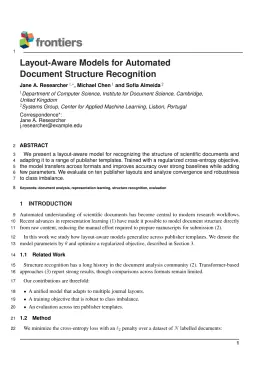
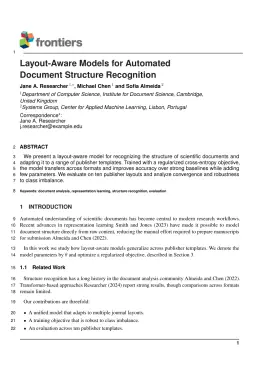
BMC (BioMed Central)

Genes and Environment Template

Write in a clean editor, then format for Genes and Environment in one click — DocuGuru applies the official BMC (BioMed Central) template with numbered references and exports a submission-ready PDF plus the editable LaTeX source. Free to start.

About the Genes and Environment format

Genes and Environment is a peer-reviewed journal published by BMC (BioMed Central), covering Carcinogens and Genotoxicity Assessment, DNA Repair Mechanisms, Effects and risks of endocrine disrupting chemicals. Over its lifetime it has published 650 papers, which have received 6,290 citations.

PublisherBMC (BioMed Central)
Reference styleNumbered (Vancouver)
Numbered — [1], [2] in the text
1. Smith A, Jones B, Lee C. A representative article title. Genes and Environment. 2023;12(3):45–58.

Formats any DOI in Genes and Environment style. No sign-up.

Publishes research inCarcinogens and Genotoxicity Assessment DNA Repair Mechanisms Effects and risks of endocrine disrupting chemicals Epigenetics and DNA Methylation Chronic Obstructive Pulmonary Disease (COPD) Research
ISSN1880-7046
Citation impact (2-yr)2.15
h-index34
i10-index180
Article processing charge$1,925
Open accessYes — indexed in DOAJ
Top institutions publishing hereNational Institute of Health Sciences
Journal websitelink.springer.com
You getA submission-ready PDF and the editable LaTeX source — ready to submit.

Papers published in Genes and Environment per year

28
2014
25
2015
28
2016
62
2017
52
2018
38
2019
49
2020
57
2021
26
2022
38
2023
28
2024
28
2025

Citation impact of Genes and Environment by publication year

210
2014
361
2015
1.2K
2016
689
2017
408
2018
429
2019
565
2020
784
2021
240
2022
262
2023
82
2024
54
2025

Citations each year’s papers have accumulated so far — the most recent years are still building up.

Most-cited papers in Genes and Environment

The micronucleus test—most widely used in vivo genotoxicity test—

Makoto Hayashi · 23 May 2016

Genotoxicity is commonly evaluated during the chemical safety assessment together with other toxicological endpoints. The micronucleus test is always included in many genotoxic test guidelines for long time in many classes of chemicals, e.g., pharmaceutical chemicals, agricultural chemicals, food additives. Although the trend of the safety assessment of chemicals faces to animal welfare and in…

Mechanism and regulation of DNA damage recognition in nucleotide excision repair

Masayuki Kusakabe, Yuki Onishi, Haruto Tada et al. · 14 Jan 2019

Nucleotide excision repair (NER) is a versatile DNA repair pathway, which can remove an extremely broad range of base lesions from the genome. In mammalian global genomic NER, the XPC protein complex initiates the repair reaction by recognizing sites of DNA damage, and this depends on detection of disrupted/destabilized base pairs within the DNA duplex.…

Mechanisms of interstrand DNA crosslink repair and human disorders

Satoru Hashimoto, Hirofumi Anai, Katsuhiro Hanada · 18 Feb 2016

Interstrand DNA crosslinks (ICLs) are the link between Watson-Crick strands of DNAs with the covalent bond and prevent separation of DNA strands. Since the ICL lesion affects both strands of the DNA, the ICL repair is not simple. So far, nucleotide excision repair (NER), structure-specific endonucleases, translesion DNA synthesis (TLS), homologous recombination (HR), and factors…

Modulation of benzo[a]pyrene–DNA adduct formation by CYP1 inducer and inhibitor

Kazuhiro Shiizaki, Masanobu Kawanishi, Takashi Yagi · 20 Feb 2017

Benzo[a]pyrene (BaP) is a well-studied pro-carcinogen that is metabolically activated by cytochrome P450 enzymes. Cytochrome P4501A1 (CYP1A1) has been considered to play a central role in the activation step, which is essential for the formation of DNA adducts. This enzyme is strongly induced by many different chemical agents, including 2,3,7,8-tetrachlorodibenzo-p-dioxin (TCDD), which binds to the…

Generation, repair and replication of guanine oxidation products

Katsuhito Kino, Masayo Hirao-Suzuki, Masayuki Morikawa et al. · 12 Jul 2017

Guanine is the most readily oxidized of the four DNA bases, and guanine oxidation products cause G:C-T:A and G:C-C:G transversions through DNA replication. 8-Oxo-7,8-dihydroguanine (8-oxoG) causes G:C-T:A transversions but not G:C-C:G transversions, and is more readily oxidized than guanine. This review covers four major findings. (i) 2,2,4-Triamino-5(2H)-oxazolone (Oz) is produced from guanine and 8-oxoG under…


Genes and Environment template — frequently asked questions

How do I write a paper in the Genes and Environment format?
In DocuGuru you write your manuscript in a normal editor — no LaTeX setup required — and select the Genes and Environment template. When you export, DocuGuru compiles the paper into the official BMC (BioMed Central) format and hands you a submission-ready PDF along with the editable LaTeX source.
What reference style does Genes and Environment use?
Genes and Environment uses Numbered (Vancouver) references, shown as numbered [1], [2] markers in the text. DocuGuru formats every in-text citation and the reference list in this exact style automatically. A reference appears like this: 1. Smith A, Jones B, Lee C. A representative article title. Genes and Environment. 2023;12(3):45–58.
Do I need to know LaTeX to submit to Genes and Environment?
No. DocuGuru generates the bmcart LaTeX class and compiles the PDF for you in the background, so you get a BMC (BioMed Central)-ready Genes and Environment document without writing any LaTeX. If you do want it, the LaTeX source is included in the export.
Can I import an existing draft into the Genes and Environment template?
Yes. Paste or upload your current manuscript — Word, LaTeX, Markdown, or plain text — and DocuGuru reflows it into the Genes and Environment format with correct headings, figures, tables, and numbered citations.
What is Genes and Environment?
BMC / BioMed Central journal. It is a life sciences and medicine journal, published by BMC (BioMed Central).
Can I export a submission-ready Genes and Environment PDF?
Yes — DocuGuru produces a PDF built with the official Genes and Environment template (the bmcart class) that is ready to submit to BMC (BioMed Central), together with the matching LaTeX source files.
How much does the Genes and Environment template cost?
You can start writing in the Genes and Environment template for free. Exporting the final submission-ready Genes and Environment PDF and LaTeX source is part of DocuGuru's paid plans — see the app for current pricing.
Use the Genes and Environment template