ASME

Journal of Thermal Science and Engineering Applications Template

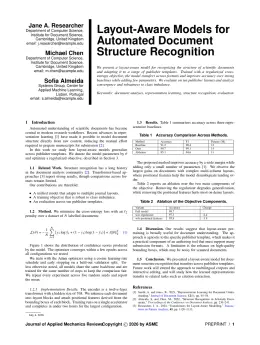
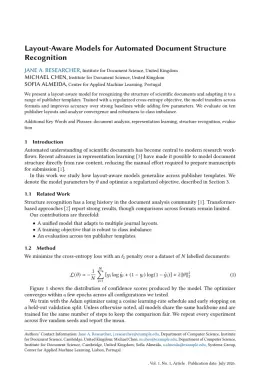
Write in a clean editor, then format for Journal of Thermal Science and Engineering Applications in one click — DocuGuru applies the official ASME template with numbered references and exports a submission-ready PDF plus the editable LaTeX source. Free to start.

About the Journal of Thermal Science and Engineering Applications format

Journal of Thermal Science and Engineering Applications is a peer-reviewed journal published by ASME, covering Heat Transfer and Optimization, Heat Transfer Mechanisms, Heat Transfer and Boiling Studies. Over its lifetime it has published 1,907 papers, which have received 17,392 citations.

PublisherASME
Reference styleNumbered (ASME)
Numbered — [1], [2] in the text
[1] Smith, A., Jones, B., and Lee, C., 2023, "A Representative Article Title," Journal of Thermal Science and Engineering Applications, 12(3), pp. 45–58.

Formats any DOI in Journal of Thermal Science and Engineering Applications style. No sign-up.

Publishes research inHeat Transfer and Optimization Heat Transfer Mechanisms Heat Transfer and Boiling Studies Nanofluid Flow and Heat Transfer Fluid Dynamics and Turbulent Flows
ISSN1948-5085
Citation impact (2-yr)1.96
h-index46
i10-index537
Top institutions publishing hereTexas A&M University
Journal websitethermalscienceapplication.asmedigitalcollection.asme.org
You getA submission-ready PDF and the editable LaTeX source — ready to submit.

Papers published in Journal of Thermal Science and Engineering Applications per year

58
2014
86
2015
68
2016
90
2017
139
2018
147
2019
187
2020
186
2021
130
2022
130
2023
144
2024
167
2025

Citation impact of Journal of Thermal Science and Engineering Applications by publication year

785
2014
1.1K
2015
763
2016
1.6K
2017
1.5K
2018
1.6K
2019
2K
2020
1.5K
2021
774
2022
698
2023
587
2024
231
2025

Citations each year’s papers have accumulated so far — the most recent years are still building up.

Most-cited papers in Journal of Thermal Science and Engineering Applications

Recent Advances in High-Flux, Two-Phase Thermal Management

Issam Mudawar · 17 May 2013

Recent developments in applications such as computer data centers, electric vehicle power electronics, avionics, radars, and lasers have led to alarming increases in heat dissipation rate, which now far exceeds the capability of air cooling schemes and even the most aggressive single-phase liquid cooling schemes. This trend is responsible for a recent transition to two-phase…

Fundamental Gas Turbine Heat Transfer

Je-Chin Han · 17 May 2013

Gas turbines are used for aircraft propulsion and land-based power generation or industrial applications. Thermal efficiency and power output of gas turbines increase with increasing turbine rotor inlet temperatures (RIT). Current advanced gas turbine engines operate at turbine RIT (1700 °C) far higher than the melting point of the blade material (1000 °C); therefore, turbine…

Forced Convection Computational Fluid Dynamics Analysis of Architected and Three-Dimensional Printable Heat Sinks Based on Triply Periodic Minimal Surfaces

Oraib Al‐Ketan, Mohamed I. Hassan Ali, Mohamad Khalil et al. · 30 May 2020

Abstract The drive for small and compact electronic components with higher processing capabilities is limited by their ability to dissipate the associated heat generated during operations, and hence, more advanced heat sink designs are required. Recently, the emergence of additive manufacturing techniques facilitated the fabrication of complex structures and overcame the limitation of traditional techniques…

Numerical Analysis of Unsteady Conjugate Natural Convection of Hybrid Water-Based Nanofluid in a Semicircular Cavity

Ali J. Chamkha, И. В. Мирошниченко, Mikhail А. Sheremet · 10 Mar 2017

Unsteady conjugate natural convection in a semicircular cavity with a solid shell of finite thickness filled with a hybrid water-based suspension of Al2O3 and Cu nanoparticles (hybrid nanofluid) has been analyzed numerically. The governing equations for this investigation are formulated in terms of the dimensionless stream function, vorticity, and temperature and have been solved by…

Technical Challenges and Opportunities for Concentrating Solar Power With Thermal Energy Storage

Joseph Stekli, L.J. Irwin, R. Pitchumani · 17 May 2013

Concentrating solar power (CSP) provides the ability to incorporate simple, efficient, and cost-effective thermal energy storage (TES) by virtue of converting sunlight to heat as an intermediate step to generating electricity. Thermal energy storage for use in CSP systems can be one of sensible heat storage, latent heat storage using phase change materials (PCMs) or…

Journal of Thermal Science and Engineering Applications template — frequently asked questions

How do I write a paper in the Journal of Thermal Science and Engineering Applications format?
In DocuGuru you write your manuscript in a normal editor — no LaTeX setup required — and select the Journal of Thermal Science and Engineering Applications template. When you export, DocuGuru compiles the paper into the official ASME format and hands you a submission-ready PDF along with the editable LaTeX source.
What reference style does Journal of Thermal Science and Engineering Applications use?
Journal of Thermal Science and Engineering Applications uses Numbered (ASME) references, shown as numbered [1], [2] markers in the text. DocuGuru formats every in-text citation and the reference list in this exact style automatically. A reference appears like this: [1] Smith, A., Jones, B., and Lee, C., 2023, "A Representative Article Title," Journal of Thermal Science and Engineering Applications, 12(3), pp. 45–58.
Do I need to know LaTeX to submit to Journal of Thermal Science and Engineering Applications?
No. DocuGuru generates the asmejour LaTeX class and compiles the PDF for you in the background, so you get a ASME-ready Journal of Thermal Science and Engineering Applications document without writing any LaTeX. If you do want it, the LaTeX source is included in the export.
Can I import an existing draft into the Journal of Thermal Science and Engineering Applications template?
Yes. Paste or upload your current manuscript — Word, LaTeX, Markdown, or plain text — and DocuGuru reflows it into the Journal of Thermal Science and Engineering Applications format with correct headings, figures, tables, and numbered citations.
What is Journal of Thermal Science and Engineering Applications?
ASME journal. It is a engineering and computer science journal, published by ASME.
Can I export a submission-ready Journal of Thermal Science and Engineering Applications PDF?
Yes — DocuGuru produces a PDF built with the official Journal of Thermal Science and Engineering Applications template (the asmejour class) that is ready to submit to ASME, together with the matching LaTeX source files.
How much does the Journal of Thermal Science and Engineering Applications template cost?
You can start writing in the Journal of Thermal Science and Engineering Applications template for free. Exporting the final submission-ready Journal of Thermal Science and Engineering Applications PDF and LaTeX source is part of DocuGuru's paid plans — see the app for current pricing.
Use the Journal of Thermal Science and Engineering Applications template