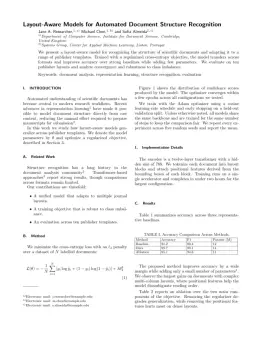
IOP Publishing

Progress in Biomedical Engineering Template

Write in a clean editor, then format for Progress in Biomedical Engineering in one click — DocuGuru applies the official IOP Publishing template with numbered references and exports a submission-ready PDF plus the editable LaTeX source. Free to start.

About the Progress in Biomedical Engineering format

Progress in Biomedical Engineering is a peer-reviewed journal published by IOP Publishing, covering 3D Printing in Biomedical Research, Neuroscience and Neural Engineering, Radiomics and Machine Learning in Medical Imaging. Over its lifetime it has published 293 papers, which have received 3,452 citations.

PublisherIOP Publishing
Reference styleNumbered (IOP)
Numbered — [1], [2] in the text
[1] Smith A, Jones B and Lee C 2023 A representative article title Progress in Biomedical Engineering 12 45–58

Formats any DOI in Progress in Biomedical Engineering style. No sign-up.

Publishes research in3D Printing in Biomedical Research Neuroscience and Neural Engineering Radiomics and Machine Learning in Medical Imaging Muscle activation and electromyography studies EEG and Brain-Computer Interfaces
ISSN2516-1091
Citation impact (2-yr)3.27
h-index31
i10-index73
Top institutions publishing hereFudan University
Journal websiteiopscience.iop.org
You getA submission-ready PDF and the editable LaTeX source — ready to submit.

Papers published in Progress in Biomedical Engineering per year

4
2010
1
2012
1
2013
1
2014
12
2015
7
2019
14
2020
26
2021
18
2022
22
2023
21
2024
45
2025

Citation impact of Progress in Biomedical Engineering by publication year

1
2010
0
2012
0
2013
0
2014
1
2015
447
2019
707
2020
815
2021
543
2022
551
2023
173
2024
115
2025

Citations each year’s papers have accumulated so far — the most recent years are still building up.

Most-cited papers in Progress in Biomedical Engineering

Challenges of continuum robots in clinical context: a review

Tomás da Veiga, James H. Chandler, Peter Lloyd et al. · 23 Jun 2020

With the maturity of surgical robotic systems based on traditional rigid-link principles, the rate of progress slowed as limits of size and controllable degrees of freedom were reached. Continuum robots came with the potential to deliver a step change in the next generation of medical devices, by providing better access, safer interactions and making new…

Deep multimodal fusion of image and non-image data in disease diagnosis and prognosis: a review

Can Cui, Haichun Yang, Yaohong Wang et al. · 9 Mar 2023

The rapid development of diagnostic technologies in healthcare is leading to higher requirements for physicians to handle and integrate the heterogeneous, yet complementary data that are produced during routine practice. For instance, the personalized diagnosis and treatment planning for a single cancer patient relies on various images (e.g. radiology, pathology and camera images) and non-image…

Translational prospects of untethered medical microrobots

Hakan Ceylan, Immihan Ceren Yasa, Uğur Kılıç et al. · 1 Jul 2019

Abstract Untethered mobile microrobots have the potential to transform medicine radically. Their small size and wireless mobility can enable access to and navigation in confined, small, hard-to-reach, and sensitive inner body sites, where they can provide new ways of minimally invasive interventions and targeted diagnosis and therapy down to the cellular length scales with high…

Vascularization in tissue engineering: fundamentals and state-of-art

Guang Yang, Bhushan Mahadik, Ji Young Choi et al. · 11 Nov 2019

Vascularization is among the top challenges that impede the clinical application of engineered tissues. This challenge has spurred tremendous research endeavor, defined as vascular tissue engineering (VTE) in this article, to establish a pre-existing vascular network inside the tissue engineered graft prior to implantation. Ideally, the engineered vasculature can be integrated into the host vasculature…

Wave-based optical coherence elastography: the 10-year perspective

Fernando Zvietcovich, Kirill V. Larin · 21 Dec 2021

After 10 years of progress and innovation, optical coherence elastography (OCE) based on the propagation of mechanical waves has become one of the major and the most studied OCE branches, producing a fundamental impact in the quantitative and nondestructive biomechanical characterization of tissues. Preceding previous progress made in ultrasound and magnetic resonance elastography; wave-based OCE…

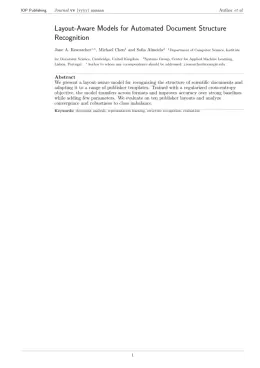
Progress in Biomedical Engineering template — frequently asked questions

How do I write a paper in the Progress in Biomedical Engineering format?
In DocuGuru you write your manuscript in a normal editor — no LaTeX setup required — and select the Progress in Biomedical Engineering template. When you export, DocuGuru compiles the paper into the official IOP Publishing format and hands you a submission-ready PDF along with the editable LaTeX source.
What reference style does Progress in Biomedical Engineering use?
Progress in Biomedical Engineering uses Numbered (IOP) references, shown as numbered [1], [2] markers in the text. DocuGuru formats every in-text citation and the reference list in this exact style automatically. A reference appears like this: [1] Smith A, Jones B and Lee C 2023 A representative article title Progress in Biomedical Engineering 12 45–58
Do I need to know LaTeX to submit to Progress in Biomedical Engineering?
No. DocuGuru generates the iopjournal LaTeX class and compiles the PDF for you in the background, so you get a IOP Publishing-ready Progress in Biomedical Engineering document without writing any LaTeX. If you do want it, the LaTeX source is included in the export.
Can I import an existing draft into the Progress in Biomedical Engineering template?
Yes. Paste or upload your current manuscript — Word, LaTeX, Markdown, or plain text — and DocuGuru reflows it into the Progress in Biomedical Engineering format with correct headings, figures, tables, and numbered citations.
What is Progress in Biomedical Engineering?
IOP Publishing journal. It is a physics journal, published by IOP Publishing.
Can I export a submission-ready Progress in Biomedical Engineering PDF?
Yes — DocuGuru produces a PDF built with the official Progress in Biomedical Engineering template (the iopjournal class) that is ready to submit to IOP Publishing, together with the matching LaTeX source files.
How much does the Progress in Biomedical Engineering template cost?
You can start writing in the Progress in Biomedical Engineering template for free. Exporting the final submission-ready Progress in Biomedical Engineering PDF and LaTeX source is part of DocuGuru's paid plans — see the app for current pricing.
Use the Progress in Biomedical Engineering template