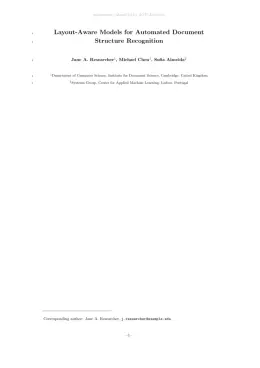
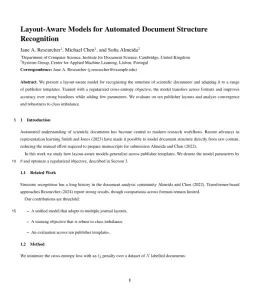
AGU (American Geophysical Union)

Geophysical Research Letters Template

Write in a clean editor, then format for Geophysical Research Letters in one click — DocuGuru applies the official AGU (American Geophysical Union) template with author–year references and exports a submission-ready PDF plus the editable LaTeX source. Free to start.

About the Geophysical Research Letters format

Geophysical Research Letters is a peer-reviewed journal published by AGU (American Geophysical Union), covering Climate variability and models, Ionosphere and magnetosphere dynamics, earthquake and tectonic studies. Over its lifetime it has published 53,096 papers, which have received 2,786,994 citations.

PublisherAGU (American Geophysical Union)
Reference styleAuthor–year (APA)
Author–year — (Smith, 2023) in the text
Smith, A., Jones, B., & Lee, C. (2023). A representative article title. Geophysical Research Letters, 12(3), 45–58.

Formats any DOI in Geophysical Research Letters style. No sign-up.

Publishes research inClimate variability and models Ionosphere and magnetosphere dynamics earthquake and tectonic studies Solar and Space Plasma Dynamics Atmospheric Ozone and Climate
ISSN0094-8276
Citation impact (2-yr)4.3
h-index429
i10-index40,546
Article processing charge$2,900
Open accessYes — indexed in DOAJ
Top institutions publishing hereCentre National de la Recherche Scientifique
Journal websiteonlinelibrary.wiley.com
You getA submission-ready PDF and the editable LaTeX source — ready to submit.

Papers published in Geophysical Research Letters per year

1.2K
2014
1.4K
2015
1.5K
2016
1.5K
2017
1.6K
2018
1.6K
2019
1.9K
2020
1.8K
2021
1.8K
2022
1.6K
2023
1.8K
2024
2.1K
2025

Citation impact of Geophysical Research Letters by publication year

84.1K
2014
90.1K
2015
89.9K
2016
80K
2017
78.8K
2018
68.2K
2019
78.1K
2020
50.2K
2021
40.2K
2022
21.5K
2023
15K
2024
5.5K
2025

Citations each year’s papers have accumulated so far — the most recent years are still building up.

Most-cited papers in Geophysical Research Letters

The Arctic oscillation signature in the wintertime geopotential height and temperature fields

David W. J. Thompson, John M. Wallace · 1 May 1998

The leading empirical orthogonal function of the wintertime sea‐level pressure field is more strongly coupled to surface air temperature fluctuations over the Eurasian continent than the North Atlantic Oscillation (NAO). It resembles the NAO in many respects; but its primary center of action covers more of the Arctic, giving it a more zonally symmetric appearance.…

4,132 citations Cite SaveGo to paper →
Effect of recent revisions to the geomagnetic reversal time scale on estimates of current plate motions

Charles DeMets, Richard G. Gordon, Donald F. Argus et al. · 1 Oct 1994

Recent revisions to the geomagnetic time scale indicate that global plate motion model NUVEL‐1 should be modified for comparison with other rates of motion including those estimated from space geodetic measurements. The optimal recalibration, which is a compromise among slightly different calibrations appropriate for slow, medium, and fast rates of seafloor spreading, is to multiply…

3,482 citations Cite SaveGo to paper →
The gravity recovery and climate experiment: Mission overview and early results

B. D. Tapley, Srinivas Bettadpur, M. M. Watkins et al. · 7 May 2004

The GRACE mission is designed to track changes in the Earth's gravity field for a period of five years. Launched in March 2002, the two GRACE satellites have collected nearly two years of data. A span of data available during the Commissioning Phase was used to obtain initial gravity models. The gravity models developed with…

3,008 citations Cite SaveGo to paper →
The Atlantic Multidecadal Oscillation and its relation to rainfall and river flows in the continental U.S.

David B. Enfield, Alberto M. Mestas‐Nuñez, Paul Trimble · 15 May 2001

North Atlantic sea surface temperatures for 1856–1999 contain a 65–80 year cycle with a 0.4 °C range, referred to as the Atlantic Multidecadal Oscillation (AMO) by Kerr [2000]. AMO warm phases occurred during 1860–1880 and 1940–1960, and cool phases during 1905–1925 and 1970–1990. The signal is global in scope, with a positively correlated co‐oscillation in…

2,974 citations Cite SaveGo to paper →
Ubiquity and dominance of oxygenated species in organic aerosols in anthropogenically‐influenced Northern Hemisphere midlatitudes

Q. Zhang, J. L. Jiménez, Manjula R. Canagaratna et al. · 6 Jul 2007

Organic aerosol (OA) data acquired by the Aerosol Mass Spectrometer (AMS) in 37 field campaigns were deconvolved into hydrocarbon‐like OA (HOA) and several types of oxygenated OA (OOA) components. HOA has been linked to primary combustion emissions (mainly from fossil fuel) and other primary sources such as meat cooking. OOA is ubiquitous in various atmospheric…

2,889 citations Cite SaveGo to paper →

Geophysical Research Letters template — frequently asked questions

How do I write a paper in the Geophysical Research Letters format?
In DocuGuru you write your manuscript in a normal editor — no LaTeX setup required — and select the Geophysical Research Letters template. When you export, DocuGuru compiles the paper into the official AGU (American Geophysical Union) format and hands you a submission-ready PDF along with the editable LaTeX source.
What reference style does Geophysical Research Letters use?
Geophysical Research Letters uses Author–year (APA) references, shown as author–year markers such as (Smith, 2023) in the text. DocuGuru formats every in-text citation and the reference list in this exact style automatically. A reference appears like this: Smith, A., Jones, B., & Lee, C. (2023). A representative article title. Geophysical Research Letters, 12(3), 45–58.
Do I need to know LaTeX to submit to Geophysical Research Letters?
No. DocuGuru generates the agujournal2025 LaTeX class and compiles the PDF for you in the background, so you get a AGU (American Geophysical Union)-ready Geophysical Research Letters document without writing any LaTeX. If you do want it, the LaTeX source is included in the export.
Can I import an existing draft into the Geophysical Research Letters template?
Yes. Paste or upload your current manuscript — Word, LaTeX, Markdown, or plain text — and DocuGuru reflows it into the Geophysical Research Letters format with correct headings, figures, tables, and author–year citations.
What is Geophysical Research Letters?
AGU Geophysical Research Letters. It is a earth and environmental sciences journal, published by AGU (American Geophysical Union).
Can I export a submission-ready Geophysical Research Letters PDF?
Yes — DocuGuru produces a PDF built with the official Geophysical Research Letters template (the agujournal2025 class) that is ready to submit to AGU (American Geophysical Union), together with the matching LaTeX source files.
How much does the Geophysical Research Letters template cost?
You can start writing in the Geophysical Research Letters template for free. Exporting the final submission-ready Geophysical Research Letters PDF and LaTeX source is part of DocuGuru's paid plans — see the app for current pricing.
Use the Geophysical Research Letters template