American Chemical Society

Journal of Agricultural and Food Chemistry Template

Write in a clean editor, then format for Journal of Agricultural and Food Chemistry in one click — DocuGuru applies the official American Chemical Society template with superscript references and exports a submission-ready PDF plus the editable LaTeX source. Free to start.

About the Journal of Agricultural and Food Chemistry format

Journal of Agricultural and Food Chemistry is a peer-reviewed journal published by American Chemical Society, covering Phytochemicals and Antioxidant Activities, Fermentation and Sensory Analysis, Pesticide and Herbicide Environmental Studies. Over its lifetime it has published 61,926 papers, which have received 2,924,457 citations.

PublisherAmerican Chemical Society
Reference styleSuperscript numbered (ACS)
Superscript — small raised numerals in the text
(1) Smith, A.; Jones, B.; Lee, C. A Representative Article Title. Journal of Agricultural and Food Chemistry 2023, 12, 45–58.

Formats any DOI in Journal of Agricultural and Food Chemistry style. No sign-up.

Publishes research inPhytochemicals and Antioxidant Activities Fermentation and Sensory Analysis Pesticide and Herbicide Environmental Studies Meat and Animal Product Quality Proteins in Food Systems
ISSN0021-8561
Citation impact (2-yr)5.94
h-index417
i10-index45,011
Top institutions publishing hereAgricultural Research Service
Journal websitepubs.acs.org
You getA submission-ready PDF and the editable LaTeX source — ready to submit.

Papers published in Journal of Agricultural and Food Chemistry per year

1.6K
2014
1.3K
2015
1.4K
2016
1.5K
2017
1.6K
2018
1.6K
2019
1.6K
2020
1.5K
2021
1.6K
2022
1.9K
2023
2.5K
2024
2.7K
2025

Citation impact of Journal of Agricultural and Food Chemistry by publication year

82K
2014
62K
2015
54.4K
2016
65K
2017
69.3K
2018
67.2K
2019
58K
2020
48K
2021
39.8K
2022
34.3K
2023
27.1K
2024
10.9K
2025

Citations each year’s papers have accumulated so far — the most recent years are still building up.

Most-cited papers in Journal of Agricultural and Food Chemistry

The Chemistry behind Antioxidant Capacity Assays

Dejian Huang, Boxin Ou, Ronald L. Prior · 25 Feb 2005

This review summarizes the multifaceted aspects of antioxidants and the basic kinetic models of inhibited autoxidation and analyzes the chemical principles of antioxidant capacity assays. Depending upon the reactions involved, these assays can roughly be classified into two types: assays based on hydrogen atom transfer (HAT) reactions and assays based on electron transfer (ET). The…

6,066 citations Cite SaveGo to paper →
Standardized Methods for the Determination of Antioxidant Capacity and Phenolics in Foods and Dietary Supplements

Ronald L. Prior, Xianli Wu, Karen M. Schaich · 26 Apr 2005

Methods available for the measurement of antioxidant capacity are reviewed, presenting the general chemistry underlying the assays, the types of molecules detected, and the most important advantages and shortcomings of each method. This overview provides a basis and rationale for developing standardized antioxidant capacity methods for the food, nutraceutical, and dietary supplement industries. From evaluation…

5,488 citations Cite SaveGo to paper →
Antioxidant Activity and Total Phenolics in Selected Fruits, Vegetables, and Grain Products

Y. Sedat Velioğlu, Giuseppe Mazza, Ling Gao et al. · 29 Aug 1998

The antioxidant activities and total phenolics of 28 plant products, including sunflower seeds, flaxseeds, wheat germ, buckwheat, and several fruits, vegetables, and medicinal plants were determined. The total phenolic content, determined according to the Folin−Ciocalteu method, varied from 169 to 10548 mg/100 g of dry product. Antioxidant activity of methanolic extract evaluated according to the…

3,861 citations Cite SaveGo to paper →
Antioxidant Activity of Plant Extracts Containing Phenolic Compounds

Marja P. Kähkönen, Anu Hopia, Heikki Vuorela et al. · 24 Sep 1999

The antioxidative activity of a total of 92 phenolic extracts from edible and nonedible plant materials (berries, fruits, vegetables, herbs, cereals, tree materials, plant sprouts, and seeds) was examined by autoxidation of methyl linoleate. The content of total phenolics in the extracts was determined spectrometrically according to the Folin-Ciocalteu procedure and calculated as gallic acid…

3,850 citations Cite SaveGo to paper →
Thermal Processing Enhances the Nutritional Value of Tomatoes by Increasing Total Antioxidant Activity

Veronica Dewanto, Xianzhong Wu, Kafui Kwami Adom et al. · 17 Apr 2002

Processed fruits and vegetables have been long considered to have lower nutritional value than their fresh commodities due to the loss of vitamin C during processing. This research group found vitamin C in apples contributed < 0.4% of total antioxidant activity, indicating most of the activity comes from the natural combination of phytochemicals. This suggests…

3,425 citations Cite SaveGo to paper →

Journal of Agricultural and Food Chemistry template — frequently asked questions

How do I write a paper in the Journal of Agricultural and Food Chemistry format?
In DocuGuru you write your manuscript in a normal editor — no LaTeX setup required — and select the Journal of Agricultural and Food Chemistry template. When you export, DocuGuru compiles the paper into the official American Chemical Society format and hands you a submission-ready PDF along with the editable LaTeX source.
What reference style does Journal of Agricultural and Food Chemistry use?
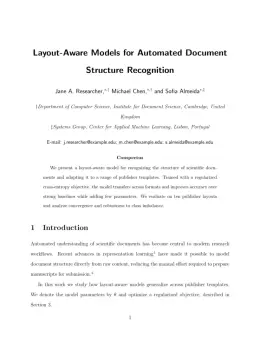
Journal of Agricultural and Food Chemistry uses Superscript numbered (ACS) references, shown as superscript numerals in the text. DocuGuru formats every in-text citation and the reference list in this exact style automatically. A reference appears like this: (1) Smith, A.; Jones, B.; Lee, C. A Representative Article Title. Journal of Agricultural and Food Chemistry 2023, 12, 45–58.
Do I need to know LaTeX to submit to Journal of Agricultural and Food Chemistry?
No. DocuGuru generates the achemso LaTeX class and compiles the PDF for you in the background, so you get a American Chemical Society-ready Journal of Agricultural and Food Chemistry document without writing any LaTeX. If you do want it, the LaTeX source is included in the export.
Can I import an existing draft into the Journal of Agricultural and Food Chemistry template?
Yes. Paste or upload your current manuscript — Word, LaTeX, Markdown, or plain text — and DocuGuru reflows it into the Journal of Agricultural and Food Chemistry format with correct headings, figures, tables, and superscript citations.
What is Journal of Agricultural and Food Chemistry?
ACS journal (achemso). It is a chemistry journal, published by American Chemical Society.
Can I export a submission-ready Journal of Agricultural and Food Chemistry PDF?
Yes — DocuGuru produces a PDF built with the official Journal of Agricultural and Food Chemistry template (the achemso class) that is ready to submit to American Chemical Society, together with the matching LaTeX source files.
How much does the Journal of Agricultural and Food Chemistry template cost?
You can start writing in the Journal of Agricultural and Food Chemistry template for free. Exporting the final submission-ready Journal of Agricultural and Food Chemistry PDF and LaTeX source is part of DocuGuru's paid plans — see the app for current pricing.
Use the Journal of Agricultural and Food Chemistry template