American Chemical Society

ACS Applied Nano Materials Template

Write in a clean editor, then format for ACS Applied Nano Materials in one click — DocuGuru applies the official American Chemical Society template with superscript references and exports a submission-ready PDF plus the editable LaTeX source. Free to start.

About the ACS Applied Nano Materials format

ACS Applied Nano Materials is a peer-reviewed journal published by American Chemical Society, covering Advanced Photocatalysis Techniques, Gas Sensing Nanomaterials and Sensors, Electrocatalysts for Energy Conversion. Over its lifetime it has published 14,893 papers, which have received 267,187 citations.

PublisherAmerican Chemical Society
Reference styleSuperscript numbered (ACS)
Superscript — small raised numerals in the text
(1) Smith, A.; Jones, B.; Lee, C. A Representative Article Title. ACS Applied Nano Materials 2023, 12, 45–58.

Formats any DOI in ACS Applied Nano Materials style. No sign-up.

Publishes research inAdvanced Photocatalysis Techniques Gas Sensing Nanomaterials and Sensors Electrocatalysts for Energy Conversion 2D Materials and Applications Advanced Nanomaterials in Catalysis
ISSN2574-0970
Citation impact (2-yr)6.21
h-index124
i10-index7,957
Top institutions publishing hereChinese Academy of Sciences
Journal websitepubs.acs.org
You getA submission-ready PDF and the editable LaTeX source — ready to submit.

Papers published in ACS Applied Nano Materials per year

1
2002
1
2009
1
2016
59
2017
817
2018
971
2019
1.3K
2020
1.5K
2021
1.9K
2022
2.3K
2023
2.7K
2024
2.3K
2025

Citation impact of ACS Applied Nano Materials by publication year

0
2002
0
2009
0
2016
2.5K
2017
30K
2018
35.7K
2019
43.4K
2020
39.8K
2021
38.4K
2022
37.3K
2023
27.5K
2024
8.2K
2025

Citations each year’s papers have accumulated so far — the most recent years are still building up.

Most-cited papers in ACS Applied Nano Materials

Effect of Ti<sub>3</sub>AlC<sub>2</sub> MAX Phase on Structure and Properties of Resultant Ti<sub>3</sub>C<sub>2</sub>T<sub><i>x</i></sub> MXene

Christopher E. Shuck, Meikang Han, Kathleen Maleski et al. · 13 May 2019

Ti3C2Tx MXene is an attractive two-dimensional (2D) material for a wide variety of applications; however, measured properties vary widely from study to study. A potential factor to the property differences relates to variability in the MAX phase precursors. To illustrate this, Ti3AlC2, the precursor for Ti3C2Tx MXene, was synthesized using three carbon sources (graphite, carbon…

Visible-Light-Active Doped Metal Oxide Nanoparticles: Review of their Synthesis, Properties, and Applications

Riddhiman Medhi, Maria D. Marquez, T. Randall Lee · 15 Jun 2020

Metal oxide semiconductors with a bandgap between 2 and 4 eV are an important class of compounds in the electronics industry and for photocatalysis. With the demand for these materials expanding rapidly, especially in the field of photocatalysis, the fabrication of nanoscale metal oxide particles, which increases the surface-to-volume ratio and thereby reduces the materials…

Carbon Quantum Dots for Energy Applications: A Review

Akash S. Rasal, Sudesh Yadav, Anchal Yadav et al. · 5 Jul 2021

Carbon quantum dots (CQDs) are a class of carbon nanomaterials that have recently gained recognition as current entrants to traditional semiconductor quantum dots. CQDs have the desirable advantages of low toxicity, environmental friendliness, low cost, photostability, favorable charge transfer with enhanced electronic conductivity, and comparable easy-synthesis protocols. This review examines the advancements in CQD research…

Recent Advances of Ferro-, Piezo-, and Pyroelectric Nanomaterials for Catalytic Applications

Shun Li, Zhicheng Zhao, Jin-Zhu Zhao et al. · 21 Jan 2020

Ferro-, piezo-, and pyroelectric materials are emerging as potential candidates for converting various forms of primary energy from the ambient environment (e.g., sunlight, mechanical, and thermal energy) into secondary energy (e.g., chemical energy). Despite the relatively short investigation time, much progress has been made related to this field. This review covers the fundamental principles of…

Nanoparticle Size Effects in Biomedical Applications

Jayanta Dolai, Kuheli Mandal, Nikhil R. Jana · 2 Jul 2021

Nanoparticle size plays a central role in determining material properties and performance in biomedical applications. A wide variety of functional nanomaterials and nano-bioconjugates have been developed for monitoring biochemical activity, controlling biological functions, and therapeutic applications. This review focuses on the role of nanoparticle size (typically in the range of 1–100 nm) in various biomedical…

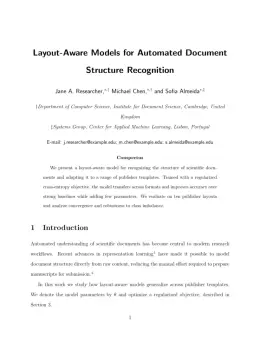
ACS Applied Nano Materials template — frequently asked questions

How do I write a paper in the ACS Applied Nano Materials format?
In DocuGuru you write your manuscript in a normal editor — no LaTeX setup required — and select the ACS Applied Nano Materials template. When you export, DocuGuru compiles the paper into the official American Chemical Society format and hands you a submission-ready PDF along with the editable LaTeX source.
What reference style does ACS Applied Nano Materials use?
ACS Applied Nano Materials uses Superscript numbered (ACS) references, shown as superscript numerals in the text. DocuGuru formats every in-text citation and the reference list in this exact style automatically. A reference appears like this: (1) Smith, A.; Jones, B.; Lee, C. A Representative Article Title. ACS Applied Nano Materials 2023, 12, 45–58.
Do I need to know LaTeX to submit to ACS Applied Nano Materials?
No. DocuGuru generates the achemso LaTeX class and compiles the PDF for you in the background, so you get a American Chemical Society-ready ACS Applied Nano Materials document without writing any LaTeX. If you do want it, the LaTeX source is included in the export.
Can I import an existing draft into the ACS Applied Nano Materials template?
Yes. Paste or upload your current manuscript — Word, LaTeX, Markdown, or plain text — and DocuGuru reflows it into the ACS Applied Nano Materials format with correct headings, figures, tables, and superscript citations.
What is ACS Applied Nano Materials?
ACS journal (achemso). It is a chemistry journal, published by American Chemical Society.
Can I export a submission-ready ACS Applied Nano Materials PDF?
Yes — DocuGuru produces a PDF built with the official ACS Applied Nano Materials template (the achemso class) that is ready to submit to American Chemical Society, together with the matching LaTeX source files.
How much does the ACS Applied Nano Materials template cost?
You can start writing in the ACS Applied Nano Materials template for free. Exporting the final submission-ready ACS Applied Nano Materials PDF and LaTeX source is part of DocuGuru's paid plans — see the app for current pricing.
Use the ACS Applied Nano Materials template