American Chemical Society

ACS Sensors Template

Write in a clean editor, then format for ACS Sensors in one click — DocuGuru applies the official American Chemical Society template with superscript references and exports a submission-ready PDF plus the editable LaTeX source. Free to start.

About the ACS Sensors format

ACS Sensors is a peer-reviewed journal published by American Chemical Society, covering Advanced biosensing and bioanalysis techniques, Gas Sensing Nanomaterials and Sensors, Analytical Chemistry and Sensors. Over its lifetime it has published 5,460 papers, which have received 177,145 citations.

PublisherAmerican Chemical Society
Reference styleSuperscript numbered (ACS)
Superscript — small raised numerals in the text
(1) Smith, A.; Jones, B.; Lee, C. A Representative Article Title. ACS Sensors 2023, 12, 45–58.

Formats any DOI in ACS Sensors style. No sign-up.

Publishes research inAdvanced biosensing and bioanalysis techniques Gas Sensing Nanomaterials and Sensors Analytical Chemistry and Sensors Biosensors and Analytical Detection Advanced Chemical Sensor Technologies
ISSN2379-3694
Citation impact (2-yr)9.94
h-index155
i10-index3,398
Top institutions publishing hereChinese Academy of Sciences
Journal websitepubs.acs.org
You getA submission-ready PDF and the editable LaTeX source — ready to submit.

Papers published in ACS Sensors per year

5
2014
33
2015
242
2016
289
2017
363
2018
455
2019
525
2020
458
2021
437
2022
526
2023
685
2024
911
2025

Citation impact of ACS Sensors by publication year

19
2014
3.4K
2015
13.9K
2016
18.3K
2017
19.3K
2018
26.1K
2019
25.1K
2020
19.9K
2021
15K
2022
13.7K
2023
13.2K
2024
6.5K
2025

Citations each year’s papers have accumulated so far — the most recent years are still building up.

Most-cited papers in ACS Sensors

Review of Carbon and Graphene Quantum Dots for Sensing

Meixiu Li, Tao Chen, J. Justin Gooding et al. · 3 Jul 2019

Carbon and graphene quantum dots (CQDs and GQDs), known as zero-dimensional (0D) nanomaterials, have been attracting increasing attention in sensing and bioimaging. Their unique electronic, fluorescent, photoluminescent, chemiluminescent, and electrochemiluminescent properties are what gives them potential in sensing. In this Review, we summarize the basic knowledge on CQDs and GQDs before focusing on their application…

Wearable Chemical Sensors: Present Challenges and Future Prospects

Amay J. Bandodkar, Itthipon Jeerapan, Joseph Wang · 6 May 2016

Wearable sensors have received considerable interest over the past decade owing to their tremendous promise for monitoring the wearers’ health, fitness, and their surroundings. However, only limited attention has been directed at developing wearable chemical sensors that offer more comprehensive information about a wearer’s well-being. The development of wearable chemical sensors faces multiple challenges on…

Advancing Biosensors with Machine Learning

Feiyun Cui, Yun Yue, Yi Zhang et al. · 13 Nov 2020

Chemometrics play a critical role in biosensors-based detection, analysis, and diagnosis. Nowadays, as a branch of artificial intelligence (AI), machine learning (ML) have achieved impressive advances. However, novel advanced ML methods, especially deep learning, which is famous for image analysis, facial recognition, and speech recognition, has remained relatively elusive to the biosensor community. Herein, how…

Intelligent Food Packaging: A Review of Smart Sensing Technologies for Monitoring Food Quality

Hanie Yousefi, Hsuan‐Ming Su, Sara M. Imani et al. · 13 Mar 2019

Food safety is a major factor affecting public health and the well-being of society. A possible solution to control food-borne illnesses is through real-time monitoring of the food quality throughout the food supply chain. The development of emerging technologies, such as active and intelligent packaging, has been greatly accelerated in recent years, with a focus…

Fluorescent Sensors Based on Aggregation-Induced Emission: Recent Advances and Perspectives

Meng Gao, Ben Zhong Tang · 25 Sep 2017

Fluorescent sensors with advantages of excellent sensitivity, rapid response, and easy operation are emerging as powerful tools in environmental monitoring, biological research, and disease diagnosis. However, conventional fluorophores featured with π-planar structures usually suffer from serious self-quenching in the aggregated state, poor photostability, and small Stokes' shift. In contrast to conventional aggregation-caused quenching (ACQ) fluorophores,…

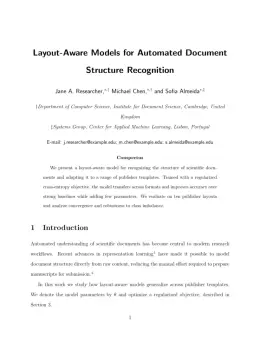
ACS Sensors template — frequently asked questions

How do I write a paper in the ACS Sensors format?
In DocuGuru you write your manuscript in a normal editor — no LaTeX setup required — and select the ACS Sensors template. When you export, DocuGuru compiles the paper into the official American Chemical Society format and hands you a submission-ready PDF along with the editable LaTeX source.
What reference style does ACS Sensors use?
ACS Sensors uses Superscript numbered (ACS) references, shown as superscript numerals in the text. DocuGuru formats every in-text citation and the reference list in this exact style automatically. A reference appears like this: (1) Smith, A.; Jones, B.; Lee, C. A Representative Article Title. ACS Sensors 2023, 12, 45–58.
Do I need to know LaTeX to submit to ACS Sensors?
No. DocuGuru generates the achemso LaTeX class and compiles the PDF for you in the background, so you get a American Chemical Society-ready ACS Sensors document without writing any LaTeX. If you do want it, the LaTeX source is included in the export.
Can I import an existing draft into the ACS Sensors template?
Yes. Paste or upload your current manuscript — Word, LaTeX, Markdown, or plain text — and DocuGuru reflows it into the ACS Sensors format with correct headings, figures, tables, and superscript citations.
What is ACS Sensors?
ACS journal (achemso). It is a chemistry journal, published by American Chemical Society.
Can I export a submission-ready ACS Sensors PDF?
Yes — DocuGuru produces a PDF built with the official ACS Sensors template (the achemso class) that is ready to submit to American Chemical Society, together with the matching LaTeX source files.
How much does the ACS Sensors template cost?
You can start writing in the ACS Sensors template for free. Exporting the final submission-ready ACS Sensors PDF and LaTeX source is part of DocuGuru's paid plans — see the app for current pricing.
Use the ACS Sensors template