American Chemical Society

ACS Nanoscience Au Template

Write in a clean editor, then format for ACS Nanoscience Au in one click — DocuGuru applies the official American Chemical Society template with superscript references and exports a submission-ready PDF plus the editable LaTeX source. Free to start.

About the ACS Nanoscience Au format

ACS Nanoscience Au is a peer-reviewed journal published by American Chemical Society, covering Gold and Silver Nanoparticles Synthesis and Applications, Academic Writing and Publishing, Quantum Dots Synthesis And Properties. Over its lifetime it has published 322 papers, which have received 3,273 citations.

PublisherAmerican Chemical Society
Reference styleSuperscript numbered (ACS)
Superscript — small raised numerals in the text
(1) Smith, A.; Jones, B.; Lee, C. A Representative Article Title. ACS Nanoscience Au 2023, 12, 45–58.

Formats any DOI in ACS Nanoscience Au style. No sign-up.

Publishes research inGold and Silver Nanoparticles Synthesis and Applications Academic Writing and Publishing Quantum Dots Synthesis And Properties 2D Materials and Applications Nanoparticle-Based Drug Delivery
ISSN2694-2496
Citation impact (2-yr)2.83
h-index28
i10-index91
Article processing charge$5,000
Open accessYes — indexed in DOAJ
Top institutions publishing herePennsylvania State University
Journal websitepubs.acs.org
You getA submission-ready PDF and the editable LaTeX source — ready to submit.

Papers published in ACS Nanoscience Au per year

1
1995
1
2010
22
2021
53
2022
56
2023
48
2024
92
2025

Citation impact of ACS Nanoscience Au by publication year

51
1995
0
2010
640
2021
1.1K
2022
878
2023
379
2024
122
2025

Citations each year’s papers have accumulated so far — the most recent years are still building up.

Most-cited papers in ACS Nanoscience Au

Metal-Oxide Nanomaterials Synthesis and Applications in Flexible and Wearable Sensors

Yeosang Yoon, Phuoc Loc Truong, Daeho Lee et al. · 29 Nov 2021

Metal-oxide nanomaterials (MONs) have gained considerable interest in the construction of flexible/wearable sensors due to their tunable band gap, low cost, large specific area, and ease of manufacturing. Furthermore, MONs are in high demand for applications, such as gas leakage alarms, environmental protection, health tracking, and smart devices integrated with another system. In this Review,…

Back to the Basics: Developing Advanced Metal–Organic Frameworks Using Fundamental Chemistry Concepts

Kent O. Kirlikovali, Sylvia L. Hanna, Florencia A. Son et al. · 27 Dec 2022

Over the past 25 years, metal-organic frameworks (MOFs) have developed into an increasingly intricate class of crystalline porous materials in which the choice of building blocks offers significant control over the physical properties of the resulting material. Despite this complexity, fundamental coordination chemistry design principles provided a strategic basis to design highly stable MOF structures.…

Two-Dimensional Electrically Conductive Metal–Organic Frameworks as Chemiresistive Sensors

Chungseong Park, Jong Won Baek, Euichul Shin et al. · 9 Aug 2023

Metal-organic frameworks (MOFs) have emerged as attractive chemical sensing materials due to their exceptionally high porosity and chemical diversity. Nevertheless, the utilization of MOFs in chemiresistive type sensors has been hindered by their inherent limitation in electrical conductivity. The recent emergence of two-dimensional conductive MOFs (2D c-MOFs) has addressed this limitation by offering enhanced electrical…

Significance of an Electrochemical Sensor and Nanocomposites: Toward the Electrocatalytic Detection of Neurotransmitters and Their Importance within the Physiological System

Harjot Kaur, Samarjeet Singh Siwal, Reena V. Saini et al. · 28 Oct 2022

A prominent neurotransmitter (NT), dopamine (DA), is a chemical messenger that transmits signals between one neuron to the next to pass on a signal to and from the central nervous system (CNS). The imbalanced concentration of DA may cause numerous neurological sicknesses and syndromes, for example, Parkinson's disease (PD) and schizophrenia. There are many types…

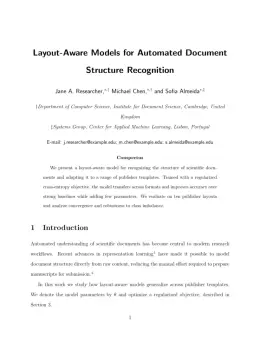
ACS Nanoscience Au template — frequently asked questions

How do I write a paper in the ACS Nanoscience Au format?
In DocuGuru you write your manuscript in a normal editor — no LaTeX setup required — and select the ACS Nanoscience Au template. When you export, DocuGuru compiles the paper into the official American Chemical Society format and hands you a submission-ready PDF along with the editable LaTeX source.
What reference style does ACS Nanoscience Au use?
ACS Nanoscience Au uses Superscript numbered (ACS) references, shown as superscript numerals in the text. DocuGuru formats every in-text citation and the reference list in this exact style automatically. A reference appears like this: (1) Smith, A.; Jones, B.; Lee, C. A Representative Article Title. ACS Nanoscience Au 2023, 12, 45–58.
Do I need to know LaTeX to submit to ACS Nanoscience Au?
No. DocuGuru generates the achemso LaTeX class and compiles the PDF for you in the background, so you get a American Chemical Society-ready ACS Nanoscience Au document without writing any LaTeX. If you do want it, the LaTeX source is included in the export.
Can I import an existing draft into the ACS Nanoscience Au template?
Yes. Paste or upload your current manuscript — Word, LaTeX, Markdown, or plain text — and DocuGuru reflows it into the ACS Nanoscience Au format with correct headings, figures, tables, and superscript citations.
What is ACS Nanoscience Au?
ACS journal (achemso). It is a chemistry journal, published by American Chemical Society.
Can I export a submission-ready ACS Nanoscience Au PDF?
Yes — DocuGuru produces a PDF built with the official ACS Nanoscience Au template (the achemso class) that is ready to submit to American Chemical Society, together with the matching LaTeX source files.
How much does the ACS Nanoscience Au template cost?
You can start writing in the ACS Nanoscience Au template for free. Exporting the final submission-ready ACS Nanoscience Au PDF and LaTeX source is part of DocuGuru's paid plans — see the app for current pricing.
Use the ACS Nanoscience Au template