American Chemical Society

ACS Applied Bio Materials Template

Write in a clean editor, then format for ACS Applied Bio Materials in one click — DocuGuru applies the official American Chemical Society template with superscript references and exports a submission-ready PDF plus the editable LaTeX source. Free to start.

About the ACS Applied Bio Materials format

ACS Applied Bio Materials is a peer-reviewed journal published by American Chemical Society, covering Nanoplatforms for cancer theranostics, Advanced biosensing and bioanalysis techniques, Electrospun Nanofibers in Biomedical Applications. Over its lifetime it has published 5,815 papers, which have received 99,492 citations.

PublisherAmerican Chemical Society
Reference styleSuperscript numbered (ACS)
Superscript — small raised numerals in the text
(1) Smith, A.; Jones, B.; Lee, C. A Representative Article Title. ACS Applied Bio Materials 2023, 12, 45–58.

Formats any DOI in ACS Applied Bio Materials style. No sign-up.

Publishes research inNanoplatforms for cancer theranostics Advanced biosensing and bioanalysis techniques Electrospun Nanofibers in Biomedical Applications Nanoparticle-Based Drug Delivery Bone Tissue Engineering Materials
ISSN2576-6422
Citation impact (2-yr)5.3
h-index92
i10-index3,014
Top institutions publishing hereChinese Academy of Sciences
Journal websitepubs.acs.org
You getA submission-ready PDF and the editable LaTeX source — ready to submit.

Papers published in ACS Applied Bio Materials per year

3
2012
2
2013
1
2014
1
2016
305
2018
657
2019
962
2020
733
2021
534
2022
555
2023
697
2024
890
2025

Citation impact of ACS Applied Bio Materials by publication year

0
2012
1
2013
0
2014
15
2016
9.2K
2018
18.4K
2019
25K
2020
16.4K
2021
10.5K
2022
8.1K
2023
7K
2024
3.1K
2025

Citations each year’s papers have accumulated so far — the most recent years are still building up.

Most-cited papers in ACS Applied Bio Materials

Latest Progress in Electrospun Nanofibers for Wound Healing Applications

Adnan Memić, Turdimuhammad Abdullah, Halimatu S. Mohammed et al. · 31 Jan 2019

Electrospinning is a versatile technique used to create native tissue-like fibrous scaffolds. Recently, it has gained a large amount of attention for generation of bioactive dressing materials suitable for treatment of both chronic and acute wounds. In this Review, we focus on the latest advances made in the application of electrospun scaffolds for bioactive wound…

Recent Advances in Synthesis, Optical Properties, and Biomedical Applications of Carbon Dots

Sadat Anwar, Haizhen Ding, Mingsheng Xu et al. · 6 May 2019

Carbon dots (CDs) are relatively new and one of the most propitious nanomaterials ever known to humanity, primarily consisting of a carbonized carbon core with heteroatoms in organic functional groups attached. CDs show various fascinating properties, such as tunable excitation/emission, chemical inertness, photostability, low toxicity, good biocompatibility, ease of handling, and eco-friendliness. Due to the…

Recent Progress in Nanostructured Smart Drug Delivery Systems for Cancer Therapy: A Review

Md Ishak Khan, Imran Hossain, M. Imran Hossain et al. · 28 Feb 2022

Traditional treatment approaches for cancer involve intravenous chemotherapy or other forms of drug delivery. These therapeutic measures suffer from several limitations such as nonspecific targeting, poor biodistribution, and buildup of drug resistances. However, significant technological advancements have been made in terms of superior modes of drug delivery over the last few decades. Technical capability in…

Aggregation-Induced Emission: A Trailblazing Journey to the Field of Biomedicine

Chunlei Zhu, Ryan T. K. Kwok, Jacky W. Y. Lam et al. · 30 Oct 2018

The emergence of the aggregation-induced emission (AIE) concept significantly changes the cognition of the scientific community toward classic photophysical phenomena. More importantly, the AIE phenomenon has brought huge opportunities for the analysis of bioactive species, the monitoring of complicated biological processes, and the elucidation of key physiological and pathological behaviors. As a class of promising…

Recent Progress in Natural Biopolymers Conductive Hydrogels for Flexible Wearable Sensors and Energy Devices: Materials, Structures, and Performance

Chen Cui, Qingjin Fu, Lei Meng et al. · 17 Aug 2020

Natural biopolymer-based conductive hydrogels, which combine inherent renewable, nontoxic features, biocompatibility and biodegradability of biopolymers, and excellent flexibility and conductivity of conductive hydrogels, exhibit great potential in applications of wearable and stretchable sensing devices. Compared to traditional flexible substrates deriving from petro-materials-derived polymers, conductive hydrogels consisting of continuous cross-linked polymer networks and a large amount…

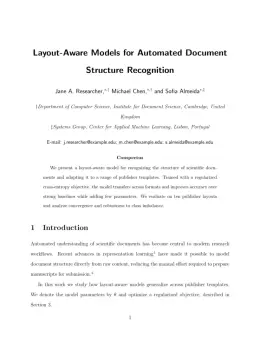
ACS Applied Bio Materials template — frequently asked questions

How do I write a paper in the ACS Applied Bio Materials format?
In DocuGuru you write your manuscript in a normal editor — no LaTeX setup required — and select the ACS Applied Bio Materials template. When you export, DocuGuru compiles the paper into the official American Chemical Society format and hands you a submission-ready PDF along with the editable LaTeX source.
What reference style does ACS Applied Bio Materials use?
ACS Applied Bio Materials uses Superscript numbered (ACS) references, shown as superscript numerals in the text. DocuGuru formats every in-text citation and the reference list in this exact style automatically. A reference appears like this: (1) Smith, A.; Jones, B.; Lee, C. A Representative Article Title. ACS Applied Bio Materials 2023, 12, 45–58.
Do I need to know LaTeX to submit to ACS Applied Bio Materials?
No. DocuGuru generates the achemso LaTeX class and compiles the PDF for you in the background, so you get a American Chemical Society-ready ACS Applied Bio Materials document without writing any LaTeX. If you do want it, the LaTeX source is included in the export.
Can I import an existing draft into the ACS Applied Bio Materials template?
Yes. Paste or upload your current manuscript — Word, LaTeX, Markdown, or plain text — and DocuGuru reflows it into the ACS Applied Bio Materials format with correct headings, figures, tables, and superscript citations.
What is ACS Applied Bio Materials?
ACS journal (achemso). It is a chemistry journal, published by American Chemical Society.
Can I export a submission-ready ACS Applied Bio Materials PDF?
Yes — DocuGuru produces a PDF built with the official ACS Applied Bio Materials template (the achemso class) that is ready to submit to American Chemical Society, together with the matching LaTeX source files.
How much does the ACS Applied Bio Materials template cost?
You can start writing in the ACS Applied Bio Materials template for free. Exporting the final submission-ready ACS Applied Bio Materials PDF and LaTeX source is part of DocuGuru's paid plans — see the app for current pricing.
Use the ACS Applied Bio Materials template