ACM

Queue Template

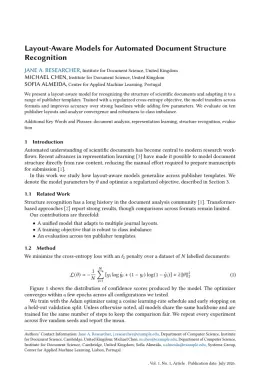
Write in a clean editor, then format for Queue in one click — DocuGuru applies the official ACM template with numbered references and exports a submission-ready PDF plus the editable LaTeX source. Free to start.

About the Queue format

Queue is a peer-reviewed journal published by ACM, covering Distributed and Parallel Computing Systems, Software System Performance and Reliability, Cloud Computing and Resource Management.

PublisherACM
Reference styleNumbered (ACM)
Numbered — [1], [2] in the text
[1] Ada Smith, Ben Jones, and Cara Lee. 2023. A representative article title. Queue 12, 3, Article 45 (2023).

Formats any DOI in Queue style. No sign-up.

Publishes research inDistributed and Parallel Computing Systems Software System Performance and Reliability Cloud Computing and Resource Management Parallel Computing and Optimization Techniques Distributed systems and fault tolerance
ISSN1542-7730
Citation impact (2-yr)1.29
h-index62
i10-index262
Total citations17,902
Top institutions publishing hereQueues Enforth Development (United States)
Journal websitequeue.acm.org
You getA submission-ready PDF and the editable LaTeX source — ready to submit.

Papers published in Queue per year

57
2014
45
2015
52
2016
48
2017
46
2018
52
2019
39
2020
39
2021
34
2022
42
2023
46
2024
21
2025

Citation impact of Queue by publication year

364
2014
375
2015
1.5K
2016
236
2017
223
2018
479
2019
250
2020
891
2021
220
2022
97
2023
83
2024
15
2025

Citations each year’s papers have accumulated so far — the most recent years are still building up.

Most-cited papers in Queue

Scalable Parallel Programming with CUDA

John Nickolls, Ian Buck, Michael Garland et al. · 1 Mar 2008

The advent of multicore CPUs and manycore GPUs means that mainstream processor chips are now parallel systems. Furthermore, their parallelism continues to scale with Moore’s law. The challenge is to develop mainstream application software that transparently scales its parallelism to leverage the increasing number of processor cores, much as 3D graphics applications transparently scale their…

1,584 citations Cite SaveGo to paper →
BBR: Congestion-Based Congestion Control

Neal Cardwell, Yuchung Cheng, C. Stephen Gunn et al. · 1 Oct 2016

When bottleneck buffers are large, loss-based congestion control keeps them full, causing bufferbloat. When bottleneck buffers are small, loss-based congestion control misinterprets loss as a signal of congestion, leading to low throughput. Fixing these problems requires an alternative to loss-based congestion control. Finding this alternative requires an understanding of where and how network congestion originates.

Interpretable Machine Learning

Valerie Chen, Jeffrey Li, Joon Sik Kim et al. · 31 Dec 2021

The emergence of machine learning as a society-changing technology in the past decade has triggered concerns about people's inability to understand the reasoning of increasingly complex models. The field of IML (interpretable machine learning) grew out of these concerns, with the goal of empowering various stakeholders to tackle use cases, such as building trust in…

Software and the Concurrency Revolution

Herb Sutter, James R. Larus · 1 Sep 2005

Concurrency has long been touted as the "next big thing" and "the way of the future," but for the past 30 years, mainstream software development has been able to ignore it. Our parallel future has finally arrived: new machines will be parallel machines, and this will require major changes in the way we develop software.…

Borg, Omega, and Kubernetes

Brendan Burns, Brian Grant, David Oppenheimer et al. · 1 Jan 2016

Though widespread interest in software containers is a relatively recent phenomenon, at Google we have been managing Linux containers at scale for more than ten years and built three different container-management systems in that time. Each system was heavily influenced by its predecessors, even though they were developed for different reasons. This article describes the…

Queue template — frequently asked questions

How do I write a paper in the Queue format?
In DocuGuru you write your manuscript in a normal editor — no LaTeX setup required — and select the Queue template. When you export, DocuGuru compiles the paper into the official ACM format and hands you a submission-ready PDF along with the editable LaTeX source.
What reference style does Queue use?
Queue uses Numbered (ACM) references, shown as numbered [1], [2] markers in the text. DocuGuru formats every in-text citation and the reference list in this exact style automatically. A reference appears like this: [1] Ada Smith, Ben Jones, and Cara Lee. 2023. A representative article title. Queue 12, 3, Article 45 (2023).
Do I need to know LaTeX to submit to Queue?
No. DocuGuru generates the acmart LaTeX class and compiles the PDF for you in the background, so you get a ACM-ready Queue document without writing any LaTeX. If you do want it, the LaTeX source is included in the export.
Can I import an existing draft into the Queue template?
Yes. Paste or upload your current manuscript — Word, LaTeX, Markdown, or plain text — and DocuGuru reflows it into the Queue format with correct headings, figures, tables, and numbered citations.
Who publishes Queue?
Queue is a engineering and computer science journal published by ACM. DocuGuru's Queue template matches ACM's official submission format.
Can I export a submission-ready Queue PDF?
Yes — DocuGuru produces a PDF built with the official Queue template (the acmart class) that is ready to submit to ACM, together with the matching LaTeX source files.
How much does the Queue template cost?
You can start writing in the Queue template for free. Exporting the final submission-ready Queue PDF and LaTeX source is part of DocuGuru's paid plans — see the app for current pricing.
Use the Queue template