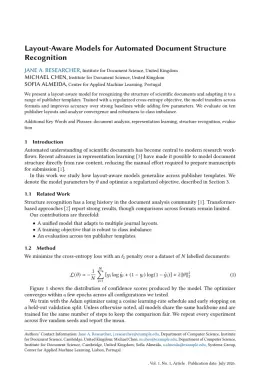
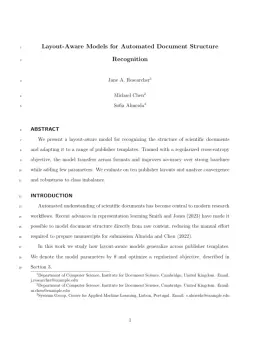
About the Formal Aspects of Computing format
Formal Aspects of Computing is a peer-reviewed journal published by ACM, covering Formal Methods in Verification, Logic, programming, and type systems, Distributed systems and fault tolerance. Over its lifetime it has published 1,243 papers, which have received 22,640 citations.
| Publisher | ACM |
|---|
| Reference style | Numbered (ACM) Numbered — [1], [2] in the text
[1] Ada Smith, Ben Jones, and Cara Lee. 2023. A representative article title. Formal Aspects of Computing 12, 3, Article 45 (2023).
Formats any DOI in Formal Aspects of Computing style. No sign-up.
|
|---|
| Publishes research in | Formal Methods in Verification Logic, programming, and type systems Distributed systems and fault tolerance Logic, Reasoning, and Knowledge Model-Driven Software Engineering Techniques |
|---|
| ISSN | 0934-5043 |
|---|
| Citation impact (2-yr) | 12.85 |
|---|
| h-index | 65 |
|---|
| i10-index | 511 |
|---|
| Top institutions publishing here | University of Oxford |
|---|
| Journal website | www.springer.com |
|---|
| You get | A submission-ready PDF and the editable LaTeX source — ready to submit. |
|---|
Papers published in Formal Aspects of Computing per year
Citation impact of Formal Aspects of Computing by publication year
Citations each year’s papers have accumulated so far — the most recent years are still building up.
Most-cited papers in Formal Aspects of Computing
A logic for reasoning about time and reliability
Hans Hansson, Bengt Jönsson · 1 Sep 1994
Abstract We present a logic for stating properties such as, “after a request for service there is at least a 98% probability that the service will be carried out within 2 seconds”. The logic extends the temporal logic CTL by Emerson, Clarke and Sistla with time and probabilities. Formulas are interpreted over discrete time Markov…
An Introduction to Input/Output Automata
Nancy Lynch, Mark R. Tuttle · 27 Jan 2026
We describe the input/output automaton model, a model for concurrent and distributed discrete event systems. We define the model, illustrate the model with several examples concerning vending machines and a leader election algorithm, and survey the ways in which the model has been used.
A New Approach to Abstract Syntax with Variable Binding
Murdoch J. Gabbay, Andrew M. Pitts · 1 Jul 2002
Abstract. The permutation model of set theory with atoms (FM-sets), devised by Fraenkel and Mostowski in the 1930s, supports notions of ‘name-abstraction’ and ‘fresh name’ that provide a new way to represent, compute with, and reason about the syntax of formal systems involving variable-binding operations. Inductively defined FM-sets involving the name-abstraction set former (together with…
Frama-C: A software analysis perspective
Florent Kirchner, Nikolaï Kosmatov, Virgile Prévosto et al. · 8 Jan 2015
Abstract Frama-C is a source code analysis platform that aims at conducting verification of industrial-size C programs. It provides its users with a collection of plug-ins that perform static analysis, deductive verification, and testing, for safety- and security-critical software. Collaborative verification across cooperating plug-ins is enabled by their integration on top of a shared kernel…
Real time process algebra
J. C. M. Baeten, J. A. Bergstra · 1 Jun 1991
Abstract We describe an axiom system ACP p that incorporates real timed actions. Many examples are provided in order to explain the intuitive contents of the notation. ACP p is a generalisation of ACP. This implies that some of the axioms have to be relaxed and that ACP can be recovered as a special case…