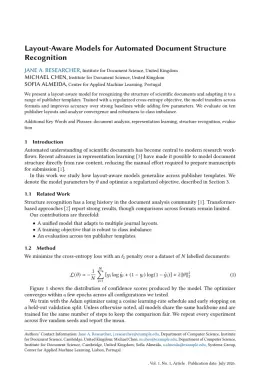
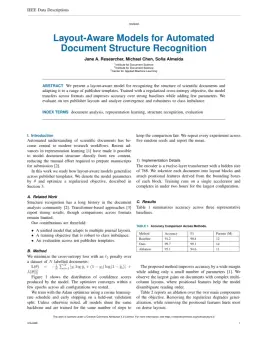
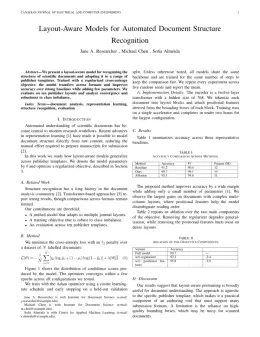
About the ACM Transactions on Applied Perception format
ACM Transactions on Applied Perception is a peer-reviewed journal published by ACM, covering Visual perception and processing mechanisms, Tactile and Sensory Interactions, Virtual Reality Applications and Impacts. Over its lifetime it has published 590 papers, which have received 16,002 citations.
| Publisher | ACM |
|---|
| Reference style | Numbered (ACM) Numbered — [1], [2] in the text
[1] Ada Smith, Ben Jones, and Cara Lee. 2023. A representative article title. ACM Transactions on Applied Perception 12, 3, Article 45 (2023).
Formats any DOI in ACM Transactions on Applied Perception style. No sign-up.
|
|---|
| Publishes research in | Visual perception and processing mechanisms Tactile and Sensory Interactions Virtual Reality Applications and Impacts Visual Attention and Saliency Detection Multisensory perception and integration |
|---|
| ISSN | 1544-3558 |
|---|
| Citation impact (2-yr) | 2.2 |
|---|
| h-index | 66 |
|---|
| i10-index | 316 |
|---|
| Top institutions publishing here | Max Planck Institute for Biological Cybernetics |
|---|
| Journal website | tap.acm.org |
|---|
| You get | A submission-ready PDF and the editable LaTeX source — ready to submit. |
|---|
Papers published in ACM Transactions on Applied Perception per year
Citation impact of ACM Transactions on Applied Perception by publication year
Citations each year’s papers have accumulated so far — the most recent years are still building up.
Most-cited papers in ACM Transactions on Applied Perception
Waypoint navigation with a vibrotactile waist belt
Jan B. F. van Erp, Hendrik A. H. C. van Veen, Chris Jansen et al. · 1 Apr 2005
Presenting waypoint navigation on a visual display is not suited for all situations. The present experiments investigate if it is feasible to present the navigation information on a tactile display. Important design issue of the display is how direction and distance information must be coded. Important usability issues are the resolution of the display and…
Computational visual attention systems and their cognitive foundations
Simone Frintrop, Erich Rome, Henrik I. Christensen · 1 Jan 2010
Based on concepts of the human visual system, computational visual attention systems aim to detect regions of interest in images. Psychologists, neurobiologists, and computer scientists have investigated visual attention thoroughly during the last decades and profited considerably from each other. However, the interdisciplinarity of the topic holds not only benefits but also difficulties: Concepts of…
Distance Perception and the Visual Horizon in Head-Mounted Displays
Ross Messing, Frank H. Durgin · 1 Jul 2005
Can distance perception be studied using virtual reality (VR) if distances are systematically underestimated in VR head-mounted displays (HMDs)? In an experiment in which a real environment was observed through an HMD, via live video, distances, as measured by visually directed walking, were underestimated even when the perceived environment was known to be real and…
Latency Requirements for Foveated Rendering in Virtual Reality
Rachel Albert, Anjul Patney, David Luebke et al. · 14 Sep 2017
Foveated rendering is a performance optimization based on the well-known degradation of peripheral visual acuity. It reduces computational costs by showing a high-quality image in the user’s central (foveal) vision and a lower quality image in the periphery. Foveated rendering is a promising optimization for Virtual Reality (VR) graphics, and generally requires accurate and low-latency…
HapticWalker---a novel haptic foot device
Henning Schmidt, Stefan Hesse, R. Bernhardt et al. · 1 Apr 2005
This paper presents a new haptic locomotion interface, which comprises two programmable foot platforms with permanent foot machine contact. It is designed as a scalable and modular system with unit-by-unit extensibility offering up to six plus one degrees of freedom (DOF) per foot. The basic setup comprises three DOF per foot in the sagittal plane.The…