AAAS (Science)

Cyborg and Bionic Systems Template

Write in a clean editor, then format for Cyborg and Bionic Systems in one click — DocuGuru applies the official AAAS (Science) template with superscript references and exports a submission-ready PDF plus the editable LaTeX source. Free to start.

About the Cyborg and Bionic Systems format

Cyborg and Bionic Systems is a peer-reviewed journal published by AAAS (Science), covering Soft Robotics and Applications, Micro and Nano Robotics, EEG and Brain-Computer Interfaces.

PublisherAAAS (Science)
Reference styleSuperscript numbered (Science)
Superscript — small raised numerals in the text
1. A. Smith, B. Jones, C. Lee, A representative article title. Cyborg and Bionic Systems 12, 45–58 (2023).

Formats any DOI in Cyborg and Bionic Systems style. No sign-up.

Publishes research inSoft Robotics and Applications Micro and Nano Robotics EEG and Brain-Computer Interfaces Muscle activation and electromyography studies Neuroscience and Neural Engineering
ISSN2097-1087
Citation impact (2-yr)12.16
h-index47
i10-index168
Total citations7,145
Open accessYes
Top institutions publishing hereBeijing Institute of Technology
Journal websitespj.sciencemag.org
You getA submission-ready PDF and the editable LaTeX source — ready to submit.

Papers published in Cyborg and Bionic Systems per year

4
2020
23
2021
31
2022
61
2023
59
2024
71
2025

Citation impact of Cyborg and Bionic Systems by publication year

113
2020
671
2021
1.5K
2022
2.7K
2023
1.6K
2024
424
2025

Citations each year’s papers have accumulated so far — the most recent years are still building up.

Most-cited papers in Cyborg and Bionic Systems

Carbon-Based Stimuli-Responsive Nanomaterials: Classification and Application

Chen Zhao, Jun Kang, Yuwen Li et al. · 1 Jan 2023

Carbon-based nanomaterials, including carbon nanotubes, carbon nanospheres, and carbon nanofibers, are becoming a research hotspot due to their unique structure and good mechanical, thermal, electrical, optical, and chemical properties. With the development of material synthesis technology, they can be functionalized and used in various fields such as energy, environment, and biomedicine. In particular, stimuli-responsive carbon-based…

Integrated Actuation and Sensing: Toward Intelligent Soft Robots

Shuai Zhou, Yuanhang Li, Qianqian Wang et al. · 1 Jan 2024

Soft robotics has received substantial attention due to its remarkable deformability, making it well-suited for a wide range of applications in complex environments, such as medicine, rescue operations, and exploration. Within this domain, the interaction of actuation and sensing is of utmost importance for controlling the movements and functions of soft robots. Nonetheless, current research…

A Survey on 3D Skeleton-Based Action Recognition Using Learning Method

Bin Ren, Mengyuan Liu, Runwei Ding et al. · 1 Jan 2024

Three-dimensional skeleton-based action recognition (3D SAR) has gained important attention within the computer vision community, owing to the inherent advantages offered by skeleton data. As a result, a plethora of impressive works, including those based on conventional handcrafted features and learned feature extraction methods, have been conducted over the years. However, prior surveys on action…

Magnetic Microrobots with Folate Targeting for Drug Delivery

Min Ye, Yan Zhou, Hongyu Zhao et al. · 1 Jan 2023

Untethered microrobots can be used for cargo delivery (e.g., drug molecules, stem cells, and genes) targeting designated areas. However, it is not enough to just reach the lesion site, as some drugs can only play the best therapeutic effect within the cells. To this end, folic acid (FA) was introduced into microrobots in this work…

Multimodal Locomotion and Cargo Transportation of Magnetically Actuated Quadruped Soft Microrobots

Chenyang Huang, Zhengyu Lai, Xinyu Wu et al. · 1 Jan 2022

Untethered microrobots have attracted extensive attention due to their potential for biomedical applications and micromanipulation at the small scale. Soft microrobots are of great research importance because of their highly deformable ability to achieve not only multiple locomotion mechanisms but also minimal invasion to the environment. However, the existing microrobots are still limited in their…

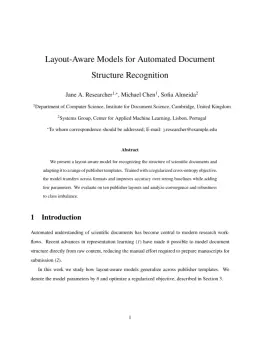
Cyborg and Bionic Systems template — frequently asked questions

How do I write a paper in the Cyborg and Bionic Systems format?
In DocuGuru you write your manuscript in a normal editor — no LaTeX setup required — and select the Cyborg and Bionic Systems template. When you export, DocuGuru compiles the paper into the official AAAS (Science) format and hands you a submission-ready PDF along with the editable LaTeX source.
What reference style does Cyborg and Bionic Systems use?
Cyborg and Bionic Systems uses Superscript numbered (Science) references, shown as superscript numerals in the text. DocuGuru formats every in-text citation and the reference list in this exact style automatically. A reference appears like this: 1. A. Smith, B. Jones, C. Lee, A representative article title. Cyborg and Bionic Systems 12, 45–58 (2023).
Do I need to know LaTeX to submit to Cyborg and Bionic Systems?
No. DocuGuru generates the article LaTeX class and compiles the PDF for you in the background, so you get a AAAS (Science)-ready Cyborg and Bionic Systems document without writing any LaTeX. If you do want it, the LaTeX source is included in the export.
Can I import an existing draft into the Cyborg and Bionic Systems template?
Yes. Paste or upload your current manuscript — Word, LaTeX, Markdown, or plain text — and DocuGuru reflows it into the Cyborg and Bionic Systems format with correct headings, figures, tables, and superscript citations.
Who publishes Cyborg and Bionic Systems?
Cyborg and Bionic Systems is a multidisciplinary journal published by AAAS (Science). DocuGuru's Cyborg and Bionic Systems template matches AAAS (Science)'s official submission format.
Can I export a submission-ready Cyborg and Bionic Systems PDF?
Yes — DocuGuru produces a PDF built with the official Cyborg and Bionic Systems template (the article class) that is ready to submit to AAAS (Science), together with the matching LaTeX source files.
How much does the Cyborg and Bionic Systems template cost?
You can start writing in the Cyborg and Bionic Systems template for free. Exporting the final submission-ready Cyborg and Bionic Systems PDF and LaTeX source is part of DocuGuru's paid plans — see the app for current pricing.
Use the Cyborg and Bionic Systems template