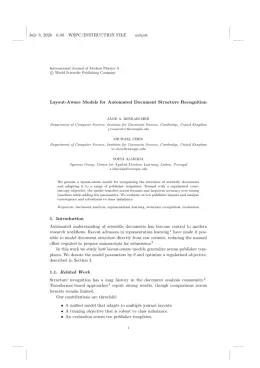
About the Journal of Computational Acoustics format
Journal of Computational Acoustics is a peer-reviewed journal published by World Scientific, covering Underwater Acoustics Research, Acoustic Wave Phenomena Research, Geophysical Methods and Applications.
| Publisher | World Scientific |
|---|
| Reference style | Superscript numbered (World Scientific) Superscript — small raised numerals in the text
1. Smith, A., Jones, B. & Lee, C. A representative article title. Journal of Computational Acoustics 12, 45–58 (2023).
Formats any DOI in the closest standard style — Journal of Computational Acoustics has no published style definition, so this is an approximation. No sign-up.
|
|---|
| Publishes research in | Underwater Acoustics Research Acoustic Wave Phenomena Research Geophysical Methods and Applications Electromagnetic Simulation and Numerical Methods Seismic Waves and Analysis |
|---|
| ISSN | 0218-396X |
|---|
| h-index | 51 |
|---|
| i10-index | 317 |
|---|
| Total citations | 13,046 |
|---|
| Open access | Yes |
|---|
| Top institutions publishing here | Centre National de la Recherche Scientifique |
|---|
| Journal website | www.worldscinet.com |
|---|
| You get | A submission-ready PDF and the editable LaTeX source — ready to submit. |
|---|
Papers published in Journal of Computational Acoustics per year
Citation impact of Journal of Computational Acoustics by publication year
Citations each year’s papers have accumulated so far — the most recent years are still building up.
Most-cited papers in Journal of Computational Acoustics
PERFECTLY MATCHED LAYERS FOR ELASTODYNAMICS: A NEW ABSORBING BOUNDARY CONDITION
Weng Cho Chew, Qing Liu · 1 Dec 1996
The use of perfectly matched layers (PML) has recently been introduced by Berenger as a material absorbing boundary condition (ABC) for electromagnetic waves. In this paper, we will first prove that a fictitious elastodynamic material half-space exists that will absorb an incident wave for all angles and all frequencies. Moreover, the wave is attenuative in…
RADIATION AND OUTFLOW BOUNDARY CONDITIONS FOR DIRECT COMPUTATION OF ACOUSTIC AND FLOW DISTURBANCES IN A NONUNIFORM MEAN FLOW
Christopher K. W. Tam, Zhong Dong · 1 Jun 1996
It is well known that Euler equations support small amplitude acoustic, vorticity and entropy waves. To perform high quality direct numerical simulations of flow generated noise problems, acoustic radiation boundary conditions are required along inflow boundaries. Along boundaries where the mean flow leaves the computation domain, outflow boundary conditions are needed to allow the acoustic,…
VERY HIGH-ORDER SPATIALLY IMPLICIT SCHEMES FOR COMPUTATIONAL ACOUSTICS ON CURVILINEAR MESHES
Miguel R. Visbal, Datta V. Gaitonde · 1 Dec 2001
A high-order compact-differencing and filtering algorithm, coupled with the classical fourth-order Runge–Kutta scheme, is developed and implemented to simulate aeroacoustic phenomena on curvilinear geometries. Several issues pertinent to the use of such schemes are addressed. The impact of mesh stretching in the generation of high-frequency spurious modes is examined and the need for a discriminating…
SIX BOUNDARY ELEMENTS PER WAVELENGTH: IS THAT ENOUGH?
Steffen Marburg · 1 Mar 2002
The commonly applied rule of thumb to use six (linear) elements per wavelength in linear time-harmonic acoustics is discussed in this paper. In a survey of related work, rules of element design in computational acoustics are collected. This is followed by a brief review of the boundary element method and a more detailed presentation of…
Very High-Order Spatially Implicit Schemes for Computational Acoustics on Curvilinear Meshes
Miguel R. Visbal · 1 Dec 2001
A high-order compact-differencing and filtering algorithm, coupled with the classical fourth-order Runge–Kutta scheme, is developed and implemented to simulate aeroacoustic phenomena on curvilinear geometries. Several issues pertinent to the use of such schemes are addressed. The impact of mesh stretching in the generation of high-frequency spurious modes is examined and the need for a discriminating…