World Scientific

Advances in Data Science and Adaptive Analysis Template

Write in a clean editor, then format for Advances in Data Science and Adaptive Analysis in one click — DocuGuru applies the official World Scientific template with superscript references and exports a submission-ready PDF plus the editable LaTeX source. Free to start.

About the Advances in Data Science and Adaptive Analysis format

Advances in Data Science and Adaptive Analysis is a peer-reviewed journal published by World Scientific, covering Machine Fault Diagnosis Techniques, Structural Health Monitoring Techniques, Image and Signal Denoising Methods.

PublisherWorld Scientific
Reference styleSuperscript numbered (World Scientific)
Superscript — small raised numerals in the text
1. Smith, A., Jones, B. & Lee, C. A representative article title. Advances in Data Science and Adaptive Analysis 12, 45–58 (2023).

Formats any DOI in the closest standard style — Advances in Data Science and Adaptive Analysis has no published style definition, so this is an approximation. No sign-up.

Publishes research inMachine Fault Diagnosis Techniques Structural Health Monitoring Techniques Image and Signal Denoising Methods EEG and Brain-Computer Interfaces Imbalanced Data Classification Techniques
ISSN2424-922X
Citation impact (2-yr)4.63
h-index11
i10-index15
Total citations596
Top institutions publishing hereSan Diego State University
You getA submission-ready PDF and the editable LaTeX source — ready to submit.

Papers published in Advances in Data Science and Adaptive Analysis per year

13
2016
11
2017
22
2018
9
2019
18
2020
20
2021
14
2022
3
2023
4
2024
13
2025

Citation impact of Advances in Data Science and Adaptive Analysis by publication year

29
2016
40
2017
113
2018
28
2019
107
2020
78
2021
52
2022
6
2023
4
2024
129
2025

Citations each year’s papers have accumulated so far — the most recent years are still building up.

Most-cited papers in Advances in Data Science and Adaptive Analysis

Predictive Modeling of Peanut Oil Prices Utilizing a Gaussian Process Regression-Based Machine Learning Framework

Bingzi Jin, Xiaojie Xu · 25 Aug 2025

Accurate anticipation of fluctuations in commodity valuations is critical for diverse stakeholders, encompassing policymakers, investors, and supply chain entities, to ensure informed decision-making within volatile markets. As a staple edible oil, peanut oil exhibits pronounced price volatility, necessitating robust predictive frameworks to mitigate economic risks. This study leverages a decade-long weekly wholesale price index data…

Empirical Mode Decomposition and its Extensions Applied to EEG Analysis: A Review

Catherine M. Sweeney‐Reed, Slawomir J. Nasuto, Marcus Fraga Vieira et al. · 1 Apr 2018

Empirical mode decomposition (EMD) provides an adaptive, data-driven approach to time–frequency analysis, yielding components from which local amplitude, phase, and frequency content can be derived. Since its initial introduction to electroencephalographic (EEG) data analysis, EMD has been extended to enable phase synchrony analysis and multivariate data processing. EMD has been integrated into a wide range…

CatBoost — An Ensemble Machine Learning Model for Prediction and Classification of Student Academic Performance

Abhisht Joshi, Pranay Saggar, Rajat Jain et al. · 1 Jul 2021

In every educational institution, predicting pupils’ performance is a vital responsibility. Due to this, a variety of data mining techniques, such as clustering, classification, and regression, are applied to anticipate the learner’s study behavior. By Machine Learning’s arrival, it has become vital to forecast students’ academic achievement, and this study attracts significant attention within the…

Machine Learning Copper Price Predictions: Evidence Based on Gaussian Process Regressions Tuned with Cross-Validation and Bayesian Optimization

Bingzi Jin, Xiaojie Xu · 10 Jan 2025

For a considerable amount of time, many market participants have placed great importance on price forecasts for major metal commodities. To tackle the problem, our study looks at the price of copper recorded on a daily basis. The sample under inquiry spans more than 10 years, from 01/02/2014 to 04/12/2024, and the price series under…

Smartphone-Based Pavement Roughness Estimation Using Deep Learning with Entity Embedding

Armstrong Aboah, Yaw Adu‐Gyamfi · 1 Jul 2020

The commonly used index for measuring pavement roughness is the International Roughness index (IRI). Traditional method for collecting road surface information is expensive and as such researchers over the years have resorted to other cheaper ways of collecting data. This study focuses on developing a deep learning model to quickly and accurately determine the IRI…

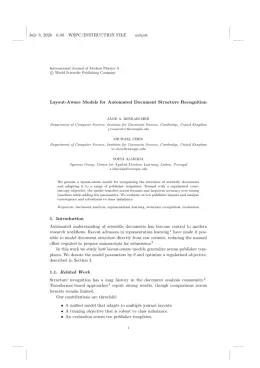
Advances in Data Science and Adaptive Analysis template — frequently asked questions

How do I write a paper in the Advances in Data Science and Adaptive Analysis format?
In DocuGuru you write your manuscript in a normal editor — no LaTeX setup required — and select the Advances in Data Science and Adaptive Analysis template. When you export, DocuGuru compiles the paper into the official World Scientific format and hands you a submission-ready PDF along with the editable LaTeX source.
What reference style does Advances in Data Science and Adaptive Analysis use?
Advances in Data Science and Adaptive Analysis uses Superscript numbered (World Scientific) references, shown as superscript numerals in the text. DocuGuru formats every in-text citation and the reference list in this exact style automatically. A reference appears like this: 1. Smith, A., Jones, B. & Lee, C. A representative article title. Advances in Data Science and Adaptive Analysis 12, 45–58 (2023).
Do I need to know LaTeX to submit to Advances in Data Science and Adaptive Analysis?
No. DocuGuru generates the ws-ijmpa LaTeX class and compiles the PDF for you in the background, so you get a World Scientific-ready Advances in Data Science and Adaptive Analysis document without writing any LaTeX. If you do want it, the LaTeX source is included in the export.
Can I import an existing draft into the Advances in Data Science and Adaptive Analysis template?
Yes. Paste or upload your current manuscript — Word, LaTeX, Markdown, or plain text — and DocuGuru reflows it into the Advances in Data Science and Adaptive Analysis format with correct headings, figures, tables, and superscript citations.
Who publishes Advances in Data Science and Adaptive Analysis?
Advances in Data Science and Adaptive Analysis is a physics journal published by World Scientific. DocuGuru's Advances in Data Science and Adaptive Analysis template matches World Scientific's official submission format.
Can I export a submission-ready Advances in Data Science and Adaptive Analysis PDF?
Yes — DocuGuru produces a PDF built with the official Advances in Data Science and Adaptive Analysis template (the ws-ijmpa class) that is ready to submit to World Scientific, together with the matching LaTeX source files.
How much does the Advances in Data Science and Adaptive Analysis template cost?
You can start writing in the Advances in Data Science and Adaptive Analysis template for free. Exporting the final submission-ready Advances in Data Science and Adaptive Analysis PDF and LaTeX source is part of DocuGuru's paid plans — see the app for current pricing.
Use the Advances in Data Science and Adaptive Analysis template