Wiley

Veterinary Dermatology Template

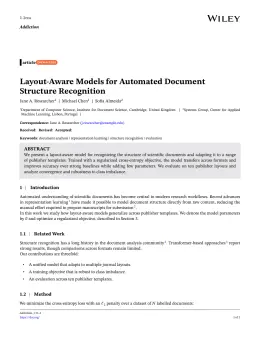
Write in a clean editor, then format for Veterinary Dermatology in one click — DocuGuru applies the official Wiley template with author–year references and exports a submission-ready PDF plus the editable LaTeX source. Free to start.

About the Veterinary Dermatology format

Veterinary Dermatology is a peer-reviewed journal published by Wiley, covering Dermatology and Skin Diseases, Veterinary Oncology Research, Nail Diseases and Treatments.

PublisherWiley
Reference styleAuthor–year (Chicago)
Author–year — (Smith, 2023) in the text
Smith, Ada, Ben Jones, and Cara Lee. 2023. "A Representative Article Title." Veterinary Dermatology 12 (3): 45–58.

Formats any DOI in Veterinary Dermatology style. No sign-up.

Publishes research inDermatology and Skin Diseases Veterinary Oncology Research Nail Diseases and Treatments Infectious Diseases and Mycology Allergic Rhinitis and Sensitization
ISSN0959-4493
Citation impact (2-yr)1.23
h-index86
i10-index1,405
Total citations53,669
Article processing charge$3,400
Top institutions publishing hereNorth Carolina State University
Journal websiteonlinelibrary.wiley.com
You getA submission-ready PDF and the editable LaTeX source — ready to submit.

Papers published in Veterinary Dermatology per year

98
2014
87
2015
140
2016
114
2017
109
2018
120
2019
102
2020
139
2021
98
2022
91
2023
94
2024
112
2025

Citation impact of Veterinary Dermatology by publication year

2.1K
2014
1.7K
2015
2K
2016
2K
2017
1.2K
2018
1.3K
2019
843
2020
1.3K
2021
587
2022
412
2023
172
2024
136
2025

Citations each year’s papers have accumulated so far — the most recent years are still building up.

Most-cited papers in Veterinary Dermatology

A prospective study on the clinical features of chronic canine atopic dermatitis and its diagnosis

Claude Favrot, Jean Steffan, Wolfgang Seewald et al. · 28 Jan 2010

Canine atopic dermatitis (CAD) is a multifaceted disease associated with exposure to various offending agents such as environmental and food allergens. The diagnosis of this condition is difficult because none of the typical signs are pathognomonic. Sets of criteria have been proposed but are mainly used to include dogs in clinical studies. The goals of…

<i>Staphylococcus pseudintermedius</i>in the dog: taxonomy, diagnostics, ecology, epidemiology and pathogenicity

Jeanette Bannoehr, Luca Guardabassi · 19 Apr 2012

The dog is the natural host of Staphylococcus pseudintermedius. Many research efforts are currently being undertaken to expand our knowledge and understanding of this important canine commensal and opportunistic pathogen. The objective of this review is to summarize the current knowledge of the species, including the latest research outcomes, with emphasis on taxonomy, diagnostics, ecology,…

Guidelines for the diagnosis and antimicrobial therapy of canine superficial bacterial folliculitis (<scp>A</scp>ntimicrobial<scp>G</scp>uidelines<scp>W</scp>orking<scp>G</scp>roup of the<scp>I</scp>nternational<scp>S</scp>ociety for<scp>C</scp>ompanion<scp>A</scp>nimal<scp>I</scp>nfectious<scp>D</scp>iseases)

Andrew Hillier, D. H. Lloyd, J. Scott Weese et al. · 11 Apr 2014

BACKGROUND: Superficial bacterial folliculitis (SBF) is usually caused by Staphylococcus pseudintermedius and routinely treated with systemic antimicrobial agents. Infection is a consequence of reduced immunity associated with alterations of the skin barrier and underlying diseases that may be difficult to diagnose and resolve; thus, SBF is frequently recurrent and repeated treatment is necessary. The emergence…

Treatment of canine atopic dermatitis: 2010 clinical practice guidelines from the International Task Force on Canine Atopic Dermatitis

Thierry Olivry, Douglas J. DeBoer, Claude Favrot et al. · 23 Apr 2010

Atopic dermatitis (AD) is a common chronic relapsing pruritic skin disease of dogs for which treatment has varied over time and geographical location. Recent high quality randomized controlled trials and systematic reviews have established which drugs are likely to offer consistent benefit. The International Task Force for Canine AD currently recommends a multi-faceted approach to…

Diagnosis and treatment of dermatophytosis in dogs and cats.

Karen A. Moriello, Kimberly S. Coyner, Sue Paterson et al. · 17 May 2017

BACKGROUND: Dermatophytosis is a superficial fungal skin disease of cats and dogs. The most common pathogens of small animals belong to the genera Microsporum and Trichophyton. It is an important skin disease because it is contagious, infectious and can be transmitted to people. OBJECTIVES: The objective of this document is to review the existing literature…

Veterinary Dermatology template — frequently asked questions

How do I write a paper in the Veterinary Dermatology format?
In DocuGuru you write your manuscript in a normal editor — no LaTeX setup required — and select the Veterinary Dermatology template. When you export, DocuGuru compiles the paper into the official Wiley format and hands you a submission-ready PDF along with the editable LaTeX source.
What reference style does Veterinary Dermatology use?
Veterinary Dermatology uses Author–year (Chicago) references, shown as author–year markers such as (Smith, 2023) in the text. DocuGuru formats every in-text citation and the reference list in this exact style automatically. A reference appears like this: Smith, Ada, Ben Jones, and Cara Lee. 2023. "A Representative Article Title." Veterinary Dermatology 12 (3): 45–58.
Do I need to know LaTeX to submit to Veterinary Dermatology?
No. DocuGuru generates the USG LaTeX class and compiles the PDF for you in the background, so you get a Wiley-ready Veterinary Dermatology document without writing any LaTeX. If you do want it, the LaTeX source is included in the export.
Can I import an existing draft into the Veterinary Dermatology template?
Yes. Paste or upload your current manuscript — Word, LaTeX, Markdown, or plain text — and DocuGuru reflows it into the Veterinary Dermatology format with correct headings, figures, tables, and author–year citations.
Who publishes Veterinary Dermatology?
Veterinary Dermatology is a multidisciplinary journal published by Wiley. DocuGuru's Veterinary Dermatology template matches Wiley's official submission format.
Can I export a submission-ready Veterinary Dermatology PDF?
Yes — DocuGuru produces a PDF built with the official Veterinary Dermatology template (the USG class) that is ready to submit to Wiley, together with the matching LaTeX source files.
How much does the Veterinary Dermatology template cost?
You can start writing in the Veterinary Dermatology template for free. Exporting the final submission-ready Veterinary Dermatology PDF and LaTeX source is part of DocuGuru's paid plans — see the app for current pricing.

Use the Veterinary Dermatology template