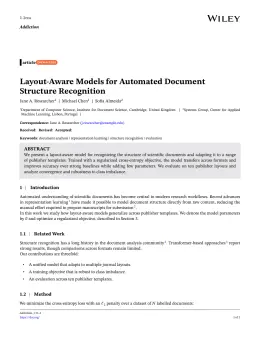
About the Psychology and Psychotherapy Theory Research and Practice format
Psychology and Psychotherapy Theory Research and Practice is a peer-reviewed journal published by Wiley, covering Psychotherapy Techniques and Applications, Schizophrenia research and treatment, Personality Disorders and Psychopathology.
| Publisher | Wiley |
|---|
| Reference style | Author–year (Chicago) Author–year — (Smith, 2023) in the text
Smith, Ada, Ben Jones, and Cara Lee. 2023. "A Representative Article Title." Psychology and Psychotherapy Theory Research and Practice 12 (3): 45–58.
Formats any DOI in Psychology and Psychotherapy Theory Research and Practice style. No sign-up.
|
|---|
| Publishes research in | Psychotherapy Techniques and Applications Schizophrenia research and treatment Personality Disorders and Psychopathology Attachment and Relationship Dynamics Anxiety, Depression, Psychometrics, Treatment, Cognitive Processes |
|---|
| ISSN | 1476-0835 |
|---|
| Citation impact (2-yr) | 1.65 |
|---|
| h-index | 85 |
|---|
| i10-index | 694 |
|---|
| Total citations | 34,142 |
|---|
| Top institutions publishing here | University of Manchester |
|---|
| Journal website | onlinelibrary.wiley.com |
|---|
| You get | A submission-ready PDF and the editable LaTeX source — ready to submit. |
|---|
Papers published in Psychology and Psychotherapy Theory Research and Practice per year
Citation impact of Psychology and Psychotherapy Theory Research and Practice by publication year
Citations each year’s papers have accumulated so far — the most recent years are still building up.
Most-cited papers in Psychology and Psychotherapy Theory Research and Practice
Fears of compassion: Development of three self‐report measures
Paul Gilbert, Kirsten McEwan, Marcela Matos et al. · 4 Nov 2010
OBJECTIVES: There is increasing evidence that helping people develop compassion for themselves and others has powerful impacts on negative affect and promotes positive affect. However, clinical observations suggest that some individuals, particularly those high in self-criticism, can find self-compassion and receiving compassion difficult and can be fearful of it. This study therefore developed measures of…
The digital revolution and its impact on mental health care
Sandra Bucci, Matthias Schwannauer, Natalie Berry · 28 Mar 2019
The digital revolution is evolving at an unstoppable pace. Alongside the unprecedented explosion of digital technology facilities and systems, mental health care is under greater pressure than ever before. With its emphasis on big data, computing power, mobile technology, and network information, digital technology is set to transform health care delivery. This article reviews the…
Compassion interventions: The programmes, the evidence, and implications for research and practice
James N. Kirby · 24 Sep 2016
PURPOSE: Over the last 10-15 years, there has been a substantive increase in compassion-based interventions aiming to improve psychological functioning and well-being. METHODS: This study provides an overview and synthesis of the currently available compassion-based interventions. What do these programmes looks like, what are their aims, and what is the state of evidence underpinning each…
Sexual and physical abuse during childhood and adulthood as predictors of hallucinations, delusions and thought disorder
John Read, Kirsty Agar, Nick Argyle et al. · 1 Mar 2003
In light of recent studies indicating a relationship between child abuse and the positive symptoms of schizophrenia, this study investigated the hypotheses that childhood sexual and physical abuse are related to hallucinations, delusions, and thought disorder in adults, and that those relationships are greater in those who have suffered abuse during adulthood as well as…
A qualitative investigation of problem gambling as an escape‐based coping strategy
Richard T. A. Wood, Mark D. Griffiths · 14 Sep 2006
BACKGROUND: There has been a small but growing body, of largely quantitative research, that has examined problem gambling in the context of poor coping skills. These studies suggest that gambling may be used as an alternative method of coping that some will use to distract themselves from having to deal with problems in their lives.…