Wiley

Protein Science Template

Write in a clean editor, then format for Protein Science in one click — DocuGuru applies the official Wiley template with author–year references and exports a submission-ready PDF plus the editable LaTeX source. Free to start.

About the Protein Science format

Protein Science is a peer-reviewed journal published by Wiley, covering Protein Structure and Dynamics, Enzyme Structure and Function, RNA and protein synthesis mechanisms.

PublisherWiley
Reference styleAuthor–year (Chicago)
Author–year — (Smith, 2023) in the text
Smith, Ada, Ben Jones, and Cara Lee. 2023. "A Representative Article Title." Protein Science 12 (3): 45–58.

Formats any DOI in Protein Science style. No sign-up.

Publishes research inProtein Structure and Dynamics Enzyme Structure and Function RNA and protein synthesis mechanisms Bacterial Genetics and Biotechnology Glycosylation and Glycoproteins Research
ISSN0961-8368
Citation impact (2-yr)3.11
h-index252
i10-index6,724
Total citations500,084
Article processing charge$4,070
Top institutions publishing hereHoward Hughes Medical Institute
Journal websitewww.proteinscience.org
You getA submission-ready PDF and the editable LaTeX source — ready to submit.

Papers published in Protein Science per year

233
2014
258
2015
257
2016
276
2017
213
2018
263
2019
216
2020
265
2021
303
2022
335
2023
390
2024
465
2025

Citation impact of Protein Science by publication year

7.4K
2014
6.7K
2015
5.9K
2016
25.5K
2017
5.7K
2018
17.1K
2019
19.2K
2020
9.1K
2021
6.1K
2022
7.8K
2023
2.3K
2024
1K
2025

Citations each year’s papers have accumulated so far — the most recent years are still building up.

Most-cited papers in Protein Science

<scp>UCSF ChimeraX</scp>: Structure visualization for researchers, educators, and developers

Eric F. Pettersen, Thomas D. Goddard, Conrad C. Huang et al. · 3 Sep 2020

UCSF ChimeraX is the next-generation interactive visualization program from the Resource for Biocomputing, Visualization, and Informatics (RBVI), following UCSF Chimera. ChimeraX brings (a) significant performance and graphics enhancements; (b) new implementations of Chimera's most highly used tools, many with further improvements; (c) several entirely new analysis features; (d) support for new areas such as virtual…

10,266 citations Cite SaveGo to paper →
Toward understanding the origin and evolution of cellular organisms

Minoru Kanehisa · 23 Aug 2019

In this era of high-throughput biology, bioinformatics has become a major discipline for making sense out of large-scale datasets. Bioinformatics is usually considered as a practical field developing databases and software tools for supporting other fields, rather than a fundamental scientific discipline for uncovering principles of biology. The KEGG resource that we have been developing…

6,675 citations Cite SaveGo to paper →
UCSF ChimeraX: Meeting modern challenges in visualization and analysis

Thomas D. Goddard, Conrad C. Huang, Elaine C. Meng et al. · 15 Jul 2017

UCSF ChimeraX is next-generation software for the visualization and analysis of molecular structures, density maps, 3D microscopy, and associated data. It addresses challenges in the size, scope, and disparate types of data attendant with cutting-edge experimental methods, while providing advanced options for high-quality rendering (interactive ambient occlusion, reliable molecular surface calculations, etc.) and professional approaches…

5,914 citations Cite SaveGo to paper →
MolProbity: More and better reference data for improved all‐atom structure validation

Christopher J. Williams, Jeffrey J. Headd, Nigel W. Moriarty et al. · 25 Oct 2017

This paper describes the current update on macromolecular model validation services that are provided at the MolProbity website, emphasizing changes and additions since the previous review in 2010. There have been many infrastructure improvements, including rewrite of previous Java utilities to now use existing or newly written Python utilities in the open-source CCTBX portion of…

5,007 citations Cite SaveGo to paper →
Verification of protein structures: Patterns of nonbonded atomic interactions

Christos Colovos, Todd O. Yeates · 1 Sep 1993

A novel method for differentiating between correctly and incorrectly determined regions of protein structures based on characteristic atomic interaction is described. Different types of atoms are distributed nonrandomly with respect to each other in proteins. Errors in model building lead to more randomized distributions of the different atom types, which can be distinguished from correct…

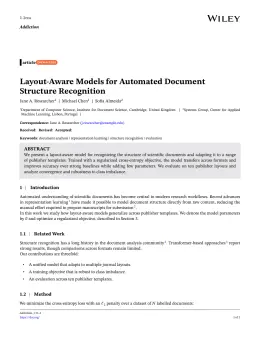
4,489 citations Cite SaveGo to paper →

Protein Science template — frequently asked questions

How do I write a paper in the Protein Science format?
In DocuGuru you write your manuscript in a normal editor — no LaTeX setup required — and select the Protein Science template. When you export, DocuGuru compiles the paper into the official Wiley format and hands you a submission-ready PDF along with the editable LaTeX source.
What reference style does Protein Science use?
Protein Science uses Author–year (Chicago) references, shown as author–year markers such as (Smith, 2023) in the text. DocuGuru formats every in-text citation and the reference list in this exact style automatically. A reference appears like this: Smith, Ada, Ben Jones, and Cara Lee. 2023. "A Representative Article Title." Protein Science 12 (3): 45–58.
Do I need to know LaTeX to submit to Protein Science?
No. DocuGuru generates the USG LaTeX class and compiles the PDF for you in the background, so you get a Wiley-ready Protein Science document without writing any LaTeX. If you do want it, the LaTeX source is included in the export.
Can I import an existing draft into the Protein Science template?
Yes. Paste or upload your current manuscript — Word, LaTeX, Markdown, or plain text — and DocuGuru reflows it into the Protein Science format with correct headings, figures, tables, and author–year citations.
Who publishes Protein Science?
Protein Science is a multidisciplinary journal published by Wiley. DocuGuru's Protein Science template matches Wiley's official submission format.
Can I export a submission-ready Protein Science PDF?
Yes — DocuGuru produces a PDF built with the official Protein Science template (the USG class) that is ready to submit to Wiley, together with the matching LaTeX source files.
How much does the Protein Science template cost?
You can start writing in the Protein Science template for free. Exporting the final submission-ready Protein Science PDF and LaTeX source is part of DocuGuru's paid plans — see the app for current pricing.
Use the Protein Science template