Wiley

Plant-Environment Interactions Template

Write in a clean editor, then format for Plant-Environment Interactions in one click — DocuGuru applies the official Wiley template with author–year references and exports a submission-ready PDF plus the editable LaTeX source. Free to start.

About the Plant-Environment Interactions format

Plant-Environment Interactions is a peer-reviewed journal published by Wiley, covering Plant Water Relations and Carbon Dynamics, Plant Stress Responses and Tolerance, Ecology and Vegetation Dynamics Studies.

PublisherWiley
Reference styleAuthor–year (Chicago)
Author–year — (Smith, 2023) in the text
Smith, Ada, Ben Jones, and Cara Lee. 2023. "A Representative Article Title." Plant-Environment Interactions 12 (3): 45–58.

Formats any DOI in Plant-Environment Interactions style. No sign-up.

Publishes research inPlant Water Relations and Carbon Dynamics Plant Stress Responses and Tolerance Ecology and Vegetation Dynamics Studies Plant Parasitism and Resistance Plant and animal studies
ISSN2575-6265
Citation impact (2-yr)1.6
h-index19
i10-index55
Total citations1,664
Article processing charge$2,100
Open accessYes
Top institutions publishing hereInstitut National de Recherche pour l'Agriculture, l'Alimentation et l'Environnement
Journal websiteonlinelibrary.wiley.com
You getA submission-ready PDF and the editable LaTeX source — ready to submit.

Papers published in Plant-Environment Interactions per year

16
2000
12
2016
26
2020
37
2021
34
2022
43
2023
55
2024
94
2025

Citation impact of Plant-Environment Interactions by publication year

133
2000
67
2016
319
2020
317
2021
213
2022
239
2023
179
2024
124
2025

Citations each year’s papers have accumulated so far — the most recent years are still building up.

Most-cited papers in Plant-Environment Interactions

Fine‐root dynamics vary with soil depth and precipitation in a low‐nutrient tropical forest in the Central Amazonia

Amanda L. Cordeiro, Richard J. Norby, Kelly M. Andersen et al. · 22 Apr 2020

A common assumption in tropical ecology is that root systems respond rapidly to climatic cues but that most of that response is limited to the uppermost layer of the soil, with relatively limited changes in deeper layers. However, this assumption has not been tested directly, preventing models from accurately predicting the response of tropical forests…

Parallels between drought and flooding: An integrated framework for plant eco‐physiological responses to water stress

Siluo Chen, Kirsten ten Tusscher, Rashmi Sasidharan et al. · 30 Jun 2023

Drought and flooding occur at opposite ends of the soil moisture spectrum yet their resulting stress responses in plants share many similarities. Drought limits root water uptake to which plants respond with stomatal closure and reduced leaf gas exchange. Flooding limits root metabolism due to soil oxygen deficiency, which also limits root water uptake and…

Topography‐driven microclimate gradients shape forest structure, diversity, and composition in a temperate refugial forest

Bailey H. McNichol, Ran Wang, Amanda Hefner et al. · 1 Jun 2024

Macroclimate drives vegetation distributions, but fine-scale topographic variation can generate microclimate refugia for plant persistence in unsuitable areas. However, we lack quantitative descriptions of topography-driven microclimatic variation and how it shapes forest structure, diversity, and composition. We hypothesized that topographic variation and the presence of the forest overstory cause spatiotemporal microclimate variation affecting tree performance,…

Stress induced dynamic adjustment of conserved miR164:NAC module

Yuniet Hernandez, Kavita Goswami, Neeti Sanan‐Mishra · 10 Aug 2020

Abstract Aims, including the rationale Salinity and drought are the two major stresses limiting the productivity of economically important crops such as Glycine max (soybean). The incidence of these stresses during the pod development stages affects the quality and quantity of seeds, which compromise the yield of soybean. The miR164: NAC module has been shown…

Plant Defense Responses to Insect Herbivores Through Molecular Signaling, Secondary Metabolites, and Associated Epigenetic Regulation

Deepak Kumar Mahanta, J. Komal, Ipsita Samal et al. · 1 Feb 2025

Over millions of years of interactions, plants have developed complex defense mechanisms to counteract diverse insect herbivory strategies. These defenses encompass morphological, biochemical, and molecular adaptations that mitigate the impacts of herbivore attacks. Physical barriers, such as spines, trichomes, and cuticle layers, deter herbivores, while biochemical defenses include the production of secondary metabolites and volatile…

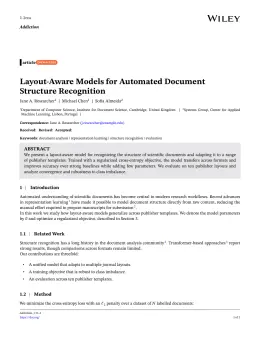
Plant-Environment Interactions template — frequently asked questions

How do I write a paper in the Plant-Environment Interactions format?
In DocuGuru you write your manuscript in a normal editor — no LaTeX setup required — and select the Plant-Environment Interactions template. When you export, DocuGuru compiles the paper into the official Wiley format and hands you a submission-ready PDF along with the editable LaTeX source.
What reference style does Plant-Environment Interactions use?
Plant-Environment Interactions uses Author–year (Chicago) references, shown as author–year markers such as (Smith, 2023) in the text. DocuGuru formats every in-text citation and the reference list in this exact style automatically. A reference appears like this: Smith, Ada, Ben Jones, and Cara Lee. 2023. "A Representative Article Title." Plant-Environment Interactions 12 (3): 45–58.
Do I need to know LaTeX to submit to Plant-Environment Interactions?
No. DocuGuru generates the USG LaTeX class and compiles the PDF for you in the background, so you get a Wiley-ready Plant-Environment Interactions document without writing any LaTeX. If you do want it, the LaTeX source is included in the export.
Can I import an existing draft into the Plant-Environment Interactions template?
Yes. Paste or upload your current manuscript — Word, LaTeX, Markdown, or plain text — and DocuGuru reflows it into the Plant-Environment Interactions format with correct headings, figures, tables, and author–year citations.
Who publishes Plant-Environment Interactions?
Plant-Environment Interactions is a multidisciplinary journal published by Wiley. DocuGuru's Plant-Environment Interactions template matches Wiley's official submission format.
Can I export a submission-ready Plant-Environment Interactions PDF?
Yes — DocuGuru produces a PDF built with the official Plant-Environment Interactions template (the USG class) that is ready to submit to Wiley, together with the matching LaTeX source files.
How much does the Plant-Environment Interactions template cost?
You can start writing in the Plant-Environment Interactions template for free. Exporting the final submission-ready Plant-Environment Interactions PDF and LaTeX source is part of DocuGuru's paid plans — see the app for current pricing.
Use the Plant-Environment Interactions template