Wiley

Pain Practice Template

Write in a clean editor, then format for Pain Practice in one click — DocuGuru applies the official Wiley template with author–year references and exports a submission-ready PDF plus the editable LaTeX source. Free to start.

About the Pain Practice format

Pain Practice is a peer-reviewed journal published by Wiley, covering Musculoskeletal pain and rehabilitation, Pain Mechanisms and Treatments, Spine and Intervertebral Disc Pathology.

PublisherWiley
Reference styleAuthor–year (Chicago)
Author–year — (Smith, 2023) in the text
Smith, Ada, Ben Jones, and Cara Lee. 2023. "A Representative Article Title." Pain Practice 12 (3): 45–58.

Formats any DOI in Pain Practice style. No sign-up.

Publishes research inMusculoskeletal pain and rehabilitation Pain Mechanisms and Treatments Spine and Intervertebral Disc Pathology Pain Management and Treatment Anesthesia and Pain Management
ISSN1530-7085
Citation impact (2-yr)1.69
h-index98
i10-index1,219
Total citations56,317
Article processing charge$4,120
Top institutions publishing hereTexas Tech University
Journal websiteonlinelibrary.wiley.com
You getA submission-ready PDF and the editable LaTeX source — ready to submit.

Papers published in Pain Practice per year

120
2014
104
2015
160
2016
122
2017
92
2018
119
2019
130
2020
112
2021
113
2022
145
2023
117
2024
135
2025

Citation impact of Pain Practice by publication year

3.5K
2014
2.8K
2015
3.5K
2016
2.8K
2017
1.9K
2018
2.4K
2019
1.8K
2020
1.2K
2021
1.1K
2022
930
2023
376
2024
149
2025

Citations each year’s papers have accumulated so far — the most recent years are still building up.

Most-cited papers in Pain Practice

The Development and Psychometric Validation of the Central Sensitization Inventory

Tom G. Mayer, Randy Neblett, Howard Cohen et al. · 27 Sep 2011

Central sensitization (CS) has been proposed as a common pathophysiological mechanism to explain related syndromes for which no specific organic cause can be found. The term "central sensitivity syndrome (CSS)" has been proposed to describe these poorly understood disorders related to CS. The goal of this investigation was to develop the Central Sensitization Inventory (CSI),…

Opioids and the Management of Chronic Severe Pain in the Elderly: Consensus Statement of an International Expert Panel with Focus on the Six Clinically Most Often Used World Health Organization step III Opioids (Buprenorphine, Fentanyl, Hydromorphone, Methadone, Morphine, Oxycodone)

Joseph V. Pergolizzi, Rainer H. Böger, Keith Budd et al. · 23 May 2008

SUMMARY OF CONSENSUS: 1. The use of opioids in cancer pain: The criteria for selecting analgesics for pain treatment in the elderly include, but are not limited to, overall efficacy, overall side-effect profile, onset of action, drug interactions, abuse potential, and practical issues, such as cost and availability of the drug, as well as the…

Intervertebral Disc: Anatomy‐Physiology‐Pathophysiology‐Treatment

P. Prithvi Raj · 1 Jan 2008

This review article describes anatomy, physiology, pathophysiology and treatment of intervertebral disc. The intervertebral discs lie between the vertebral bodies, linking them together. The components of the disc are nucleus pulposus, annulus fibrosus and cartilagenous end-plates. The blood supply to the disc is only to the cartilagenous end-plates. The nerve supply is basically through the…

The Numeric Rating Scale for Clinical Pain Measurement: A Ratio Measure?

Craig T. Hartrick, Juliann P. Kovan, Sharon Shapiro · 1 Dec 2003

The Numeric Rating Scale (NRS-11) has been widely used clinically for the assessment of pain. Its use for clinical research is controversial. Reports differ as to whether or not the NRS-11 should be treated as a ratio pain measurement tool. This study compared the NRS-11 to a ratio measure for pain assessment: the visual analog…

Pelvic Girdle Pain and Low Back Pain in Pregnancy: A Review

Era Vermani, Rajnish Mittal, Andrew Weeks · 26 Oct 2009

Pregnancy-related pelvic girdle pain (PGP) and pregnancy-related low back pain (PLBP) are common problems with significant physical, psychological, and socioeconomic implications. There are several management options that are underutilized because of lack of comprehensive knowledge by health-care professionals and fear of harmful effects of treatment on the developing fetus. Interventions such as patient education, the…

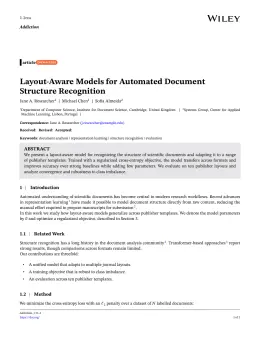
Pain Practice template — frequently asked questions

How do I write a paper in the Pain Practice format?
In DocuGuru you write your manuscript in a normal editor — no LaTeX setup required — and select the Pain Practice template. When you export, DocuGuru compiles the paper into the official Wiley format and hands you a submission-ready PDF along with the editable LaTeX source.
What reference style does Pain Practice use?
Pain Practice uses Author–year (Chicago) references, shown as author–year markers such as (Smith, 2023) in the text. DocuGuru formats every in-text citation and the reference list in this exact style automatically. A reference appears like this: Smith, Ada, Ben Jones, and Cara Lee. 2023. "A Representative Article Title." Pain Practice 12 (3): 45–58.
Do I need to know LaTeX to submit to Pain Practice?
No. DocuGuru generates the USG LaTeX class and compiles the PDF for you in the background, so you get a Wiley-ready Pain Practice document without writing any LaTeX. If you do want it, the LaTeX source is included in the export.
Can I import an existing draft into the Pain Practice template?
Yes. Paste or upload your current manuscript — Word, LaTeX, Markdown, or plain text — and DocuGuru reflows it into the Pain Practice format with correct headings, figures, tables, and author–year citations.
Who publishes Pain Practice?
Pain Practice is a multidisciplinary journal published by Wiley. DocuGuru's Pain Practice template matches Wiley's official submission format.
Can I export a submission-ready Pain Practice PDF?
Yes — DocuGuru produces a PDF built with the official Pain Practice template (the USG class) that is ready to submit to Wiley, together with the matching LaTeX source files.
How much does the Pain Practice template cost?
You can start writing in the Pain Practice template for free. Exporting the final submission-ready Pain Practice PDF and LaTeX source is part of DocuGuru's paid plans — see the app for current pricing.
Use the Pain Practice template