
910 citations
Cite
SaveGo to paper →
Wiley
Nordic Journal of Botany Template
Write in a clean editor, then format for Nordic Journal of Botany in one click — DocuGuru applies the official Wiley template with author–year references and exports a submission-ready PDF plus the editable LaTeX source. Free to start.
About the Nordic Journal of Botany format
Nordic Journal of Botany is a peer-reviewed journal published by Wiley, covering Plant Diversity and Evolution, Plant and Fungal Species Descriptions, Plant and animal studies.
| Publisher | Wiley |
|---|---|
| Reference style | Author–year (Chicago) Author–year — (Smith, 2023) in the text Smith, Ada, Ben Jones, and Cara Lee. 2023. "A Representative Article Title." Nordic Journal of Botany 12 (3): 45–58.
Formats any DOI in Nordic Journal of Botany style. No sign-up. |
| Publishes research in | Plant Diversity and Evolution Plant and Fungal Species Descriptions Plant and animal studies Botany and Plant Ecology Studies Botany, Ecology, and Taxonomy Studies |
| ISSN | 0107-055X |
| Citation impact (2-yr) | 0.89 |
| h-index | 69 |
| i10-index | 1,244 |
| Total citations | 44,395 |
| Article processing charge | $2,730 |
| Top institutions publishing here | Uppsala University |
| Journal website | onlinelibrary.wiley.com |
| You get | A submission-ready PDF and the editable LaTeX source — ready to submit. |
Papers published in Nordic Journal of Botany per year
Citation impact of Nordic Journal of Botany by publication year
Citations each year’s papers have accumulated so far — the most recent years are still building up.
Most-cited papers in Nordic Journal of Botany
Based on SEM examinations of about 5000 species of seed plants, this is a survey of their epidermal surface characters with an aim to application in taxonomy. Surface characters may be grouped into four categories: (1) Cellular arrangement or cellular pattern. (2) Shape of cells (the “primary sculpture” of a surface). (3) Relief of outer…
742 citations
Cite
SaveGo to paper →
Taxonomy makes increasing use of significant results from many fields of research including the rapidly developing fields of micro– and macromolecular chemistry, ultrastructure and micromorphology in combination with macromorphology, anatomy, embryology, cytology, paleontology, biological interaction and distribution. Some of these results have contributed to make the current systems of classifications more concordant. Recent studies on…
456 citations
Cite
SaveGo to paper →
Our attempt at putatively phylogenetic classifications of Angiospermae, considering our vast ignorance of more than 120 million years of evolution of the class, must be very tentative and elastic to make full use of the new approaches and new data constantly being made available to us. Some of the realignments thus required in my system…
388 citations
Cite
SaveGo to paper →
A systematic analysis of the Melastomataceae, a pantropical family of about 4200–4500 species in c. 166 genera, and their traditional allies, the Memecylaceae, with c. 430 species in six genera, suggests a phylogeny in which there are two major lineages in the Melastomataceae and a clearly distinct Memecylaceae. Melastomataceae have close affinities with Crypteroniaceae and…
360 citations
Cite
SaveGo to paper →
Related journal templates
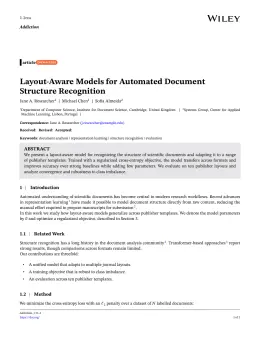
Nordic Journal of Botany template — frequently asked questions
How do I write a paper in the Nordic Journal of Botany format?
In DocuGuru you write your manuscript in a normal editor — no LaTeX setup required — and select the Nordic Journal of Botany template. When you export, DocuGuru compiles the paper into the official Wiley format and hands you a submission-ready PDF along with the editable LaTeX source.
What reference style does Nordic Journal of Botany use?
Nordic Journal of Botany uses Author–year (Chicago) references, shown as author–year markers such as (Smith, 2023) in the text. DocuGuru formats every in-text citation and the reference list in this exact style automatically. A reference appears like this: Smith, Ada, Ben Jones, and Cara Lee. 2023. "A Representative Article Title." Nordic Journal of Botany 12 (3): 45–58.
Do I need to know LaTeX to submit to Nordic Journal of Botany?
No. DocuGuru generates the USG LaTeX class and compiles the PDF for you in the background, so you get a Wiley-ready Nordic Journal of Botany document without writing any LaTeX. If you do want it, the LaTeX source is included in the export.
Can I import an existing draft into the Nordic Journal of Botany template?
Yes. Paste or upload your current manuscript — Word, LaTeX, Markdown, or plain text — and DocuGuru reflows it into the Nordic Journal of Botany format with correct headings, figures, tables, and author–year citations.
Who publishes Nordic Journal of Botany?
Nordic Journal of Botany is a multidisciplinary journal published by Wiley. DocuGuru's Nordic Journal of Botany template matches Wiley's official submission format.
Can I export a submission-ready Nordic Journal of Botany PDF?
Yes — DocuGuru produces a PDF built with the official Nordic Journal of Botany template (the USG class) that is ready to submit to Wiley, together with the matching LaTeX source files.
How much does the Nordic Journal of Botany template cost?
You can start writing in the Nordic Journal of Botany template for free. Exporting the final submission-ready Nordic Journal of Botany PDF and LaTeX source is part of DocuGuru's paid plans — see the app for current pricing.