Wiley

Muscle & Nerve Template

Write in a clean editor, then format for Muscle & Nerve in one click — DocuGuru applies the official Wiley template with author–year references and exports a submission-ready PDF plus the editable LaTeX source. Free to start.

About the Muscle & Nerve format

Muscle & Nerve is a peer-reviewed journal published by Wiley, covering Peripheral Nerve Disorders, Muscle Physiology and Disorders, Muscle activation and electromyography studies.

PublisherWiley
Reference styleAuthor–year (Chicago)
Author–year — (Smith, 2023) in the text
Smith, Ada, Ben Jones, and Cara Lee. 2023. "A Representative Article Title." Muscle & Nerve 12 (3): 45–58.

Formats any DOI in Muscle & Nerve style. No sign-up.

Publishes research inPeripheral Nerve Disorders Muscle Physiology and Disorders Muscle activation and electromyography studies Peripheral Neuropathies and Disorders Myasthenia Gravis and Thymoma
ISSN0148-639X
Citation impact (2-yr)1.96
h-index217
i10-index7,654
Total citations415,670
Article processing charge$4,530
Top institutions publishing hereMayo Clinic
Journal websiteonlinelibrary.wiley.com
You getA submission-ready PDF and the editable LaTeX source — ready to submit.

Papers published in Muscle & Nerve per year

429
2014
453
2015
532
2016
419
2017
339
2018
378
2019
378
2020
337
2021
315
2022
262
2023
306
2024
326
2025

Citation impact of Muscle & Nerve by publication year

9.7K
2014
9.7K
2015
10.4K
2016
7.9K
2017
5.5K
2018
6K
2019
5.9K
2020
3.7K
2021
2.5K
2022
1.6K
2023
1.1K
2024
440
2025

Citations each year’s papers have accumulated so far — the most recent years are still building up.

Most-cited papers in Muscle & Nerve

Functional and clinical significance of skeletal muscle architecture

Richard L. Lieber, Jan Frid�n · 1 Jan 2000

Skeletal muscle architecture is the structural property of whole muscles that dominates their function. This review describes the basic architectural properties of human upper and lower extremity muscles. The designs of various muscle groups in humans and other species are analyzed from the point of view of optimizing function. Muscle fiber arrangement and motor unit…

1,203 citations Cite SaveGo to paper →
Myogenic cells derived from rat bone marrow mesenchymal stem cells exposed to 5‐azacytidine

Shigeyuki Wakitani, Tomoyuki Saito, Arnold I. Caplan · 1 Dec 1995

The compound 5-azacytidine has been previously shown to convert cells of the rat embryonic fibroblastic cell line, C3H/10T1/2, into myoblasts, adipocytes, and chondrocytes. Rare, resident cells of bone marrow and periosteum, referred to as mesenchymal stem cells, have been shown to differentiate into a number of mesenchymal phenotypes including bone, cartilage, and adipocytes. Rat bone…

1,079 citations Cite SaveGo to paper →
Changes in muscle contractile properties and neural control during human muscular fatigue

B. Bigland‐Ritchie, J. J. Woods · 1 Dec 1984

The factors limiting force production and exercise endurance time have been briefly described, together with some of the changes occurring at various sites within the muscle and central nervous system. Evidence is presented that, in fatigue of sustained maximal voluntary contractions (MVC) executed by well-motivated subjects, the reduction in force generating capacity need not be…

1,014 citations Cite SaveGo to paper →
Structure and function of the skeletal muscle extracellular matrix

Allison R. Gillies, Richard L. Lieber · 9 Mar 2011

The skeletal muscle extracellular matrix (ECM) plays an important role in muscle fiber force transmission, maintenance, and repair. In both injured and diseased states, ECM adapts dramatically, a property that has clinical manifestations and alters muscle function. Here we review the structure, composition, and mechanical properties of skeletal muscle ECM; describe the cells that contribute…

1,010 citations Cite SaveGo to paper →
Interobserver agreement in the assessment of muscle strength and functional abilities in Guillain‐Barré syndrome

R. P. Kleyweg, F.G.A. van der Meché, Paul Schmitz · 1 Nov 1991

In studies of Guillain-Barré syndrome, functional deficit is usually assessed according to a functional scale consisting of several categories. The level of interobserver agreement in this scoring method is not known; furthermore, this method seems to be insensitive when applied to bedridden and artificially ventilated patients. We have developed an additional score (MRC-sumscore), reflecting muscle…

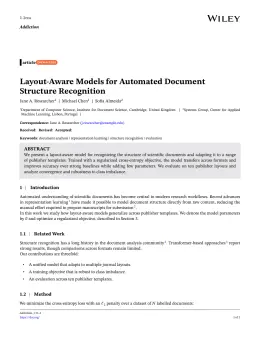
Muscle & Nerve template — frequently asked questions

How do I write a paper in the Muscle & Nerve format?
In DocuGuru you write your manuscript in a normal editor — no LaTeX setup required — and select the Muscle & Nerve template. When you export, DocuGuru compiles the paper into the official Wiley format and hands you a submission-ready PDF along with the editable LaTeX source.
What reference style does Muscle & Nerve use?
Muscle & Nerve uses Author–year (Chicago) references, shown as author–year markers such as (Smith, 2023) in the text. DocuGuru formats every in-text citation and the reference list in this exact style automatically. A reference appears like this: Smith, Ada, Ben Jones, and Cara Lee. 2023. "A Representative Article Title." Muscle & Nerve 12 (3): 45–58.
Do I need to know LaTeX to submit to Muscle & Nerve?
No. DocuGuru generates the USG LaTeX class and compiles the PDF for you in the background, so you get a Wiley-ready Muscle & Nerve document without writing any LaTeX. If you do want it, the LaTeX source is included in the export.
Can I import an existing draft into the Muscle & Nerve template?
Yes. Paste or upload your current manuscript — Word, LaTeX, Markdown, or plain text — and DocuGuru reflows it into the Muscle & Nerve format with correct headings, figures, tables, and author–year citations.
Who publishes Muscle & Nerve?
Muscle & Nerve is a multidisciplinary journal published by Wiley. DocuGuru's Muscle & Nerve template matches Wiley's official submission format.
Can I export a submission-ready Muscle & Nerve PDF?
Yes — DocuGuru produces a PDF built with the official Muscle & Nerve template (the USG class) that is ready to submit to Wiley, together with the matching LaTeX source files.
How much does the Muscle & Nerve template cost?
You can start writing in the Muscle & Nerve template for free. Exporting the final submission-ready Muscle & Nerve PDF and LaTeX source is part of DocuGuru's paid plans — see the app for current pricing.
Use the Muscle & Nerve template