
495 citations
Cite
SaveGo to paper →
Wiley
Journal of the Society of Dyers and Colourists Template
Write in a clean editor, then format for Journal of the Society of Dyers and Colourists in one click — DocuGuru applies the official Wiley template with author–year references and exports a submission-ready PDF plus the editable LaTeX source. Free to start.
About the Journal of the Society of Dyers and Colourists format
Journal of the Society of Dyers and Colourists is a peer-reviewed journal published by Wiley, covering Dyeing and Modifying Textile Fibers, Textile materials and evaluations, Cultural Heritage Materials Analysis.
| Publisher | Wiley |
|---|---|
| Reference style | Author–year (Chicago) Author–year — (Smith, 2023) in the text Smith, Ada, Ben Jones, and Cara Lee. 2023. "A Representative Article Title." Journal of the Society of Dyers and Colourists 12 (3): 45–58.
Formats any DOI in Journal of the Society of Dyers and Colourists style. No sign-up. |
| Publishes research in | Dyeing and Modifying Textile Fibers Textile materials and evaluations Cultural Heritage Materials Analysis Color Science and Applications Dye analysis and toxicity |
| ISSN | 0037-9859 |
| h-index | 57 |
| i10-index | 1,069 |
| Total citations | 34,623 |
| Top institutions publishing here | Hexagon (United Kingdom) |
| You get | A submission-ready PDF and the editable LaTeX source — ready to submit. |
Papers published in Journal of the Society of Dyers and Colourists per year
Citation impact of Journal of the Society of Dyers and Colourists by publication year
Citations each year’s papers have accumulated so far — the most recent years are still building up.
Most-cited papers in Journal of the Society of Dyers and Colourists
The JPC79 colour–difference formula has represented a substantial improvement over earlier formulae and is being applied successfully in industrial shade passing. Modifications are described which overcome certain problems and, to some extent, simplify the formula. With available experimental data, the modified version performed even better than the original formula. Perceptibility data are fitted better by…
304 citations
Cite
SaveGo to paper →
Strict controls are being introduced on coloured effluents from UK dyehouses discharged to sewer. Failure to comply with these new regulations could result in prosecution. Yet in certain cases the technology to treat dyehouse waste waters adequately is either not available or prohibitively costly. This paper (originally given at a conference at the Manchester Conference…
240 citations
Cite
SaveGo to paper →
The potential restrictions of the discharge of coloured effluent has generated a great deal of work on decolorisation technology, but the problem has not been fully defined, let alone measured. Here, Jeff Pierce gives theoretical models, worst case scenarios and actual measurements of colour in effluent.
204 citations
Cite
SaveGo to paper →
182 citations
Cite
SaveGo to paper →
Related journal templates
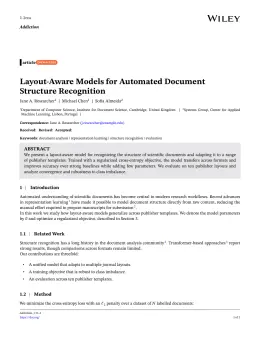
Journal of the Society of Dyers and Colourists template — frequently asked questions
How do I write a paper in the Journal of the Society of Dyers and Colourists format?
In DocuGuru you write your manuscript in a normal editor — no LaTeX setup required — and select the Journal of the Society of Dyers and Colourists template. When you export, DocuGuru compiles the paper into the official Wiley format and hands you a submission-ready PDF along with the editable LaTeX source.
What reference style does Journal of the Society of Dyers and Colourists use?
Journal of the Society of Dyers and Colourists uses Author–year (Chicago) references, shown as author–year markers such as (Smith, 2023) in the text. DocuGuru formats every in-text citation and the reference list in this exact style automatically. A reference appears like this: Smith, Ada, Ben Jones, and Cara Lee. 2023. "A Representative Article Title." Journal of the Society of Dyers and Colourists 12 (3): 45–58.
Do I need to know LaTeX to submit to Journal of the Society of Dyers and Colourists?
No. DocuGuru generates the USG LaTeX class and compiles the PDF for you in the background, so you get a Wiley-ready Journal of the Society of Dyers and Colourists document without writing any LaTeX. If you do want it, the LaTeX source is included in the export.
Can I import an existing draft into the Journal of the Society of Dyers and Colourists template?
Yes. Paste or upload your current manuscript — Word, LaTeX, Markdown, or plain text — and DocuGuru reflows it into the Journal of the Society of Dyers and Colourists format with correct headings, figures, tables, and author–year citations.
Who publishes Journal of the Society of Dyers and Colourists?
Journal of the Society of Dyers and Colourists is a multidisciplinary journal published by Wiley. DocuGuru's Journal of the Society of Dyers and Colourists template matches Wiley's official submission format.
Can I export a submission-ready Journal of the Society of Dyers and Colourists PDF?
Yes — DocuGuru produces a PDF built with the official Journal of the Society of Dyers and Colourists template (the USG class) that is ready to submit to Wiley, together with the matching LaTeX source files.
How much does the Journal of the Society of Dyers and Colourists template cost?
You can start writing in the Journal of the Society of Dyers and Colourists template for free. Exporting the final submission-ready Journal of the Society of Dyers and Colourists PDF and LaTeX source is part of DocuGuru's paid plans — see the app for current pricing.