
56 citations
Cite
SaveGo to paper →
Wiley
International Insolvency Review Template
Write in a clean editor, then format for International Insolvency Review in one click — DocuGuru applies the official Wiley template with author–year references and exports a submission-ready PDF plus the editable LaTeX source. Free to start.
About the International Insolvency Review format
International Insolvency Review is a peer-reviewed journal published by Wiley, covering Corporate Insolvency and Governance, Corporate Governance and Law, Legal principles and applications.
| Publisher | Wiley |
|---|---|
| Reference style | Author–year (Chicago) Author–year — (Smith, 2023) in the text Smith, Ada, Ben Jones, and Cara Lee. 2023. "A Representative Article Title." International Insolvency Review 12 (3): 45–58.
Formats any DOI in International Insolvency Review style. No sign-up. |
| Publishes research in | Corporate Insolvency and Governance Corporate Governance and Law Legal principles and applications Conflict of Laws and Jurisdiction Corporate Law and Human Rights |
| ISSN | 1099-1107 |
| Citation impact (2-yr) | 0.09 |
| h-index | 20 |
| i10-index | 53 |
| Total citations | 1,820 |
| Article processing charge | $2,630 |
| Top institutions publishing here | Leiden University |
| Journal website | onlinelibrary.wiley.com |
| You get | A submission-ready PDF and the editable LaTeX source — ready to submit. |
Papers published in International Insolvency Review per year
Citation impact of International Insolvency Review by publication year
Citations each year’s papers have accumulated so far — the most recent years are still building up.
Most-cited papers in International Insolvency Review
Abstract This paper examines the impact that the United Nations Commission on International Trade Law (UNCITRAL) Model Law on Cross‐border Insolvency has had on States in the light of the central problems often associated with transnational insolvencies. Despite the accolades that it has received, the Model Law has been adopted in only 19 countries in…
55 citations
Cite
SaveGo to paper →
51 citations
Cite
SaveGo to paper →
The recast of the European Insolvency Regulation introduces a new coordination procedure for handling insolvencies of groups of companies. The procedure relies on a group coordinator to create a helpful group insolvency plan while the individual insolvency proceedings remain independent. Albeit being a step into the right direction, the procedure has significant shortcomings such as…
40 citations
Cite
SaveGo to paper →
Abstract Insolvency law has finally become a field of law for which harmonisation at a European level is considered both important and feasible. In deciding upon the content of such harmonised rules, there will need to be a common understanding about the goals of insolvency law and, therefore, a European debate on bankruptcy theory. Bankruptcy…
38 citations
Cite
SaveGo to paper →
Related journal templates
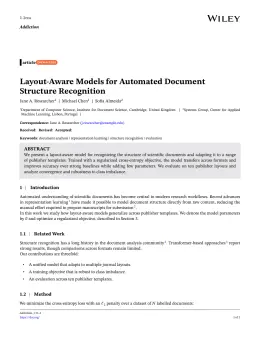
International Insolvency Review template — frequently asked questions
How do I write a paper in the International Insolvency Review format?
In DocuGuru you write your manuscript in a normal editor — no LaTeX setup required — and select the International Insolvency Review template. When you export, DocuGuru compiles the paper into the official Wiley format and hands you a submission-ready PDF along with the editable LaTeX source.
What reference style does International Insolvency Review use?
International Insolvency Review uses Author–year (Chicago) references, shown as author–year markers such as (Smith, 2023) in the text. DocuGuru formats every in-text citation and the reference list in this exact style automatically. A reference appears like this: Smith, Ada, Ben Jones, and Cara Lee. 2023. "A Representative Article Title." International Insolvency Review 12 (3): 45–58.
Do I need to know LaTeX to submit to International Insolvency Review?
No. DocuGuru generates the USG LaTeX class and compiles the PDF for you in the background, so you get a Wiley-ready International Insolvency Review document without writing any LaTeX. If you do want it, the LaTeX source is included in the export.
Can I import an existing draft into the International Insolvency Review template?
Yes. Paste or upload your current manuscript — Word, LaTeX, Markdown, or plain text — and DocuGuru reflows it into the International Insolvency Review format with correct headings, figures, tables, and author–year citations.
Who publishes International Insolvency Review?
International Insolvency Review is a multidisciplinary journal published by Wiley. DocuGuru's International Insolvency Review template matches Wiley's official submission format.
Can I export a submission-ready International Insolvency Review PDF?
Yes — DocuGuru produces a PDF built with the official International Insolvency Review template (the USG class) that is ready to submit to Wiley, together with the matching LaTeX source files.
How much does the International Insolvency Review template cost?
You can start writing in the International Insolvency Review template for free. Exporting the final submission-ready International Insolvency Review PDF and LaTeX source is part of DocuGuru's paid plans — see the app for current pricing.