Wiley

Human Factors and Ergonomics in Manufacturing & Service Industries Template

Write in a clean editor, then format for Human Factors and Ergonomics in Manufacturing & Service Industries in one click — DocuGuru applies the official Wiley template with author–year references and exports a submission-ready PDF plus the editable LaTeX source. Free to start.

About the Human Factors and Ergonomics in Manufacturing & Service Industries format

Human Factors and Ergonomics in Manufacturing & Service Industries is a peer-reviewed journal published by Wiley, covering Occupational Health and Safety Research, Human-Automation Interaction and Safety, Ergonomics and Musculoskeletal Disorders.

PublisherWiley
Reference styleAuthor–year (Chicago)
Author–year — (Smith, 2023) in the text
Smith, Ada, Ben Jones, and Cara Lee. 2023. "A Representative Article Title." Human Factors and Ergonomics in Manufacturing & Service Industries 12 (3): 45–58.

Formats any DOI in Human Factors and Ergonomics in Manufacturing & Service Industries style. No sign-up.

Publishes research inOccupational Health and Safety Research Human-Automation Interaction and Safety Ergonomics and Musculoskeletal Disorders Musculoskeletal pain and rehabilitation Ergonomics and Human Factors
ISSN1090-8471
Citation impact (2-yr)1.95
h-index64
i10-index570
Total citations20,274
Article processing charge$3,090
Top institutions publishing hereTsinghua University
Journal websiteonlinelibrary.wiley.com
You getA submission-ready PDF and the editable LaTeX source — ready to submit.

Papers published in Human Factors and Ergonomics in Manufacturing & Service Industries per year

67
2014
30
2015
63
2016
40
2017
64
2018
49
2019
53
2020
64
2021
40
2022
47
2023
44
2024
41
2025

Citation impact of Human Factors and Ergonomics in Manufacturing & Service Industries by publication year

1.1K
2014
569
2015
841
2016
705
2017
986
2018
332
2019
804
2020
868
2021
294
2022
297
2023
148
2024
60
2025

Citations each year’s papers have accumulated so far — the most recent years are still building up.

Most-cited papers in Human Factors and Ergonomics in Manufacturing & Service Industries

M‐payment service: Interplay of perceived risk, benefit, and trust in service adoption

Jungkun Park, Eklou Amendah, Younghee Lee et al. · 2 Jul 2018

Abstract This study aimed to examine the effects of perceived risk, perceived benefits, and trust on consumers’ intention to use mobile payment, or m‐payment. In addition, different effects of some demographic factors (e.g., income, age, education) on m‐payment usage were examined. The sample of 457 respondents was used to analyze the causal relationships between the…

Developing Elements of User Experience for Mobile Phones and Services: Survey, Interview, and Observation Approaches

Jaehyun Park, Sung H. Han, Hyun K. Kim et al. · 20 Oct 2011

Abstract The term user experience (UX) encompasses the concepts of usability and affective engineering. However, UX has not been defined clearly. In this study, a literature survey, user interview and indirect observation were conducted to develop definitions of UX and its elements. A literature survey investigated 127 articles that were considered to be helpful to…

Capabilities, processes, and performance of knowledge management: A structural approach

Young‐Chan Lee, Sun‐Kyu Lee · 12 Dec 2006

Abstract The purpose of this study is to examine structural relationships among the capabilities, processes, and performance of knowledge management, and suggest strategic directions for the successful implementation of knowledge management. To serve this purpose, the authors conducted an extensive survey of 68 knowledge management‐adopting Korean firms in diverse industries and collected 215 questionnaires. Analyzing…

Not All Autonomy is the Same. Different Dimensions of Job Autonomy and Their Relation to Work Engagement & Innovative Work Behavior

Stan De Spiegelaere, Guy Van Gyes, Geert Van Hootegem · 15 Apr 2016

Abstract Job autonomy is a key enabling factor for employee engagement and innovative employee behavior. Although job autonomy used to be viewed as a multi‐dimensional construct, there has been little recent discussion on the different dimensions of job autonomy and how they relate to employee outcomes. This study uses a sample of 927 employees from…

Predicting the Intention to Use a Web‐Based Learning System: Perceived Content Quality, Anxiety, Perceived System Quality, Image, and the Technology Acceptance Model

Fethi Çalışır, Çiğdem Altın Gümüşsoy, Ayse Elvan Bayraktaroglu et al. · 28 Aug 2014

Abstract The aim of this study is to determine the factors affecting blue‐collar workers’ intention to use a web‐based learning system in the preimplementation phase in the automotive industry. For that purpose an extended technology acceptance model (TAM) is proposed, which included factors such as image, perceived content quality, and perceived system quality as additions…

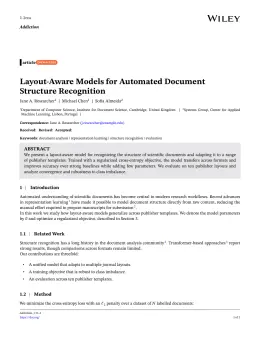
Human Factors and Ergonomics in Manufacturing & Service Industries template — frequently asked questions

How do I write a paper in the Human Factors and Ergonomics in Manufacturing & Service Industries format?
In DocuGuru you write your manuscript in a normal editor — no LaTeX setup required — and select the Human Factors and Ergonomics in Manufacturing & Service Industries template. When you export, DocuGuru compiles the paper into the official Wiley format and hands you a submission-ready PDF along with the editable LaTeX source.
What reference style does Human Factors and Ergonomics in Manufacturing & Service Industries use?
Human Factors and Ergonomics in Manufacturing & Service Industries uses Author–year (Chicago) references, shown as author–year markers such as (Smith, 2023) in the text. DocuGuru formats every in-text citation and the reference list in this exact style automatically. A reference appears like this: Smith, Ada, Ben Jones, and Cara Lee. 2023. "A Representative Article Title." Human Factors and Ergonomics in Manufacturing & Service Industries 12 (3): 45–58.
Do I need to know LaTeX to submit to Human Factors and Ergonomics in Manufacturing & Service Industries?
No. DocuGuru generates the USG LaTeX class and compiles the PDF for you in the background, so you get a Wiley-ready Human Factors and Ergonomics in Manufacturing & Service Industries document without writing any LaTeX. If you do want it, the LaTeX source is included in the export.
Can I import an existing draft into the Human Factors and Ergonomics in Manufacturing & Service Industries template?
Yes. Paste or upload your current manuscript — Word, LaTeX, Markdown, or plain text — and DocuGuru reflows it into the Human Factors and Ergonomics in Manufacturing & Service Industries format with correct headings, figures, tables, and author–year citations.
Who publishes Human Factors and Ergonomics in Manufacturing & Service Industries?
Human Factors and Ergonomics in Manufacturing & Service Industries is a multidisciplinary journal published by Wiley. DocuGuru's Human Factors and Ergonomics in Manufacturing & Service Industries template matches Wiley's official submission format.
Can I export a submission-ready Human Factors and Ergonomics in Manufacturing & Service Industries PDF?
Yes — DocuGuru produces a PDF built with the official Human Factors and Ergonomics in Manufacturing & Service Industries template (the USG class) that is ready to submit to Wiley, together with the matching LaTeX source files.
How much does the Human Factors and Ergonomics in Manufacturing & Service Industries template cost?
You can start writing in the Human Factors and Ergonomics in Manufacturing & Service Industries template for free. Exporting the final submission-ready Human Factors and Ergonomics in Manufacturing & Service Industries PDF and LaTeX source is part of DocuGuru's paid plans — see the app for current pricing.
Use the Human Factors and Ergonomics in Manufacturing & Service Industries template