Wiley

Hepatology Research Template

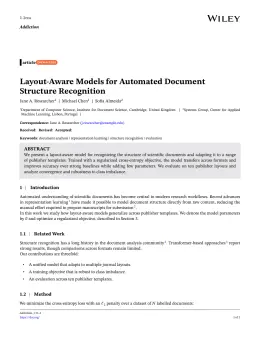
Write in a clean editor, then format for Hepatology Research in one click — DocuGuru applies the official Wiley template with author–year references and exports a submission-ready PDF plus the editable LaTeX source. Free to start.

About the Hepatology Research format

Hepatology Research is a peer-reviewed journal published by Wiley, covering Liver Disease Diagnosis and Treatment, Hepatitis C virus research, Liver Disease and Transplantation.

PublisherWiley
Reference styleAuthor–year (Chicago)
Author–year — (Smith, 2023) in the text
Smith, Ada, Ben Jones, and Cara Lee. 2023. "A Representative Article Title." Hepatology Research 12 (3): 45–58.

Formats any DOI in Hepatology Research style. No sign-up.

Publishes research inLiver Disease Diagnosis and Treatment Hepatitis C virus research Liver Disease and Transplantation Hepatocellular Carcinoma Treatment and Prognosis Hepatitis B Virus Studies
ISSN1386-6346
Citation impact (2-yr)1.97
h-index105
i10-index2,403
Total citations93,770
Article processing charge$3,400
Top institutions publishing hereKurume University
Journal websiteonlinelibrary.wiley.com
You getA submission-ready PDF and the editable LaTeX source — ready to submit.

Papers published in Hepatology Research per year

198
2014
194
2015
230
2016
168
2017
150
2018
178
2019
139
2020
139
2021
141
2022
148
2023
158
2024
218
2025

Citation impact of Hepatology Research by publication year

4.8K
2014
5.1K
2015
6.3K
2016
3.1K
2017
3.2K
2018
4.1K
2019
2.7K
2020
2.3K
2021
1.4K
2022
1.2K
2023
681
2024
261
2025

Citations each year’s papers have accumulated so far — the most recent years are still building up.

Most-cited papers in Hepatology Research

Japan Society of Hepatology guidelines for sarcopenia in liver disease (1st edition): Recommendation from the working group for creation of sarcopenia assessment criteria

Hiroki Nishikawa, Makoto Shiraki, Akira Hiramatsu et al. · 3 Aug 2016

Sarcopenia is defined by muscle loss and muscle dysfunction. Sarcopenia is classified into primary and secondary types, based on the cause. Primary sarcopenia is mainly aging-related sarcopenia, whereas secondary sarcopenia is the reduced muscle mass and strength that accompanies an underlying disease. Given the essential role of the liver in metabolism, secondary sarcopenia due to…

Clinical practice guidelines for hepatocellular carcinoma: The Japan Society of Hepatology 2017 (4th JSH‐HCC guidelines) 2019 update

Norihiro Kokudo, Nobuyuki Takemura, Kiyoshi Hasegawa et al. · 23 Jul 2019

The fourth version of Clinical Practice Guidelines for Hepatocellular Carcinoma was revised by the Japan Society of Hepatology, according to the methodology of evidence-based medicine and partly to the Grading of Recommendations Assessment, Development, and Evaluation system, which was published in October 2017 in Japanese. New or revised recommendations were described, herein, with a special…

Report of the 17th Nationwide Follow‐up Survey of Primary Liver Cancer in Japan†

Iwao Ikai, Shigeki Arii, Masatoshi Okazaki et al. · 4 Jul 2007

In the 17th Nationwide Follow-up Survey of Primary Liver Cancer in Japan, 18 213 individuals were newly registered as patients with primary liver cancer at 645 medical institutions over a period of 2 years (from 1 January 2002 to 31 December 2003). Of these patients, 94.2% had hepatocellular carcinoma (HCC) and 4.1% had intrahepatic cholangiocarcinoma…

Evidence‐based <scp>C</scp>linical <scp>P</scp>ractice <scp>G</scp>uidelines for <scp>H</scp>epatocellular <scp>C</scp>arcinoma: The <scp>J</scp>apan <scp>S</scp>ociety of <scp>H</scp>epatology 2013 update (3rd <scp>JSH‐HCC G</scp>uidelines)

Norihiro Kokudo, Kiyoshi Hasegawa, Masaaki Akahane et al. · 1 Jan 2015

The 3rd version of Clinical Practice Guidelines for Hepatocellular Carcinoma was revised by the Japan Society of Hepatology, according to the methodology of evidence-based medicine, which was published in October 2013 in Japanese. Here, we briefly describe new or changed recommendations with a special reference to the two algorithms for surveillance, diagnosis, and treatment.

Hepatology Research template — frequently asked questions

How do I write a paper in the Hepatology Research format?
In DocuGuru you write your manuscript in a normal editor — no LaTeX setup required — and select the Hepatology Research template. When you export, DocuGuru compiles the paper into the official Wiley format and hands you a submission-ready PDF along with the editable LaTeX source.
What reference style does Hepatology Research use?
Hepatology Research uses Author–year (Chicago) references, shown as author–year markers such as (Smith, 2023) in the text. DocuGuru formats every in-text citation and the reference list in this exact style automatically. A reference appears like this: Smith, Ada, Ben Jones, and Cara Lee. 2023. "A Representative Article Title." Hepatology Research 12 (3): 45–58.
Do I need to know LaTeX to submit to Hepatology Research?
No. DocuGuru generates the USG LaTeX class and compiles the PDF for you in the background, so you get a Wiley-ready Hepatology Research document without writing any LaTeX. If you do want it, the LaTeX source is included in the export.
Can I import an existing draft into the Hepatology Research template?
Yes. Paste or upload your current manuscript — Word, LaTeX, Markdown, or plain text — and DocuGuru reflows it into the Hepatology Research format with correct headings, figures, tables, and author–year citations.
Who publishes Hepatology Research?
Hepatology Research is a multidisciplinary journal published by Wiley. DocuGuru's Hepatology Research template matches Wiley's official submission format.
Can I export a submission-ready Hepatology Research PDF?
Yes — DocuGuru produces a PDF built with the official Hepatology Research template (the USG class) that is ready to submit to Wiley, together with the matching LaTeX source files.
How much does the Hepatology Research template cost?
You can start writing in the Hepatology Research template for free. Exporting the final submission-ready Hepatology Research PDF and LaTeX source is part of DocuGuru's paid plans — see the app for current pricing.

Use the Hepatology Research template