
11,821 citations
Cite
SaveGo to paper →
Wiley
Ecological Monographs Template
Write in a clean editor, then format for Ecological Monographs in one click — DocuGuru applies the official Wiley template with author–year references and exports a submission-ready PDF plus the editable LaTeX source. Free to start.
About the Ecological Monographs format
Ecological Monographs is a peer-reviewed journal published by Wiley, covering Ecology and Vegetation Dynamics Studies, Plant and animal studies, Rangeland and Wildlife Management.
| Publisher | Wiley |
|---|---|
| Reference style | Author–year (Chicago) Author–year — (Smith, 2023) in the text Smith, Ada, Ben Jones, and Cara Lee. 2023. "A Representative Article Title." Ecological Monographs 12 (3): 45–58.
Formats any DOI in Ecological Monographs style. No sign-up. |
| Publishes research in | Ecology and Vegetation Dynamics Studies Plant and animal studies Rangeland and Wildlife Management Species Distribution and Climate Change Botany, Ecology, and Taxonomy Studies |
| ISSN | 0012-9615 |
| Citation impact (2-yr) | 5.5 |
| h-index | 304 |
| i10-index | 2,012 |
| Total citations | 411,345 |
| Article processing charge | $3,600 |
| Top institutions publishing here | Centre National de la Recherche Scientifique |
| Journal website | esajournals.onlinelibrary.wiley.com |
| You get | A submission-ready PDF and the editable LaTeX source — ready to submit. |
Papers published in Ecological Monographs per year
Citation impact of Ecological Monographs by publication year
Citations each year’s papers have accumulated so far — the most recent years are still building up.
Most-cited papers in Ecological Monographs
Pseudoreplication is defined as the use of inferential statistics to test for treatment effects with data from experiments where either treatments are not replicated (though samples may be) or replicates are not statistically independent. In ANOVA terminology, it is the testing for treatment effects with an error term inappropriate to the hypothesis being considered. Scrutiny…
8,329 citations
Cite
SaveGo to paper →
Humans are altering the composition of biological communities through a variety of activities that increase rates of species invasions and species extinctions, at all scales, from local to global. These changes in components of the Earth's biodiversity cause concern for ethical and aesthetic reasons, but they also have a strong potential to alter ecosystem properties…
7,962 citations
Cite
SaveGo to paper →
This paper presents a new and simple method to find indicator species and species assemblages characterizing groups of sites. The novelty of our approach lies in the way we combine a species relative abundance with its relative frequency of occurrence in the various groups of sites. This index is maximum when all individuals of a…
7,407 citations
Cite
SaveGo to paper →
The global decline in estuarine and coastal ecosystems (ECEs) is affecting a number of critical benefits, or ecosystem services. We review the main ecological services across a variety of ECEs, including marshes, mangroves, nearshore coral reefs, seagrass beds, and sand beaches and dunes. Where possible, we indicate estimates of the key economic values arising from…
5,547 citations
Cite
SaveGo to paper →
Related journal templates
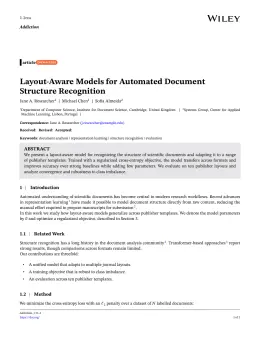
Ecological Monographs template — frequently asked questions
How do I write a paper in the Ecological Monographs format?
In DocuGuru you write your manuscript in a normal editor — no LaTeX setup required — and select the Ecological Monographs template. When you export, DocuGuru compiles the paper into the official Wiley format and hands you a submission-ready PDF along with the editable LaTeX source.
What reference style does Ecological Monographs use?
Ecological Monographs uses Author–year (Chicago) references, shown as author–year markers such as (Smith, 2023) in the text. DocuGuru formats every in-text citation and the reference list in this exact style automatically. A reference appears like this: Smith, Ada, Ben Jones, and Cara Lee. 2023. "A Representative Article Title." Ecological Monographs 12 (3): 45–58.
Do I need to know LaTeX to submit to Ecological Monographs?
No. DocuGuru generates the USG LaTeX class and compiles the PDF for you in the background, so you get a Wiley-ready Ecological Monographs document without writing any LaTeX. If you do want it, the LaTeX source is included in the export.
Can I import an existing draft into the Ecological Monographs template?
Yes. Paste or upload your current manuscript — Word, LaTeX, Markdown, or plain text — and DocuGuru reflows it into the Ecological Monographs format with correct headings, figures, tables, and author–year citations.
Who publishes Ecological Monographs?
Ecological Monographs is a multidisciplinary journal published by Wiley. DocuGuru's Ecological Monographs template matches Wiley's official submission format.
Can I export a submission-ready Ecological Monographs PDF?
Yes — DocuGuru produces a PDF built with the official Ecological Monographs template (the USG class) that is ready to submit to Wiley, together with the matching LaTeX source files.
How much does the Ecological Monographs template cost?
You can start writing in the Ecological Monographs template for free. Exporting the final submission-ready Ecological Monographs PDF and LaTeX source is part of DocuGuru's paid plans — see the app for current pricing.