Wiley

Ecohydrology Template

Write in a clean editor, then format for Ecohydrology in one click — DocuGuru applies the official Wiley template with author–year references and exports a submission-ready PDF plus the editable LaTeX source. Free to start.

About the Ecohydrology format

Ecohydrology is a peer-reviewed journal published by Wiley, covering Plant Water Relations and Carbon Dynamics, Hydrology and Watershed Management Studies, Hydrology and Sediment Transport Processes.

PublisherWiley
Reference styleAuthor–year (Chicago)
Author–year — (Smith, 2023) in the text
Smith, Ada, Ben Jones, and Cara Lee. 2023. "A Representative Article Title." Ecohydrology 12 (3): 45–58.

Formats any DOI in Ecohydrology style. No sign-up.

Publishes research inPlant Water Relations and Carbon Dynamics Hydrology and Watershed Management Studies Hydrology and Sediment Transport Processes Fish Ecology and Management Studies Soil erosion and sediment transport
ISSN1936-0584
Citation impact (2-yr)2.02
h-index92
i10-index1,167
Total citations50,548
Article processing charge$4,220
Top institutions publishing hereChinese Academy of Sciences
Journal websiteonlinelibrary.wiley.com
You getA submission-ready PDF and the editable LaTeX source — ready to submit.

Papers published in Ecohydrology per year

132
2014
134
2015
110
2016
114
2017
132
2018
136
2019
93
2020
135
2021
125
2022
102
2023
149
2024
187
2025

Citation impact of Ecohydrology by publication year

5.3K
2014
4K
2015
3.1K
2016
3.2K
2017
2.9K
2018
2.6K
2019
1.4K
2020
1.8K
2021
1.1K
2022
546
2023
568
2024
241
2025

Citations each year’s papers have accumulated so far — the most recent years are still building up.

Most-cited papers in Ecohydrology

Hydrological feedbacks in northern peatlands

J. M. Waddington, Paul J. Morris, Nicholas Kettridge et al. · 2 Apr 2014

Abstract Northern peatlands provide important global and regional ecosystem services (carbon storage, water storage, and biodiversity). However, these ecosystems face increases in the severity, areal extent and frequency of climate‐mediated (e.g. wildfire and drought) and land‐use change (e.g. drainage, flooding and mining) disturbances that are placing the future security of these critical ecosystem services in…

A synthetic review of feedbacks and drivers of shrub encroachment in arid grasslands

Paolo D’Odorico, Gregory S. Okin, Brandon T. Bestelmeyer · 20 Oct 2011

ABSTRACT Many arid grasslands around the world are affected by woody plant encroachment and by the replacement of a relatively continuous grass cover with shrub patches bordered by bare soil. This shift in plant community composition is often abrupt in space and time, suggesting that it is likely sustained by positive feedbacks between vegetation and…

Inter‐disciplinary perspectives on processes in the hyporheic zone

Stefan Krause, David M. Hannah, Jan H. Fleckenstein et al. · 26 Nov 2010

Abstract The interface between groundwater and surface water within riverine/riparian ecosystems—the hyporheic zone (HZ)—is experiencing a rapid growth of research interest from a range of scientific disciplines, often with different perspectives. The majority of the multi‐disciplinary research aims to elucidate HZ process dynamics and their importance for surface water and groundwater ecohydrology and biogeochemical cycling.…

A review of groundwater–surface water interactions in arid/semi‐arid wetlands and the consequences of salinity for wetland ecology

Ian Jolly, Kerryn L. McEwan, Kate L. Holland · 1 Jan 2008

Abstract In arid/semi‐arid environments, where rainfall is seasonal, highly variable and significantly less than the evaporation rate, groundwater discharge can be a major component of the water and salt balance of a wetland, and hence a major determinant of wetland ecology. Under natural conditions, wetlands in arid/semi‐arid zones occasionally experience periods of higher salinity as…

A conceptual framework for understanding semi‐arid land degradation: ecohydrological interactions across multiple‐space and time scales

Laura Turnbull, John Wainwright, Richard E. Brazier · 1 Jan 2008

Abstract Land degradation is a problem prolific across semi‐arid areas worldwide. Despite being a complex process including both biotic and abiotic elements, previous attempts to understand ecosystem dynamics have largely been carried out within the disparate disciplines of ecology and hydrology, which has led to significant limitations. Here, an ecohydrological framework is outlined, to provide…

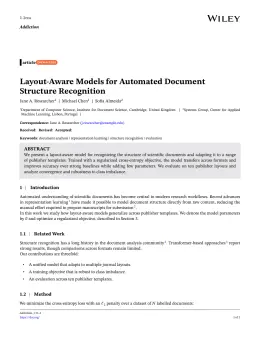
Ecohydrology template — frequently asked questions

How do I write a paper in the Ecohydrology format?
In DocuGuru you write your manuscript in a normal editor — no LaTeX setup required — and select the Ecohydrology template. When you export, DocuGuru compiles the paper into the official Wiley format and hands you a submission-ready PDF along with the editable LaTeX source.
What reference style does Ecohydrology use?
Ecohydrology uses Author–year (Chicago) references, shown as author–year markers such as (Smith, 2023) in the text. DocuGuru formats every in-text citation and the reference list in this exact style automatically. A reference appears like this: Smith, Ada, Ben Jones, and Cara Lee. 2023. "A Representative Article Title." Ecohydrology 12 (3): 45–58.
Do I need to know LaTeX to submit to Ecohydrology?
No. DocuGuru generates the USG LaTeX class and compiles the PDF for you in the background, so you get a Wiley-ready Ecohydrology document without writing any LaTeX. If you do want it, the LaTeX source is included in the export.
Can I import an existing draft into the Ecohydrology template?
Yes. Paste or upload your current manuscript — Word, LaTeX, Markdown, or plain text — and DocuGuru reflows it into the Ecohydrology format with correct headings, figures, tables, and author–year citations.
Who publishes Ecohydrology?
Ecohydrology is a multidisciplinary journal published by Wiley. DocuGuru's Ecohydrology template matches Wiley's official submission format.
Can I export a submission-ready Ecohydrology PDF?
Yes — DocuGuru produces a PDF built with the official Ecohydrology template (the USG class) that is ready to submit to Wiley, together with the matching LaTeX source files.
How much does the Ecohydrology template cost?
You can start writing in the Ecohydrology template for free. Exporting the final submission-ready Ecohydrology PDF and LaTeX source is part of DocuGuru's paid plans — see the app for current pricing.
Use the Ecohydrology template