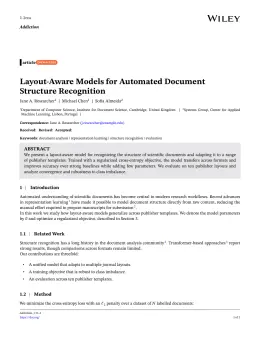
About the Clinical Pharmacology & Therapeutics format
Clinical Pharmacology & Therapeutics is a peer-reviewed journal published by Wiley, covering Pharmacogenetics and Drug Metabolism, Pharmaceutical studies and practices, Cancer Treatment and Pharmacology.
| Publisher | Wiley |
|---|
| Reference style | Author–year (Chicago) Author–year — (Smith, 2023) in the text
Smith, Ada, Ben Jones, and Cara Lee. 2023. "A Representative Article Title." Clinical Pharmacology & Therapeutics 12 (3): 45–58.
Formats any DOI in Clinical Pharmacology & Therapeutics style. No sign-up.
|
|---|
| Publishes research in | Pharmacogenetics and Drug Metabolism Pharmaceutical studies and practices Cancer Treatment and Pharmacology Pharmacological Effects and Toxicity Studies Drug Transport and Resistance Mechanisms |
|---|
| ISSN | 0009-9236 |
|---|
| Citation impact (2-yr) | 3.57 |
|---|
| h-index | 271 |
|---|
| i10-index | 9,322 |
|---|
| Total citations | 658,180 |
|---|
| Article processing charge | $4,000 |
|---|
| Top institutions publishing here | United States Food and Drug Administration |
|---|
| Journal website | onlinelibrary.wiley.com |
|---|
| You get | A submission-ready PDF and the editable LaTeX source — ready to submit. |
|---|
Papers published in Clinical Pharmacology & Therapeutics per year
Citation impact of Clinical Pharmacology & Therapeutics by publication year
Citations each year’s papers have accumulated so far — the most recent years are still building up.
Most-cited papers in Clinical Pharmacology & Therapeutics
A method for estimating the probability of adverse drug reactions
C. A. Naranjo, U. Busto, Edward M. Sellers et al. · 1 Aug 1981
The estimation of the probability that a drug caused an adverse clinical event is usually based on clinical judgment. Lack of a method for establishing causality generates large between-raters and within-raters variability in assessment. Using the conventional categories and definitions of definite, probable, possible, and doubtful adverse drug reactions (ADRs), the between-raters agreement of two…
Biomarkers and surrogate endpoints: Preferred definitions and conceptual framework
1 Mar 2001
Nanoparticles in Medicine: Therapeutic Applications and Developments
Luxian Zhang, Frank Gu, Juliana M. Chan et al. · 24 Oct 2007
Nanotechnology is the understanding and control of matter generally in the 1-100 nm dimension range. The application of nanotechnology to medicine, known as nanomedicine, concerns the use of precisely engineered materials at this length scale to develop novel therapeutic and diagnostic modalities. Nanomaterials have unique physicochemical properties, such as ultra small size, large surface area…
A physiological approach to hepatic drug clearance
G. Wilkinson, David G. Shand · 1 Oct 1975
A physiological approach has been developed recognizing that hepatic blood flow, the activity of the overall elimination process (intrinsic clearance), drug binding in the blood, and the anatomical arrangement of the hepatic circulation are the major biological determinants of hepatic drug clearance. This approach permits quantitative prediction of both the unbound and total drug concentration/time…
Pharmacogenomics Knowledge for Personalized Medicine
Michelle Whirl‐Carrillo, Ellen M. McDonagh, Joan M. Hebert et al. · 19 Sep 2012
The Pharmacogenomics Knowledgebase (PharmGKB) is a resource that collects, curates, and disseminates information about the impact of human genetic variation on drug responses. It provides clinically relevant information, including dosing guidelines, annotated drug labels, and potentially actionable gene-drug associations and genotype-phenotype relationships. Curators assign levels of evidence to variant-drug associations using well-defined criteria based on…