
1,121 citations
Cite
SaveGo to paper →
Wiley
Bioethics Template
Write in a clean editor, then format for Bioethics in one click — DocuGuru applies the official Wiley template with author–year references and exports a submission-ready PDF plus the editable LaTeX source. Free to start.
About the Bioethics format
Bioethics is a peer-reviewed journal published by Wiley, covering Ethics in medical practice, Ethics and Legal Issues in Pediatric Healthcare, Neuroethics, Human Enhancement, Biomedical Innovations.
| Publisher | Wiley |
|---|---|
| Reference style | Author–year (Chicago) Author–year — (Smith, 2023) in the text Smith, Ada, Ben Jones, and Cara Lee. 2023. "A Representative Article Title." Bioethics 12 (3): 45–58.
Formats any DOI in Bioethics style. No sign-up. |
| Publishes research in | Ethics in medical practice Ethics and Legal Issues in Pediatric Healthcare Neuroethics, Human Enhancement, Biomedical Innovations Reproductive Health and Technologies Ethics in Clinical Research |
| ISSN | 0269-9702 |
| Citation impact (2-yr) | 1.35 |
| h-index | 93 |
| i10-index | 1,196 |
| Total citations | 54,011 |
| Article processing charge | $4,120 |
| Top institutions publishing here | University of Oxford |
| Journal website | onlinelibrary.wiley.com |
| You get | A submission-ready PDF and the editable LaTeX source — ready to submit. |
Papers published in Bioethics per year
Citation impact of Bioethics by publication year
Citations each year’s papers have accumulated so far — the most recent years are still building up.
Most-cited papers in Bioethics
Eugenic selection of embryos is now possible by employing in vitro fertilization (IVF) and preimplantation genetic diagnosis (PGD). While PGD is currently being employed for the purposes of detecting chromosomal abnormalities or inherited genetic abnormalities, it could in principle be used to test any genetic trait such as hair colour or eye colour. Genetic research…
863 citations
Cite
SaveGo to paper →
Positions on the ethics of human enhancement technologies can be (crudely) characterized as ranging from transhumanism to bioconservatism. Transhumanists believe that human enhancement technologies should be made widely available, that individuals should have broad discretion over which of these technologies to apply to themselves, and that parents should normally have the right to choose enhancements…
647 citations
Cite
SaveGo to paper →
According to what we call the Principle of Procreative Beneficence (PB),couples who decide to have a child have a significant moral reason to select the child who, given his or her genetic endowment, can be expected to enjoy the most well-being. In the first part of this paper, we introduce PB,explain its content, grounds, and…
601 citations
Cite
SaveGo to paper →
Despite broad agreement that the vulnerable have a claim to special protection, defining vulnerable persons or populations has proved more difficult than we would like. This is a theoretical as well as a practical problem, as it hinders both convincing justifications for this claim and the practical application of required protections. In this paper, I…
414 citations
Cite
SaveGo to paper →
Related journal templates
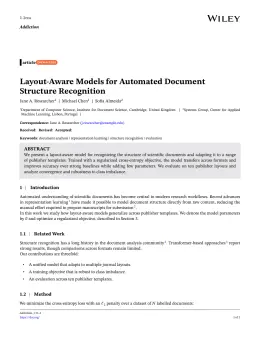
Bioethics template — frequently asked questions
How do I write a paper in the Bioethics format?
In DocuGuru you write your manuscript in a normal editor — no LaTeX setup required — and select the Bioethics template. When you export, DocuGuru compiles the paper into the official Wiley format and hands you a submission-ready PDF along with the editable LaTeX source.
What reference style does Bioethics use?
Bioethics uses Author–year (Chicago) references, shown as author–year markers such as (Smith, 2023) in the text. DocuGuru formats every in-text citation and the reference list in this exact style automatically. A reference appears like this: Smith, Ada, Ben Jones, and Cara Lee. 2023. "A Representative Article Title." Bioethics 12 (3): 45–58.
Do I need to know LaTeX to submit to Bioethics?
No. DocuGuru generates the USG LaTeX class and compiles the PDF for you in the background, so you get a Wiley-ready Bioethics document without writing any LaTeX. If you do want it, the LaTeX source is included in the export.
Can I import an existing draft into the Bioethics template?
Yes. Paste or upload your current manuscript — Word, LaTeX, Markdown, or plain text — and DocuGuru reflows it into the Bioethics format with correct headings, figures, tables, and author–year citations.
Who publishes Bioethics?
Bioethics is a multidisciplinary journal published by Wiley. DocuGuru's Bioethics template matches Wiley's official submission format.
Can I export a submission-ready Bioethics PDF?
Yes — DocuGuru produces a PDF built with the official Bioethics template (the USG class) that is ready to submit to Wiley, together with the matching LaTeX source files.
How much does the Bioethics template cost?
You can start writing in the Bioethics template for free. Exporting the final submission-ready Bioethics PDF and LaTeX source is part of DocuGuru's paid plans — see the app for current pricing.