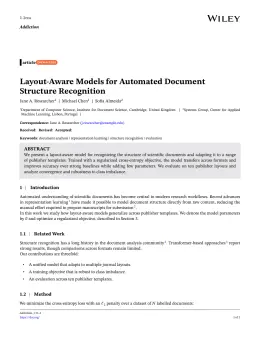
About the American Journal on Addictions format
American Journal on Addictions is a peer-reviewed journal published by Wiley, covering Substance Abuse Treatment and Outcomes, Opioid Use Disorder Treatment, Attention Deficit Hyperactivity Disorder.
| Publisher | Wiley |
|---|
| Reference style | Author–year (Chicago) Author–year — (Smith, 2023) in the text
Smith, Ada, Ben Jones, and Cara Lee. 2023. "A Representative Article Title." American Journal on Addictions 12 (3): 45–58.
Formats any DOI in American Journal on Addictions style. No sign-up.
|
|---|
| Publishes research in | Substance Abuse Treatment and Outcomes Opioid Use Disorder Treatment Attention Deficit Hyperactivity Disorder Neurotransmitter Receptor Influence on Behavior Cannabis and Cannabinoid Research |
|---|
| ISSN | 1055-0496 |
|---|
| Citation impact (2-yr) | 0.83 |
|---|
| h-index | 109 |
|---|
| i10-index | 1,520 |
|---|
| Total citations | 73,631 |
|---|
| Article processing charge | $3,550 |
|---|
| Top institutions publishing here | Yale University |
|---|
| Journal website | onlinelibrary.wiley.com |
|---|
| You get | A submission-ready PDF and the editable LaTeX source — ready to submit. |
|---|
Papers published in American Journal on Addictions per year
Citation impact of American Journal on Addictions by publication year
Citations each year’s papers have accumulated so far — the most recent years are still building up.
Most-cited papers in American Journal on Addictions
Dialectical Behavior Therapy for Patients with Borderline Personality Disorder and Drug‐Dependence
Marsha M. Linehan, Henry C. Schmidt, Linda A. Dimeff et al. · 1 Oct 1999
A randomized clinical trial was conducted to evaluate whether Dialectical Behavior Therapy (DBT), an effective cognitive-behavioral treatment for suicidal individuals with borderline personality disorder (BPD), would also be effective for drug-dependent women with BPD when compared with treatment-as-usual (TAU) in the community. Subjects were randomly assigned to either DBT or TAU for a year of…
Co‐Morbidity of Smoking in Patients with Psychiatric and Substance Use Disorders
David Kalman, Sandra B. Morissette, Tony P. George · 4 Mar 2005
This article reviews cigarette smoking in patients with psychiatric disorders (PD) and substance use disorders (SUD). Rates of smoking are approximately 23% in the U.S. population but approximately two- to four-fold higher in patients with PD and SUD. Many remaining smokers have had repeated smoking cessation failures, possibly due to the presence of co-morbid PD…
Readiness and Stages of Change in Addiction Treatment
Carlo C. DiClemente, Debra Schlundt, Leigh Gemmell · 4 Mar 2004
Understanding the role of personal motivation in addiction treatment changed with the advent of the Transtheoretical Model of intentional behavior change, a better understanding of relapse, and a shift in focus from denial to readiness. Motivation is a complex concept that covers many diverse aspects of the process of intentional behavior change. This review examines…
Development and Validation of the GAIN Short Screener (GSS) for Internalizing, Externalizing and Substance Use Disorders and Crime/Violence Problems Among Adolescents and Adults
Michael L. Dennis, Ya‐Fen Chan, Rodney R. Funk · 12 Nov 2006
The Global Appraisal of Individual Needs (GAIN)1 is a 1-2 hour standardized biopsychosocial that integrates clinical and research assessment for people presenting to substance abuse treatment. The GAIN - Short Screener (GSS) is 3-5 minute screener to quickly identify those who would have a disorder based on the full 60-120 minute GAIN and triage the…
Brief Report: Increased Addictive Internet and Substance Use Behavior During the COVID‐19 Pandemic in China
Yan Sun, Yangyang Li, Yanping Bao et al. · 4 Jun 2020
BACKGROUND AND OBJECTIVES: The COVID-19 pandemic and control measures may have increased the risk of abusing addictive substances as well as addictive behaviors. METHODS: We present an initial online survey in 6416 Chinese about the relation between the COVID-19 pandemic and addictive behavior in China. RESULTS: During the COVID-19 pandemic, 46.8% of the subjects reported…