
1,038 citations
Cite
SaveGo to paper →
Wiley
Acta hydrochimica et hydrobiologica Template
Write in a clean editor, then format for Acta hydrochimica et hydrobiologica in one click — DocuGuru applies the official Wiley template with author–year references and exports a submission-ready PDF plus the editable LaTeX source. Free to start.
About the Acta hydrochimica et hydrobiologica format
Acta hydrochimica et hydrobiologica is a peer-reviewed journal published by Wiley, covering Wastewater Treatment and Nitrogen Removal, Diatoms and Algae Research, Environmental Science and Water Management.
| Publisher | Wiley |
|---|---|
| Reference style | Author–year (Chicago) Author–year — (Smith, 2023) in the text Smith, Ada, Ben Jones, and Cara Lee. 2023. "A Representative Article Title." Acta hydrochimica et hydrobiologica 12 (3): 45–58.
Formats any DOI in Acta hydrochimica et hydrobiologica style. No sign-up. |
| Publishes research in | Wastewater Treatment and Nitrogen Removal Diatoms and Algae Research Environmental Science and Water Management Aquatic Ecosystems and Phytoplankton Dynamics Analytical chemistry methods development |
| ISSN | 0323-4320 |
| h-index | 55 |
| i10-index | 431 |
| Total citations | 19,829 |
| Top institutions publishing here | Technische Universität Dresden |
| Journal website | www3.interscience.wiley.com |
| You get | A submission-ready PDF and the editable LaTeX source — ready to submit. |
Papers published in Acta hydrochimica et hydrobiologica per year
Citation impact of Acta hydrochimica et hydrobiologica by publication year
Citations each year’s papers have accumulated so far — the most recent years are still building up.
Most-cited papers in Acta hydrochimica et hydrobiologica
Abstract In natural waters arsenic concentrations up to a few milligrams per litre were measured. The natural content of arsenic found in soils varies between 0.01 mg/kg and a few hundred milligrams per kilogram. Anthropogenic sources of arsenic in the environment are the smelting of ores, the burning of coal, and the use of arsenic…
896 citations
Cite
SaveGo to paper →
Abstract In natural waters arsenic normally occurs in the oxidation states +III (arsenite) and +V (arsenate). The removal of As(III) is more difficult than the removal of As(V). Therefore, As(III) has to be oxidized to As(V) prior to its removal. The oxidation in the presence of air or pure oxygen is slow. The oxidation rate…
575 citations
Cite
SaveGo to paper →
Abstract In the last years more and more often detections of antimicrobially active compounds (“antibiotics”) in surface waters have been reported. As a possible input pathway in most cases municipal sewage has been discussed. But as an input from the realm of agriculture is conceivable as well, in this study it should be investigated if…
528 citations
Cite
SaveGo to paper →
The potential for humic substances to serve as a terminal electron acceptor in microbial respiration and to function as an electron shuttle between Fe(III)-reducing microorganisms and insoluble Fe(III) oxides was investigated. The Fe(III)-reducing microorganism Geobacter metallireducens conserved energy to support growth from electron transport to humics as evidenced by continued oxidation of acetate to carbon…
498 citations
Cite
SaveGo to paper →
Related journal templates
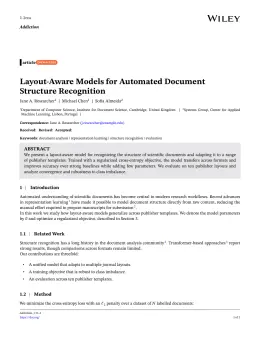
Acta hydrochimica et hydrobiologica template — frequently asked questions
How do I write a paper in the Acta hydrochimica et hydrobiologica format?
In DocuGuru you write your manuscript in a normal editor — no LaTeX setup required — and select the Acta hydrochimica et hydrobiologica template. When you export, DocuGuru compiles the paper into the official Wiley format and hands you a submission-ready PDF along with the editable LaTeX source.
What reference style does Acta hydrochimica et hydrobiologica use?
Acta hydrochimica et hydrobiologica uses Author–year (Chicago) references, shown as author–year markers such as (Smith, 2023) in the text. DocuGuru formats every in-text citation and the reference list in this exact style automatically. A reference appears like this: Smith, Ada, Ben Jones, and Cara Lee. 2023. "A Representative Article Title." Acta hydrochimica et hydrobiologica 12 (3): 45–58.
Do I need to know LaTeX to submit to Acta hydrochimica et hydrobiologica?
No. DocuGuru generates the USG LaTeX class and compiles the PDF for you in the background, so you get a Wiley-ready Acta hydrochimica et hydrobiologica document without writing any LaTeX. If you do want it, the LaTeX source is included in the export.
Can I import an existing draft into the Acta hydrochimica et hydrobiologica template?
Yes. Paste or upload your current manuscript — Word, LaTeX, Markdown, or plain text — and DocuGuru reflows it into the Acta hydrochimica et hydrobiologica format with correct headings, figures, tables, and author–year citations.
Who publishes Acta hydrochimica et hydrobiologica?
Acta hydrochimica et hydrobiologica is a multidisciplinary journal published by Wiley. DocuGuru's Acta hydrochimica et hydrobiologica template matches Wiley's official submission format.
Can I export a submission-ready Acta hydrochimica et hydrobiologica PDF?
Yes — DocuGuru produces a PDF built with the official Acta hydrochimica et hydrobiologica template (the USG class) that is ready to submit to Wiley, together with the matching LaTeX source files.
How much does the Acta hydrochimica et hydrobiologica template cost?
You can start writing in the Acta hydrochimica et hydrobiologica template for free. Exporting the final submission-ready Acta hydrochimica et hydrobiologica PDF and LaTeX source is part of DocuGuru's paid plans — see the app for current pricing.