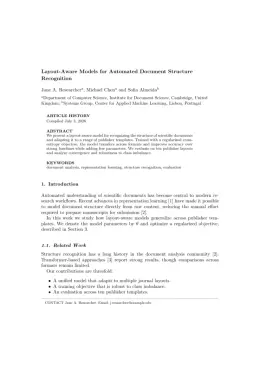
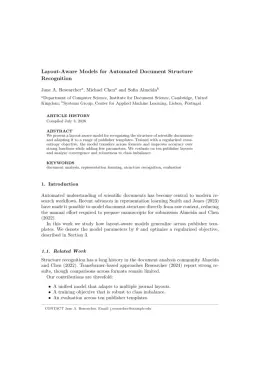
Taylor & Francis

Spectroscopy Letters Template

Write in a clean editor, then format for Spectroscopy Letters in one click — DocuGuru applies the official Taylor & Francis template with author–year references and exports a submission-ready PDF plus the editable LaTeX source. Free to start.

About the Spectroscopy Letters format

Spectroscopy Letters is a peer-reviewed journal published by Taylor & Francis, covering Solid-state spectroscopy and crystallography, Analytical Chemistry and Chromatography, Molecular spectroscopy and chirality.

PublisherTaylor & Francis
Reference styleAuthor–year (Chicago, T&F)
Author–year — (Smith, 2023) in the text
Smith, Ada, Ben Jones, and Cara Lee. 2023. "A Representative Article Title." Spectroscopy Letters 12 (3): 45–58.

Formats any DOI in Spectroscopy Letters style. No sign-up.

Publishes research inSolid-state spectroscopy and crystallography Analytical Chemistry and Chromatography Molecular spectroscopy and chirality Photochemistry and Electron Transfer Studies Analytical chemistry methods development
ISSN0038-7010
Citation impact (2-yr)1.18
h-index51
i10-index1,123
Total citations35,987
Top institutions publishing hereLouisiana State University
Journal websitewww.tandfonline.com
You getA submission-ready PDF and the editable LaTeX source — ready to submit.

Papers published in Spectroscopy Letters per year

71
2014
82
2015
68
2016
90
2017
77
2018
85
2019
71
2020
65
2021
55
2022
48
2023
70
2024
131
2025

Citation impact of Spectroscopy Letters by publication year

585
2014
1K
2015
626
2016
1K
2017
702
2018
866
2019
793
2020
447
2021
331
2022
159
2023
225
2024
129
2025

Citations each year’s papers have accumulated so far — the most recent years are still building up.

Most-cited papers in Spectroscopy Letters

A FT-IR Study of the Hydrolysis of Tetraethylorthosilicate (TEOS).

F. Rubio, J. Rubio, J. L. Oteo · 1 Jan 1998

The hydrolysis and polymerization of a non-catalyzed silica sol was investigated by Fourier Transform Infrared Spectroscopy (FT-IR) and deconvolution of the infrared spectra. The hydrolysis was followed by the 1168 and 812 cm−1 bands which have been observed that decrease continously with the reaction time, and they dissapear showing the complete hydrolysis. The bands located…

Europium and Terbium<i>tris</i>(Dipicolinates) as Secondary Standards for Quantum Yield Determination

Anne‐Sophie Chauvin, F. Gumy, Daniel Imbert et al. · 17 Sep 2004

Abstract Aqueous solutions of europium(III) and terbium(III) tris(dipicolinates), around physiological pH are shown to be convenient secondary standards in the determination of quantum yields of lanthanide complexes containing these ions. Conditions for which a strict linearity is observed between the concentration of the solutions and the emission intensity are established. The speciation in these solutions,…

The Infrared and Raman Spectra of β-and α-Tricalcium Phosphate (Ca<sub>3</sub>(Po<sub>4</sub>)<sub>2</sub>)

A. Jillavenkatesa, R. A. Condrate · 1 Dec 1998

Abstract Factor group analysis was applied to interpret the vibrational spectra of β-and α-tricalcium phosphate (Ca3(PO4)2). The analysis predicts the number of bands formed due to the splitting of the fundamental vibrational modes of the PO4 3-ion. The number of the infrared and Raman bands predicted by this analysis for the two phases are drastically…

Prediction of Cassava Starch Edible Film Properties by Chemometric Analysis of Infrared Spectra

Nívea Maria Vicentini, Nathalie Dupuy, M. Leitzelman et al. · 1 Nov 2005

Abstract Cassava starch has been shown to make transparent and colorless flexible films without any previous chemical treatment. The functional properties of edible films are influenced by starch properties, including chain conformation, molecular bonding, crystallinity, and water content. Fourier‐transform infrared (FTIR) spectroscopy in combination with attenuated total reflectance (ATR) has been applied for the elucidation…

Raman Spectra of Vateritic Calcium Carbonate

Gesa Behrens, Liisa T. Kuhn, Rick Ubic et al. · 1 Sep 1995

Abstract The Raman spectrum of polycrystalline vaterite is presented and compared to spectra of calcite and aragonite, the other two common CaCO3 polymorphs; Raman spectroscopy easily distinguishes between these three polymorphs. An important feature of the Raman spectrum of vaterite is splitting of both the ν1 and ν4 peaks. The splitting of the ν1 peak…

Spectroscopy Letters template — frequently asked questions

How do I write a paper in the Spectroscopy Letters format?
In DocuGuru you write your manuscript in a normal editor — no LaTeX setup required — and select the Spectroscopy Letters template. When you export, DocuGuru compiles the paper into the official Taylor & Francis format and hands you a submission-ready PDF along with the editable LaTeX source.
What reference style does Spectroscopy Letters use?
Spectroscopy Letters uses Author–year (Chicago, T&F) references, shown as author–year markers such as (Smith, 2023) in the text. DocuGuru formats every in-text citation and the reference list in this exact style automatically. A reference appears like this: Smith, Ada, Ben Jones, and Cara Lee. 2023. "A Representative Article Title." Spectroscopy Letters 12 (3): 45–58.
Do I need to know LaTeX to submit to Spectroscopy Letters?
No. DocuGuru generates the interact LaTeX class and compiles the PDF for you in the background, so you get a Taylor & Francis-ready Spectroscopy Letters document without writing any LaTeX. If you do want it, the LaTeX source is included in the export.
Can I import an existing draft into the Spectroscopy Letters template?
Yes. Paste or upload your current manuscript — Word, LaTeX, Markdown, or plain text — and DocuGuru reflows it into the Spectroscopy Letters format with correct headings, figures, tables, and author–year citations.
Who publishes Spectroscopy Letters?
Spectroscopy Letters is a multidisciplinary journal published by Taylor & Francis. DocuGuru's Spectroscopy Letters template matches Taylor & Francis's official submission format.
Can I export a submission-ready Spectroscopy Letters PDF?
Yes — DocuGuru produces a PDF built with the official Spectroscopy Letters template (the interact class) that is ready to submit to Taylor & Francis, together with the matching LaTeX source files.
How much does the Spectroscopy Letters template cost?
You can start writing in the Spectroscopy Letters template for free. Exporting the final submission-ready Spectroscopy Letters PDF and LaTeX source is part of DocuGuru's paid plans — see the app for current pricing.

Use the Spectroscopy Letters template