Taylor & Francis

Separation Science Template

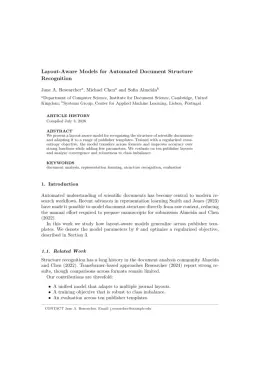
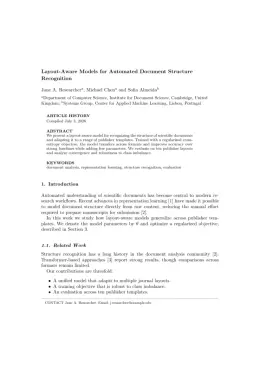
Write in a clean editor, then format for Separation Science in one click — DocuGuru applies the official Taylor & Francis template with author–year references and exports a submission-ready PDF plus the editable LaTeX source. Free to start.

About the Separation Science format

Separation Science is a peer-reviewed journal published by Taylor & Francis, covering Analytical Chemistry and Chromatography, Extraction and Separation Processes, Radioactive element chemistry and processing.

PublisherTaylor & Francis
Reference styleAuthor–year (Chicago, T&F)
Author–year — (Smith, 2023) in the text
Smith, Ada, Ben Jones, and Cara Lee. 2023. "A Representative Article Title." Separation Science 12 (3): 45–58.

Formats any DOI in Separation Science style. No sign-up.

Publishes research inAnalytical Chemistry and Chromatography Extraction and Separation Processes Radioactive element chemistry and processing Minerals Flotation and Separation Techniques Analytical chemistry methods development
ISSN0037-2366
h-index40
i10-index205
Total citations7,775
Top institutions publishing herePurdue University West Lafayette
Journal websitewww.tandfonline.com
You getA submission-ready PDF and the editable LaTeX source — ready to submit.

Papers published in Separation Science per year

59
1967
42
1968
47
1969
70
1970
77
1971
71
1972
60
1973
54
1974
61
1975
51
1976
48
1977
1
2012

Citation impact of Separation Science by publication year

963
1967
360
1968
605
1969
835
1970
646
1971
597
1972
408
1973
610
1974
548
1975
452
1976
393
1977
0
2012

Citations each year’s papers have accumulated so far — the most recent years are still building up.

Most-cited papers in Separation Science

A New Separation Concept Based on a Coupling of Concentration and Flow Nonuniformities

J. Calvin Giddings · 1 Jan 1966

Abstract Described here is a new separation concept which theory shows to have considerable potential for analytical-scale work. Like chromatography, separation is achieved by differential migration in a narrow tube through which fluid is flowing unidirectionally. Unlike chromatography, separation is brought about in a one phase (or at least a continuous phase) system. It should…

Generation of Variance, “Theoretical Plates,” Resolution, and Peak Capacity in Electrophoresis and Sedimentation

J. Calvin Giddings · 1 Jun 1969

Abstract The rate of generation of variance, dσ2/dX, is a fundamental parameter which determines peak or boundary width and, thus, resolution in many differential migration systems. This parameter can be identified with the “plate height” of chromatography. By extending this nomenclature and the underlying concepts to electrophoresis and sedimentation, we arrive at parameters, particularly the…

Molecular-Sieve Chromatography of Proteins on Granulated Polyacrylamide Gels

J. Fawcett, C. J. O. R. Morris · 1 Jan 1966

Abstract A method for molecular-sieve chromatography of proteins on columns of granulated polyacrylamide gels is described in detail. Distribution coefficients (K D and K av) are given for the model proteins γ globulin, bovine serum albumin, ovalbumin, ovomucoid, pepsin, myoglobin, and cytochrome c, as well as certain other proteins, between 0.5 M NaCl and polyacrylamide…

Quantitative Analysis of the Twenty Natural Protein Amino Acids by Gas-Liquid Chromatography

Charles W. Gehrke, David L. Stalling · 1 Jan 1967

Abstract A quantitative gas-chromatographic method has been developed and kipplied to the analysis of the 20 protein amino acids and other nonprotein amino acids as their Ntrifluoroacety | nbuty| esters. Pure reference standards were prepared and used to determine yield of derivatives. Yields of 98 ≠ 3% were obtained for dl the amino acids. The…

Separation Science template — frequently asked questions

How do I write a paper in the Separation Science format?
In DocuGuru you write your manuscript in a normal editor — no LaTeX setup required — and select the Separation Science template. When you export, DocuGuru compiles the paper into the official Taylor & Francis format and hands you a submission-ready PDF along with the editable LaTeX source.
What reference style does Separation Science use?
Separation Science uses Author–year (Chicago, T&F) references, shown as author–year markers such as (Smith, 2023) in the text. DocuGuru formats every in-text citation and the reference list in this exact style automatically. A reference appears like this: Smith, Ada, Ben Jones, and Cara Lee. 2023. "A Representative Article Title." Separation Science 12 (3): 45–58.
Do I need to know LaTeX to submit to Separation Science?
No. DocuGuru generates the interact LaTeX class and compiles the PDF for you in the background, so you get a Taylor & Francis-ready Separation Science document without writing any LaTeX. If you do want it, the LaTeX source is included in the export.
Can I import an existing draft into the Separation Science template?
Yes. Paste or upload your current manuscript — Word, LaTeX, Markdown, or plain text — and DocuGuru reflows it into the Separation Science format with correct headings, figures, tables, and author–year citations.
Who publishes Separation Science?
Separation Science is a multidisciplinary journal published by Taylor & Francis. DocuGuru's Separation Science template matches Taylor & Francis's official submission format.
Can I export a submission-ready Separation Science PDF?
Yes — DocuGuru produces a PDF built with the official Separation Science template (the interact class) that is ready to submit to Taylor & Francis, together with the matching LaTeX source files.
How much does the Separation Science template cost?
You can start writing in the Separation Science template for free. Exporting the final submission-ready Separation Science PDF and LaTeX source is part of DocuGuru's paid plans — see the app for current pricing.

Use the Separation Science template