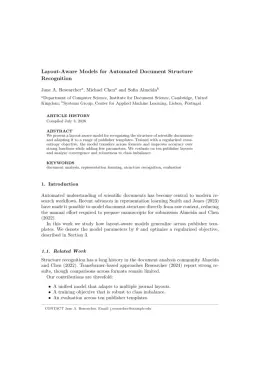
About the Popular Communication format
Popular Communication is a peer-reviewed journal published by Taylor & Francis, covering Media Studies and Communication, Gender, Feminism, and Media, Digital Games and Media.
| Publisher | Taylor & Francis |
|---|
| Reference style | Author–year (Chicago, T&F) Author–year — (Smith, 2023) in the text
Smith, Ada, Ben Jones, and Cara Lee. 2023. "A Representative Article Title." Popular Communication 12 (3): 45–58.
Formats any DOI in Popular Communication style. No sign-up.
|
|---|
| Publishes research in | Media Studies and Communication Gender, Feminism, and Media Digital Games and Media Cinema and Media Studies Media, Gender, and Advertising |
|---|
| ISSN | 1540-5702 |
|---|
| Citation impact (2-yr) | 0.33 |
|---|
| h-index | 48 |
|---|
| i10-index | 219 |
|---|
| Total citations | 9,004 |
|---|
| Top institutions publishing here | Stockholm University |
|---|
| Journal website | www.tandfonline.com |
|---|
| You get | A submission-ready PDF and the editable LaTeX source — ready to submit. |
|---|
Papers published in Popular Communication per year
Citation impact of Popular Communication by publication year
Citations each year’s papers have accumulated so far — the most recent years are still building up.
Most-cited papers in Popular Communication
“Sharenting,” parent blogging, and the boundaries of the digital self
Alicia Blum‐Ross, Sonia Livingstone · 3 Apr 2017
This article asks whether “sharenting” (sharing representations of one’s parenting or children online) is a form of digital self-representation. Drawing on interviews with 17 parent bloggers, we explore how parents define the borders of their digital selves and justify what is their “story to tell.” We find that bloggers grapple with profound ethical dilemmas, as…
Images of Animated Others: The Orientalization of Disney's Cartoon Heroines From The Little Mermaid to The Hunchback of Notre Dame
Celeste Lacroix · 1 Nov 2004
Because of the success of the first six animated feature films produced in the "new era" of Disney animation (The Little Mermaid, 1989; Beauty and the Beast, 1991; Aladdin, 1993; The Lion King, 1994; Pocahontas, 1995; The Hunchback of Notre Dame, 1996) and their mass merchandising, Disney animated characters became ubiquitous for children of the…
Fandom in the Digital Era
Roberta Pearson · 4 Feb 2010
This essay traces the profound impact of the digital revolution upon fandom, looking particularly at debates within the fan and acafan communities. It argues that fans have always been at the forefront of media industry transformations, summarizes some of the common themes emerging in the debate, and considers the wider implications for the reconfigured relationships…
Mobile Phones, Popular Media, and Everyday African Democracy: Transmissions and Transgressions
Herman Wasserman · 29 Apr 2011
The effectiveness of new media technologies, including mobile phones, to facilitate political participation and create social change has long been contested. Recent events in countries such as Mozambique, Iran, Tunisia, and Egypt have again raised questions about the role new media technologies can play to create alternative public spheres and mobilize for social action. In…
Connected migrants: Encapsulation and cosmopolitanization
Koen Leurs, Sandra Ponzanesi · 2 Jan 2018
Taking a cue from Dana Diminescu’s seminal manifesto on “the connected migrant,” this special issue introduces the notions of encapsulation and cosmopolitanism to understand digital migration studies. The pieces here present a nonbinary, integrated notion of an increasingly digitally mediated cosmopolitanism that accommodates differences within but also recognizes Europe’s colonial legacy and the fraught postcolonial…