Taylor & Francis

Physical Therapy Reviews Template

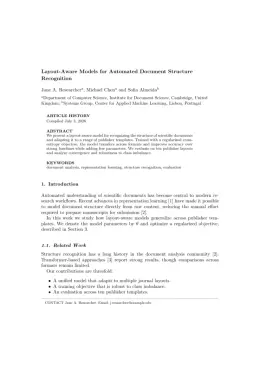
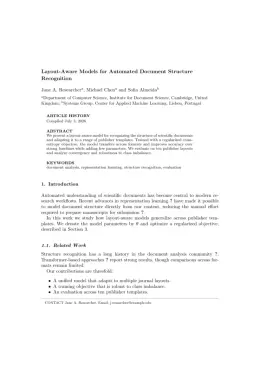
Write in a clean editor, then format for Physical Therapy Reviews in one click — DocuGuru applies the official Taylor & Francis template with author–year references and exports a submission-ready PDF plus the editable LaTeX source. Free to start.

About the Physical Therapy Reviews format

Physical Therapy Reviews is a peer-reviewed journal published by Taylor & Francis, covering Musculoskeletal pain and rehabilitation, Stroke Rehabilitation and Recovery, Cerebral Palsy and Movement Disorders.

PublisherTaylor & Francis
Reference styleAuthor–year (Chicago, T&F)
Author–year — (Smith, 2023) in the text
Smith, Ada, Ben Jones, and Cara Lee. 2023. "A Representative Article Title." Physical Therapy Reviews 12 (3): 45–58.

Formats any DOI in Physical Therapy Reviews style. No sign-up.

Publishes research inMusculoskeletal pain and rehabilitation Stroke Rehabilitation and Recovery Cerebral Palsy and Movement Disorders Sports injuries and prevention Shoulder Injury and Treatment
ISSN1083-3196
Citation impact (2-yr)0.72
h-index50
i10-index368
Total citations14,919
Top institutions publishing hereUniversity of Otago
Journal websitewww.tandfonline.com
You getA submission-ready PDF and the editable LaTeX source — ready to submit.

Papers published in Physical Therapy Reviews per year

39
2014
35
2015
25
2016
40
2017
34
2018
46
2019
56
2020
48
2021
30
2022
21
2023
26
2024
58
2025

Citation impact of Physical Therapy Reviews by publication year

117
2014
407
2015
619
2016
457
2017
414
2018
340
2019
272
2020
330
2021
121
2022
173
2023
36
2024
35
2025

Citations each year’s papers have accumulated so far — the most recent years are still building up.

Most-cited papers in Physical Therapy Reviews

Visual analogue scale, numeric pain rating scale and the McGill pain Questionnaire: an overview of psychometric properties

Cristiana Kahl, Joshua A. Cleland · 1 Jun 2005

AbstractAbstractIt is essential for physical therapists to use outcome measures that identify and measure a change in patient status; however, pain is a multidimensional experience that is often difficult to measure. A variety of instruments have been developed in an attempt to obtain an accurate measure of patients' perceived level of pain. Three of the…

The use of inertial sensors system for human motion analysis

Antonio Cuesta-Vargas, Alejandro Galán-Mercant, Jonathan M. Williams · 1 Dec 2010

OBJECTIVE: The aim of this article is to review systematically and appraise critically the literature surrounding the research, comparing inertial sensors with any kind of gold standard; this gold standard has to be a tool for measuring human movement (e.g. electrogoniometry, optoelectronic systems, electromagnetic systems, etc.). METHOD: A MEDLINE, EMBASE, CINAHL, PEDRo and SCOPUS search…

Intention to treat analysis, compliance, drop-outs and how to deal with missing data in clinical research: a review

Susan Armijo‐Olivo, Sharon Warren, David J. Magee · 1 Feb 2009

Background: Pragmatically, intention to treat (ITT) analysis has become the 'gold standard' for analysing the results of clinical trials. Despite its popularity and wide use, ITT is not without its critics, controversies and misunderstandings. To perform an ideal ITT requires a full set of data, where all patients providing data are followed, independent of any…

Dry needling: a literature review with implications for clinical practice guidelines

James Dunning, Raymond Butts, Firas Mourad et al. · 21 Nov 2013

Background: Wet needling uses hollow-bore needles to deliver corticosteroids, anesthetics, sclerosants, botulinum toxins, or other agents. In contrast, dry needling requires the insertion of thin monofilament needles, as used in the practice of acupuncture, without the use of injectate into muscles, ligaments, tendons, subcutaneous fascia, and scar tissue. Dry needles may also be inserted in…

Reconceptualising pain according to modern pain science

G. Lorimer Moseley · 1 Sep 2007

This paper argues that the biology of pain is never really straightforward, even when it appears to be. It is proposed that understanding what is currently known about the biology of pain requires a reconceptualisation of what pain actually is, and how it serves our livelihood. There are four key points: (i) that pain does…

Physical Therapy Reviews template — frequently asked questions

How do I write a paper in the Physical Therapy Reviews format?
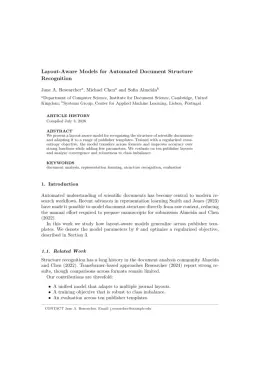
In DocuGuru you write your manuscript in a normal editor — no LaTeX setup required — and select the Physical Therapy Reviews template. When you export, DocuGuru compiles the paper into the official Taylor & Francis format and hands you a submission-ready PDF along with the editable LaTeX source.
What reference style does Physical Therapy Reviews use?
Physical Therapy Reviews uses Author–year (Chicago, T&F) references, shown as author–year markers such as (Smith, 2023) in the text. DocuGuru formats every in-text citation and the reference list in this exact style automatically. A reference appears like this: Smith, Ada, Ben Jones, and Cara Lee. 2023. "A Representative Article Title." Physical Therapy Reviews 12 (3): 45–58.
Do I need to know LaTeX to submit to Physical Therapy Reviews?
No. DocuGuru generates the interact LaTeX class and compiles the PDF for you in the background, so you get a Taylor & Francis-ready Physical Therapy Reviews document without writing any LaTeX. If you do want it, the LaTeX source is included in the export.
Can I import an existing draft into the Physical Therapy Reviews template?
Yes. Paste or upload your current manuscript — Word, LaTeX, Markdown, or plain text — and DocuGuru reflows it into the Physical Therapy Reviews format with correct headings, figures, tables, and author–year citations.
Who publishes Physical Therapy Reviews?
Physical Therapy Reviews is a multidisciplinary journal published by Taylor & Francis. DocuGuru's Physical Therapy Reviews template matches Taylor & Francis's official submission format.
Can I export a submission-ready Physical Therapy Reviews PDF?
Yes — DocuGuru produces a PDF built with the official Physical Therapy Reviews template (the interact class) that is ready to submit to Taylor & Francis, together with the matching LaTeX source files.
How much does the Physical Therapy Reviews template cost?
You can start writing in the Physical Therapy Reviews template for free. Exporting the final submission-ready Physical Therapy Reviews PDF and LaTeX source is part of DocuGuru's paid plans — see the app for current pricing.
Use the Physical Therapy Reviews template