Taylor & Francis

Neuropsychological Rehabilitation Template

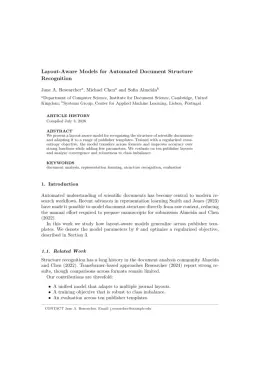
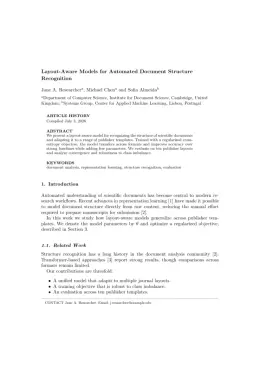
Write in a clean editor, then format for Neuropsychological Rehabilitation in one click — DocuGuru applies the official Taylor & Francis template with author–year references and exports a submission-ready PDF plus the editable LaTeX source. Free to start.

About the Neuropsychological Rehabilitation format

Neuropsychological Rehabilitation is a peer-reviewed journal published by Taylor & Francis, covering Traumatic Brain Injury Research, Neurobiology of Language and Bilingualism, Stroke Rehabilitation and Recovery.

PublisherTaylor & Francis
Reference styleAuthor–year (Chicago, T&F)
Author–year — (Smith, 2023) in the text
Smith, Ada, Ben Jones, and Cara Lee. 2023. "A Representative Article Title." Neuropsychological Rehabilitation 12 (3): 45–58.

Formats any DOI in Neuropsychological Rehabilitation style. No sign-up.

Publishes research inTraumatic Brain Injury Research Neurobiology of Language and Bilingualism Stroke Rehabilitation and Recovery Dementia and Cognitive Impairment Research Cardiac Arrest and Resuscitation
ISSN0960-2011
Citation impact (2-yr)1.55
h-index110
i10-index1,177
Total citations62,115
Top institutions publishing hereMonash University
Journal websitewww.tandfonline.com
You getA submission-ready PDF and the editable LaTeX source — ready to submit.

Papers published in Neuropsychological Rehabilitation per year

76
2014
94
2015
81
2016
97
2017
84
2018
66
2019
96
2020
77
2021
84
2022
45
2023
75
2024
82
2025

Citation impact of Neuropsychological Rehabilitation by publication year

2.2K
2014
2.7K
2015
2.5K
2016
2.2K
2017
2.1K
2018
1.6K
2019
1.7K
2020
913
2021
790
2022
236
2023
222
2024
62
2025

Citations each year’s papers have accumulated so far — the most recent years are still building up.

Most-cited papers in Neuropsychological Rehabilitation

Transcranial electrical stimulation (tES – tDCS; tRNS, tACS) methods

Walter Paulus · 5 Aug 2011

Weak transcranial direct current stimulation (tDCS) with a homogenous DC field at intensities of around 1 mA induces long-lasting changes in the brain. tDCS can be used to manipulate brain excitability via membrane polarisation: cathodal stimulation hyperpolarises, while anodal stimulation depolarises the resting membrane potential, whereby the induced after-effects depend on polarity, duration and intensity…

Cognitive training and cognitive rehabilitation for people with early-stage Alzheimer's disease: A review

Linda Clare, Bob Woods · 1 Sep 2004

Memory difficulties are a defining feature of Alzheimer's disease (AD), with significant implications for people with AD and family members. Interventions aimed at helping with memory difficulties, therefore, may be important in reducing excess disability and improving well-being. There is a long tradition of cognition-focused intervention in dementia care. In this review we offer broad…

Maintaining group memberships: Social identity continuity predicts well-being after stroke

Catherine Haslam, Abigail Holme, S. Alexander Haslam et al. · 12 May 2008

A survey study of patients recovering from stroke (N = 53) examined the extent to which belonging to multiple groups prior to stroke and the maintenance of those group memberships (as measured by the Exeter Identity Transitions Scales, EXITS) predicted well-being after stroke. Results of correlation analysis showed that life satisfaction was associated both with…

Analysis of assets for virtual reality applications in neuropsychology

Albert Rizzo, Maria T. Schultheis, Kimberly A. Kerns et al. · 1 Mar 2004

Abstract Virtual reality (VR) technology offers new opportunities for the development of innovative neuropsychological assessment and rehabilitation tools. VR-based testing and training scenarios that would be difficult, if not impossible, to deliver using conventional neuropsychological methods are now being developed that take advantage of the assets available with VR technology. If empirical studies continue to…

Neuropsychological Rehabilitation template — frequently asked questions

How do I write a paper in the Neuropsychological Rehabilitation format?
In DocuGuru you write your manuscript in a normal editor — no LaTeX setup required — and select the Neuropsychological Rehabilitation template. When you export, DocuGuru compiles the paper into the official Taylor & Francis format and hands you a submission-ready PDF along with the editable LaTeX source.
What reference style does Neuropsychological Rehabilitation use?
Neuropsychological Rehabilitation uses Author–year (Chicago, T&F) references, shown as author–year markers such as (Smith, 2023) in the text. DocuGuru formats every in-text citation and the reference list in this exact style automatically. A reference appears like this: Smith, Ada, Ben Jones, and Cara Lee. 2023. "A Representative Article Title." Neuropsychological Rehabilitation 12 (3): 45–58.
Do I need to know LaTeX to submit to Neuropsychological Rehabilitation?
No. DocuGuru generates the interact LaTeX class and compiles the PDF for you in the background, so you get a Taylor & Francis-ready Neuropsychological Rehabilitation document without writing any LaTeX. If you do want it, the LaTeX source is included in the export.
Can I import an existing draft into the Neuropsychological Rehabilitation template?
Yes. Paste or upload your current manuscript — Word, LaTeX, Markdown, or plain text — and DocuGuru reflows it into the Neuropsychological Rehabilitation format with correct headings, figures, tables, and author–year citations.
Who publishes Neuropsychological Rehabilitation?
Neuropsychological Rehabilitation is a multidisciplinary journal published by Taylor & Francis. DocuGuru's Neuropsychological Rehabilitation template matches Taylor & Francis's official submission format.
Can I export a submission-ready Neuropsychological Rehabilitation PDF?
Yes — DocuGuru produces a PDF built with the official Neuropsychological Rehabilitation template (the interact class) that is ready to submit to Taylor & Francis, together with the matching LaTeX source files.
How much does the Neuropsychological Rehabilitation template cost?
You can start writing in the Neuropsychological Rehabilitation template for free. Exporting the final submission-ready Neuropsychological Rehabilitation PDF and LaTeX source is part of DocuGuru's paid plans — see the app for current pricing.

Use the Neuropsychological Rehabilitation template