Taylor & Francis

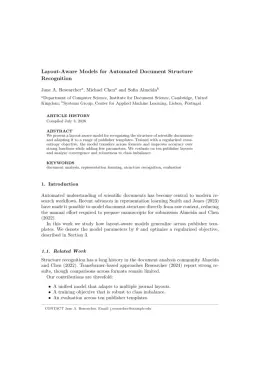
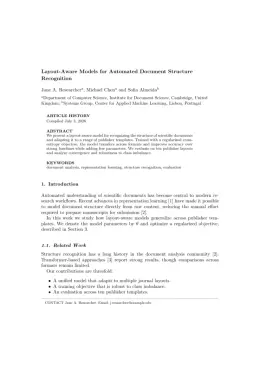
Nanocomposites Template

Write in a clean editor, then format for Nanocomposites in one click — DocuGuru applies the official Taylor & Francis template with author–year references and exports a submission-ready PDF plus the editable LaTeX source. Free to start.

About the Nanocomposites format

Nanocomposites is a peer-reviewed journal published by Taylor & Francis, covering Polymer Nanocomposites and Properties, Carbon Nanotubes in Composites, Advanced Sensor and Energy Harvesting Materials.

PublisherTaylor & Francis
Reference styleAuthor–year (Chicago, T&F)
Author–year — (Smith, 2023) in the text
Smith, Ada, Ben Jones, and Cara Lee. 2023. "A Representative Article Title." Nanocomposites 12 (3): 45–58.

Formats any DOI in Nanocomposites style. No sign-up.

Publishes research inPolymer Nanocomposites and Properties Carbon Nanotubes in Composites Advanced Sensor and Energy Harvesting Materials Graphene research and applications biodegradable polymer synthesis and properties
ISSN2055-0324
Citation impact (2-yr)4.72
h-index35
i10-index116
Total citations4,646
Article processing charge$1,590
Open accessYes
Top institutions publishing hereQueen Mary University of London
Journal websitewww.tandfonline.com
You getA submission-ready PDF and the editable LaTeX source — ready to submit.

Papers published in Nanocomposites per year

5
2014
21
2015
20
2016
10
2017
20
2018
15
2019
16
2020
26
2021
49
2022
22
2023
23
2024
17
2025

Citation impact of Nanocomposites by publication year

180
2014
531
2015
371
2016
671
2017
630
2018
380
2019
458
2020
475
2021
398
2022
205
2023
198
2024
57
2025

Citations each year’s papers have accumulated so far — the most recent years are still building up.

Most-cited papers in Nanocomposites

Water purification by polymer nanocomposites: an overview

Neeta Pandey, S.K. Shukla, N.B. Singh · 3 Apr 2017

In recent years, polymer nanocomposites (PNCs) have attracted the attention of scientists and technologists in water purification due to improved processability, surface area, stability, tunable properties, and cost effectiveness. PNCs showed fast decontamination ability with high selectivity to remove various pollutants. This review provides up-to-date information about the importance of PNCs in the removal of…

A review on carbon nanotubes in biosensor devices and their applications in medicine

Merum Sireesha, Veluru Jagadeesh Babu, Ali S. Kiran et al. · 3 Apr 2018

In recent years, integrating biological components in analytical instruments especially in biomedical research has become a prerequisite for early diagnosis of many diseases. It is well known that the material properties (electrical and physical) of CNTs is very sensitive to be affected by exposure to biomolecules and this led to the investigation by many researchers.…

The use of carbon nanotubes for damage sensing and structural health monitoring in laminated composites: a review

Han Zhang, Emiliano Bilotti, Ton Peijs · 2 Oct 2015

The increasing use of fiber-reinforced plastics (FRPs) in industries such as aerospace, marine, and automotive, has resulted in a necessity to monitor the structural integrity of composite structures and materials. Apart from development of traditional non-destructive testing methods which are performed off-line, there is a growing need to integrate structural health monitoring (SHM) systems within…

Mechanical and wear behavior of AA7075 aluminum matrix composites reinforced by Al<sub>2</sub>O<sub>3</sub>nanoparticles

Huda A. Al-Salihi, Adil Akram Mahmood, Hussain J. M. Alalkawi · 3 Jul 2019

An attempt was made to synthesize aluminum alloy (AA) 7075 matrix reinforced with 0, 1, 3, 5 wt% Al2O3 particulates by using stir casting technique. Mechanical properties and wear behavior were examined. The hardness and tensile properties were obtained before and after addition of Al2O3 particulates to reveal the extent improvement. Wear behavior was examined…

Sonication amplitude and processing time influence the cellulose nanocrystals morphology and dispersion

Jamileh Shojaeiarani, Dilpreet S. Bajwa, Gregory Holt · 2 Jan 2020

The application of bio-based materials is becoming impellent owing to the increasing demand for alternatives to petroleum-based analogs. In this regard, cellulose nanocrystals (CNCs) with unique properties have received a significant interest, while their hydrophilic character poses a challenge to their commercial applications. Ultrasonication treatment is one of the most commonly used methods to improve…

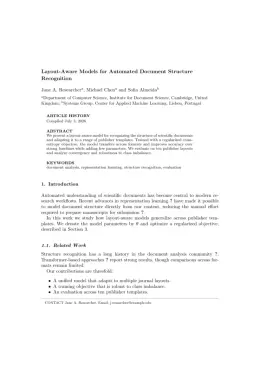
Nanocomposites template — frequently asked questions

How do I write a paper in the Nanocomposites format?
In DocuGuru you write your manuscript in a normal editor — no LaTeX setup required — and select the Nanocomposites template. When you export, DocuGuru compiles the paper into the official Taylor & Francis format and hands you a submission-ready PDF along with the editable LaTeX source.
What reference style does Nanocomposites use?
Nanocomposites uses Author–year (Chicago, T&F) references, shown as author–year markers such as (Smith, 2023) in the text. DocuGuru formats every in-text citation and the reference list in this exact style automatically. A reference appears like this: Smith, Ada, Ben Jones, and Cara Lee. 2023. "A Representative Article Title." Nanocomposites 12 (3): 45–58.
Do I need to know LaTeX to submit to Nanocomposites?
No. DocuGuru generates the interact LaTeX class and compiles the PDF for you in the background, so you get a Taylor & Francis-ready Nanocomposites document without writing any LaTeX. If you do want it, the LaTeX source is included in the export.
Can I import an existing draft into the Nanocomposites template?
Yes. Paste or upload your current manuscript — Word, LaTeX, Markdown, or plain text — and DocuGuru reflows it into the Nanocomposites format with correct headings, figures, tables, and author–year citations.
Who publishes Nanocomposites?
Nanocomposites is a multidisciplinary journal published by Taylor & Francis. DocuGuru's Nanocomposites template matches Taylor & Francis's official submission format.
Can I export a submission-ready Nanocomposites PDF?
Yes — DocuGuru produces a PDF built with the official Nanocomposites template (the interact class) that is ready to submit to Taylor & Francis, together with the matching LaTeX source files.
How much does the Nanocomposites template cost?
You can start writing in the Nanocomposites template for free. Exporting the final submission-ready Nanocomposites PDF and LaTeX source is part of DocuGuru's paid plans — see the app for current pricing.
Use the Nanocomposites template