
496 citations
Go to paper →
Taylor & Francis
Metals Technology Template
Write in a clean editor, then format for Metals Technology in one click — DocuGuru applies the official Taylor & Francis template with author–year references and exports a submission-ready PDF plus the editable LaTeX source. Free to start.
About the Metals Technology format
Metals Technology is a peer-reviewed journal published by Taylor & Francis, covering Microstructure and Mechanical Properties of Steels, Legal and Regulatory Analysis, Linguistic, Cultural, and Literary Studies.
| Publisher | Taylor & Francis |
|---|---|
| Reference style | Author–year (Chicago, T&F) Author–year — (Smith, 2023) in the text Smith, Ada, Ben Jones, and Cara Lee. 2023. "A Representative Article Title." Metals Technology 12 (3): 45–58.
Formats any DOI in Metals Technology style. No sign-up. |
| Publishes research in | Microstructure and Mechanical Properties of Steels Legal and Regulatory Analysis Linguistic, Cultural, and Literary Studies Military Technology and Strategies Metallurgy and Material Forming |
| ISSN | 0307-1693 |
| h-index | 45 |
| i10-index | 308 |
| Total citations | 10,796 |
| Top institutions publishing here | University of Strathclyde |
| Journal website | www.tandfonline.com |
| You get | A submission-ready PDF and the editable LaTeX source — ready to submit. |
Papers published in Metals Technology per year
Most-cited papers in Metals Technology
AbstractAbstractAn alternative form of the hyperbolic sine relationship is developed for use as a constitutive equation at elevated temperatures. It is shown how an optimization technique may be applied to results from torsion tests to determine the constants in this equation and that this method must be more accurate than those presented previously. Experimental results…
217 citations
Cite
SaveGo to paper →
AbstractAbstractThe influence of composition on the tendency for surface-crack propagation to occur on straightening of continuously cast strand of a commercial C–Mn–Nb–Al grade of steel has been examined and compared with the hot-ductility behaviour obtained from Gleeble tensile tests, using reduction of area as the measure for hot ductility. The tendency for surface-crack propagation was…
164 citations
Cite
SaveGo to paper →
AbstractAbstractCemented carbide inserts, both uncoated and coated with single or composite layers of TiC, TiN, or Al2O3, were used to cut En. 8 and En 24 steel at speeds between 183 and 305 min−1 Quick-stop specimens and tool-temperature estimates demonstrated that conditions at the tool/work interface were essentially similar for uncoated tools and for all…
157 citations
Cite
SaveGo to paper →
Deep-groove ball bearings have been endurance tested at high stress levels. The purpose of the work was to study the simultaneous generation of residual stresses and occurrence of structural changes owing to cyclic rolling contact fatigue. During the investigation the decomposition of both retained austenite and parent martensite were followed. The residual stresses and the…
153 citations
Cite
SaveGo to paper →
Related journal templates
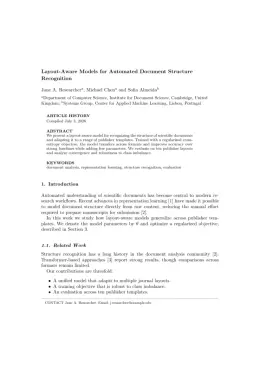
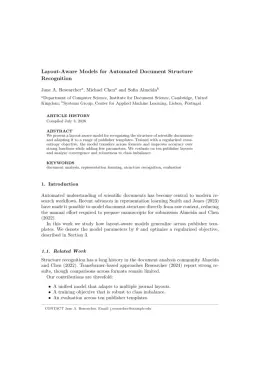
Metals Technology template — frequently asked questions
How do I write a paper in the Metals Technology format?
In DocuGuru you write your manuscript in a normal editor — no LaTeX setup required — and select the Metals Technology template. When you export, DocuGuru compiles the paper into the official Taylor & Francis format and hands you a submission-ready PDF along with the editable LaTeX source.
What reference style does Metals Technology use?
Metals Technology uses Author–year (Chicago, T&F) references, shown as author–year markers such as (Smith, 2023) in the text. DocuGuru formats every in-text citation and the reference list in this exact style automatically. A reference appears like this: Smith, Ada, Ben Jones, and Cara Lee. 2023. "A Representative Article Title." Metals Technology 12 (3): 45–58.
Do I need to know LaTeX to submit to Metals Technology?
No. DocuGuru generates the interact LaTeX class and compiles the PDF for you in the background, so you get a Taylor & Francis-ready Metals Technology document without writing any LaTeX. If you do want it, the LaTeX source is included in the export.
Can I import an existing draft into the Metals Technology template?
Yes. Paste or upload your current manuscript — Word, LaTeX, Markdown, or plain text — and DocuGuru reflows it into the Metals Technology format with correct headings, figures, tables, and author–year citations.
Who publishes Metals Technology?
Metals Technology is a multidisciplinary journal published by Taylor & Francis. DocuGuru's Metals Technology template matches Taylor & Francis's official submission format.
Can I export a submission-ready Metals Technology PDF?
Yes — DocuGuru produces a PDF built with the official Metals Technology template (the interact class) that is ready to submit to Taylor & Francis, together with the matching LaTeX source files.
How much does the Metals Technology template cost?
You can start writing in the Metals Technology template for free. Exporting the final submission-ready Metals Technology PDF and LaTeX source is part of DocuGuru's paid plans — see the app for current pricing.