
171 citations
Go to paper →
Taylor & Francis
Medieval Archaeology Template
Write in a clean editor, then format for Medieval Archaeology in one click — DocuGuru applies the official Taylor & Francis template with author–year references and exports a submission-ready PDF plus the editable LaTeX source. Free to start.
About the Medieval Archaeology format
Medieval Archaeology is a peer-reviewed journal published by Taylor & Francis, covering Archaeology and ancient environmental studies, Historical and Archaeological Studies, Medieval Literature and History.
| Publisher | Taylor & Francis |
|---|---|
| Reference style | Author–year (Chicago, T&F) Author–year — (Smith, 2023) in the text Smith, Ada, Ben Jones, and Cara Lee. 2023. "A Representative Article Title." Medieval Archaeology 12 (3): 45–58.
Formats any DOI in Medieval Archaeology style. No sign-up. |
| Publishes research in | Archaeology and ancient environmental studies Historical and Archaeological Studies Medieval Literature and History Historical Studies of British Isles Historical and Cultural Archaeology Studies |
| ISSN | 0076-6097 |
| Citation impact (2-yr) | 0.38 |
| h-index | 38 |
| i10-index | 224 |
| Total citations | 7,805 |
| Top institutions publishing here | British Museum |
| Journal website | www.medievalarchaeology.co.uk |
| You get | A submission-ready PDF and the editable LaTeX source — ready to submit. |
Papers published in Medieval Archaeology per year
Citation impact of Medieval Archaeology by publication year
Citations each year’s papers have accumulated so far — the most recent years are still building up.
Most-cited papers in Medieval Archaeology
This paper examines patterns in the placement of apotropaic objects and materials in high- to late-medieval burials in Britain (11th to 15th centuries). It develops an interdisciplinary classification to identify: (1) healing charms and protective amulets; (2) objects perceived to have occult natural power; (3) 'antique' items that were treated as possessing occult power; and…
147 citations
Cite
SaveGo to paper →
The Burials of pre-Christian Scandinavia in the Viking Age can be broadly divided into a number of basic categories, yet within these the range of individual expression in mortuary behaviour is immense. This paper proposes a model to explain such variation, focusing on the evident deliberation shown in the precise selection and placement of objects,…
125 citations
Cite
SaveGo to paper →
THE MANY HUNDREDS of known early medieval cemeteries dated between the late 5th and early 8th centuries A.D. from southern and eastern England have largely been studied in terms of artefacts and human remains. The reuse of prehistoric and Roman structures by these burial sites has received much less attention and discussion. It is suggested…
117 citations
Cite
SaveGo to paper →
A clear distinction between imported artefacts found in Kent and those occurring elsewhere is demonstrated, and it is suggested that the patterning is related to the modes of exchange which both brought the artefacts into England and circulated the items within the country. A number of different mechanisms by which goods may be exchanged over…
111 citations
Cite
SaveGo to paper →
Related journal templates
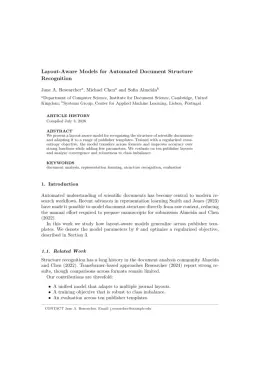 International Journal of Geographical Information Science
International Journal of Production Research
International Journal of Geographical Information Science
International Journal of Production Research
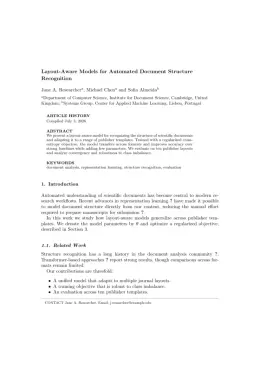 Journal of Applied Economics
Journal of Computational and Graphical Statistics
Journal of Applied Economics
Journal of Computational and Graphical Statistics
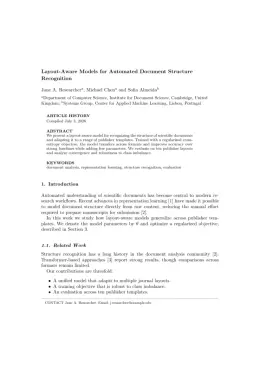 Journal of Modern Optics
Journal of Quality Technology
Journal of the American Statistical Association
Liquid Crystals
Journal of Modern Optics
Journal of Quality Technology
Journal of the American Statistical Association
Liquid Crystals
Medieval Archaeology template — frequently asked questions
How do I write a paper in the Medieval Archaeology format?
In DocuGuru you write your manuscript in a normal editor — no LaTeX setup required — and select the Medieval Archaeology template. When you export, DocuGuru compiles the paper into the official Taylor & Francis format and hands you a submission-ready PDF along with the editable LaTeX source.
What reference style does Medieval Archaeology use?
Medieval Archaeology uses Author–year (Chicago, T&F) references, shown as author–year markers such as (Smith, 2023) in the text. DocuGuru formats every in-text citation and the reference list in this exact style automatically. A reference appears like this: Smith, Ada, Ben Jones, and Cara Lee. 2023. "A Representative Article Title." Medieval Archaeology 12 (3): 45–58.
Do I need to know LaTeX to submit to Medieval Archaeology?
No. DocuGuru generates the interact LaTeX class and compiles the PDF for you in the background, so you get a Taylor & Francis-ready Medieval Archaeology document without writing any LaTeX. If you do want it, the LaTeX source is included in the export.
Can I import an existing draft into the Medieval Archaeology template?
Yes. Paste or upload your current manuscript — Word, LaTeX, Markdown, or plain text — and DocuGuru reflows it into the Medieval Archaeology format with correct headings, figures, tables, and author–year citations.
Who publishes Medieval Archaeology?
Medieval Archaeology is a multidisciplinary journal published by Taylor & Francis. DocuGuru's Medieval Archaeology template matches Taylor & Francis's official submission format.
Can I export a submission-ready Medieval Archaeology PDF?
Yes — DocuGuru produces a PDF built with the official Medieval Archaeology template (the interact class) that is ready to submit to Taylor & Francis, together with the matching LaTeX source files.
How much does the Medieval Archaeology template cost?
You can start writing in the Medieval Archaeology template for free. Exporting the final submission-ready Medieval Archaeology PDF and LaTeX source is part of DocuGuru's paid plans — see the app for current pricing.