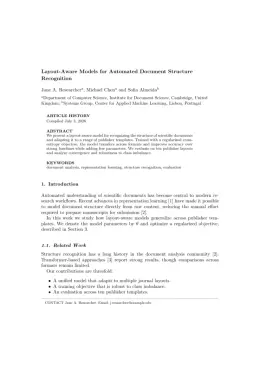
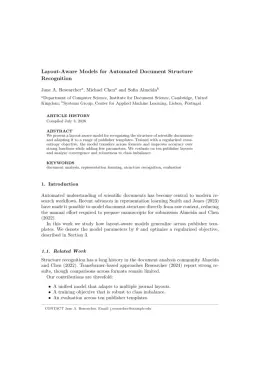
Taylor & Francis

Liquid Fuels Technology Template

Write in a clean editor, then format for Liquid Fuels Technology in one click — DocuGuru applies the official Taylor & Francis template with author–year references and exports a submission-ready PDF plus the editable LaTeX source. Free to start.

About the Liquid Fuels Technology format

Liquid Fuels Technology is a peer-reviewed journal published by Taylor & Francis, covering Petroleum Processing and Analysis, Hydrocarbon exploration and reservoir analysis, Thermochemical Biomass Conversion Processes.

PublisherTaylor & Francis
Reference styleAuthor–year (Chicago, T&F)
Author–year — (Smith, 2023) in the text
Smith, Ada, Ben Jones, and Cara Lee. 2023. "A Representative Article Title." Liquid Fuels Technology 12 (3): 45–58.

Formats any DOI in Liquid Fuels Technology style. No sign-up.

Publishes research inPetroleum Processing and Analysis Hydrocarbon exploration and reservoir analysis Thermochemical Biomass Conversion Processes Coal and Coke Industries Research NMR spectroscopy and applications
ISSN0737-7266
h-index12
i10-index21
Total citations591
Top institutions publishing hereWestern Research Institute
Journal websitewww.tandfonline.com
You getA submission-ready PDF and the editable LaTeX source — ready to submit.

Papers published in Liquid Fuels Technology per year

21
1983
25
1984
22
1985

Citation impact of Liquid Fuels Technology by publication year

112
1983
264
1984
215
1985

Citations each year’s papers have accumulated so far — the most recent years are still building up.

Most-cited papers in Liquid Fuels Technology

CHARACTERIZATION OF VANADIUM COMPOUNDS IN SELECTED CRUDES I. PORPHYRIN AND NON-PORPHYRIN SEPARATION

Wilton R. Biggs, John C. Fetzer, Rick J. Brown et al. · 1 Jan 1985

ABSTRACT We have applied size-exclusion chromatography (SEC-HPLC) and reversed-phase chromatography (RP-HPLC), with element specific detection, [Inductively coupled and direct current plasma atomic emission spectroscopy (ICP and DCP)], to selected crude oils –– Boscan, Beta, Morichal, Arabian Heavy, and Maya –– and their separated fractions. By these procedures, we have further characterized both the V porphyrin…

CHARACTERIZATION OF HEAVY RESIDUA BY AAPPLICATION OF A MODIFIED D 2007 SEPARATION AND ELECTRON PARAMAGNETIC RESONANCE

John G. Reynolds · 1 Jan 1985

ABSTRACT Seven atmospheric residua (343°C + [ 65O°F + ]) were separated into saturate, aromatic, resin, and asphaltene fractions for detailled assessment of feed structure. The weight percent distribution of the fractions revealed two groupings of the residua. One grouping exhibited 20 wt % saturate composition, while the other only 10 wt %. The residua…

STRUCTURAL TYPES IN PETROLEUM ASPHALTENES AS DEDUCED FROM PYROLYSIS/GAS CHROMATOGRAPHY/MASS SPECTROMETRY

James G. Speight, R.J. Pancirov · 1 Jan 1984

ABSTRACT An integrated technique has been developed for the study of the thermal chemistry of petroleum fractions—particularly the asphaltenes. The procedure involves the integrated use of a pyroprobe/gas chroma-tographic/mass spectrometric technique which offers information about the structuraI-types and distribution within the volatile products from the thermal decomposition of asphaltenes. The technique offers itself as an…

X-RAY DIFFRACTION OF N-PARAFFINS AND STACKED AROMATIC MOLECULES: INSIGHTS INTO THE STRUCTURE OF PETROLEUM ASPHALTENES

Lawrence B. Ebert, Joseph C. Scanlon, Daniel R. Mills · 1 Jan 1984

ABSTRACT X-ray diffraction investigation of normal paraffins and Debye internal interference calculations on stacks of aromatic molecules are used to make inferences about the structure of petroleum asphaltenes. The gamma band, a broad peak near 4.5 Å, is associated with weakly ordered paraffins. Stacks of aromatic molecules can give rise to diffraction peaks at d…

CHARACTERIZATION OP VANADIUM COMPOUNDS IN SELECTED CRUDES II. ELECTRON PARAMAGNETIC RESONANCE STUDIES OP THE FIRST COORDINATION SPHERES IN PORPHYRIN AND NON-PORPHYRIN FRACTIONS

John G. Reynolds, Wilton R. Biggs, John C. Fetzer · 1 Jan 1985

ABSTRACT We applied electron paramagnetic resonance spectroscopy (EPR) to heavy petroleum fractions to characterize the first coordination sphere around the vanadyl +2 ion. The fractions were generated using a modified porphyrin extraction procedure. For the residual oil from the extraction, which contains the non-porphyrin metals, the first coordination sphere was dominated by 4N and N…

Liquid Fuels Technology template — frequently asked questions

How do I write a paper in the Liquid Fuels Technology format?
In DocuGuru you write your manuscript in a normal editor — no LaTeX setup required — and select the Liquid Fuels Technology template. When you export, DocuGuru compiles the paper into the official Taylor & Francis format and hands you a submission-ready PDF along with the editable LaTeX source.
What reference style does Liquid Fuels Technology use?
Liquid Fuels Technology uses Author–year (Chicago, T&F) references, shown as author–year markers such as (Smith, 2023) in the text. DocuGuru formats every in-text citation and the reference list in this exact style automatically. A reference appears like this: Smith, Ada, Ben Jones, and Cara Lee. 2023. "A Representative Article Title." Liquid Fuels Technology 12 (3): 45–58.
Do I need to know LaTeX to submit to Liquid Fuels Technology?
No. DocuGuru generates the interact LaTeX class and compiles the PDF for you in the background, so you get a Taylor & Francis-ready Liquid Fuels Technology document without writing any LaTeX. If you do want it, the LaTeX source is included in the export.
Can I import an existing draft into the Liquid Fuels Technology template?
Yes. Paste or upload your current manuscript — Word, LaTeX, Markdown, or plain text — and DocuGuru reflows it into the Liquid Fuels Technology format with correct headings, figures, tables, and author–year citations.
Who publishes Liquid Fuels Technology?
Liquid Fuels Technology is a multidisciplinary journal published by Taylor & Francis. DocuGuru's Liquid Fuels Technology template matches Taylor & Francis's official submission format.
Can I export a submission-ready Liquid Fuels Technology PDF?
Yes — DocuGuru produces a PDF built with the official Liquid Fuels Technology template (the interact class) that is ready to submit to Taylor & Francis, together with the matching LaTeX source files.
How much does the Liquid Fuels Technology template cost?
You can start writing in the Liquid Fuels Technology template for free. Exporting the final submission-ready Liquid Fuels Technology PDF and LaTeX source is part of DocuGuru's paid plans — see the app for current pricing.

Use the Liquid Fuels Technology template