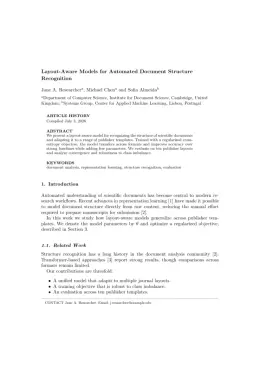
Taylor & Francis

Journal of Experimental Nanoscience Template

Write in a clean editor, then format for Journal of Experimental Nanoscience in one click — DocuGuru applies the official Taylor & Francis template with numbered references and exports a submission-ready PDF plus the editable LaTeX source. Free to start.

About the Journal of Experimental Nanoscience format

Journal of Experimental Nanoscience is a peer-reviewed journal published by Taylor & Francis, covering Nanoparticles: synthesis and applications, Quantum Dots Synthesis And Properties, Gold and Silver Nanoparticles Synthesis and Applications.

PublisherTaylor & Francis
Reference styleNumbered (Vancouver/NLM)
Numbered — [1], [2] in the text
1. Smith A, Jones B, Lee C. A representative article title. Journal of Experimental Nanoscience. 2023;12(3):45–58.

Formats any DOI in Journal of Experimental Nanoscience style. No sign-up.

Publishes research inNanoparticles: synthesis and applications Quantum Dots Synthesis And Properties Gold and Silver Nanoparticles Synthesis and Applications Advanced Photocatalysis Techniques Carbon Nanotubes in Composites
ISSN1745-8080
Citation impact (2-yr)4.58
h-index63
i10-index561
Total citations21,483
Article processing charge$1,790
Open accessYes
Top institutions publishing hereChinese Academy of Sciences
Journal websitewww.tandfonline.com
You getA submission-ready PDF and the editable LaTeX source — ready to submit.

Papers published in Journal of Experimental Nanoscience per year

49
2014
69
2015
61
2016
34
2017
20
2018
15
2019
31
2020
29
2021
40
2022
35
2023
20
2024
7
2025

Citation impact of Journal of Experimental Nanoscience by publication year

872
2014
2.9K
2015
2.2K
2016
1K
2017
433
2018
166
2019
472
2020
532
2021
493
2022
235
2023
113
2024
20
2025

Citations each year’s papers have accumulated so far — the most recent years are still building up.

Most-cited papers in Journal of Experimental Nanoscience

Synthesis of silver nanoparticles by chemical and biological methods and their antimicrobial properties

Gudikandula Krishna, Singara Charya Maringanti · 28 Jan 2016

Biogenic synthesis of nanoparticles offers an attractive alternate to chemical synthesis methods. Various hazard free, eco-friendly methods of synthesis of silver nanoparticles are in operation. In chemical reduction methods, the reducing agent is a chemical solution, whereas in biological ones, the collection of enzymes, especially nitrate reductase, plays this role. The highest antibacterial activity of…

Preparation and characterisation of lignin nanoparticles: evaluation of their potential as antioxidants and UV protectants

Srinivasa Rao Yearla, Kollipara Padmasree · 18 Jun 2015

Lignin, an abundant plant biopolymer, is known to possess antioxidant and UV protectant properties in its native state. Nanoparticles exhibit either improved or different properties corresponding to their bulk materials or parent polymers. In the present study, using nanoprecipitation method, dioxane lignin nanoparticles (DLNP) and alkali lignin nanoparticles (ALNP) are fabricated from two different sources…

Stability analysis of Al<sub>2</sub>O<sub>3</sub>/water nanofluids

Rajesh Choudhary, Deepak Khurana, Aditya Kumar et al. · 1 Jan 2017

This paper presents the stability analysis of Al2O3/water nanofluid. The stability is investigated with the help of zeta potential and visual inspection methods. The effects of pH and sonication time for the stability of nanofluids are studied in detail. The visual inspection method is used to calculate the stability period of nanofluids. The zeta potential…

Ultrafine dispersed CuO nanoparticles and their antibacterial activity

Ojas Mahapatra, Megha Bhagat, C. Gopalakrishnan et al. · 1 Sep 2008

Copper oxide nanoparticles with a particle size ranging from 80 to 160 nm were prepared by a wet chemical procedure. Copper carbonate hydroxide and sodium hydroxide were used as raw materials. Copper hydroxide was generated as a precursor which was thermally decomposed to CuO nanoparticles. The nanoparticles were characterised using atomic force microscopy, X-ray diffraction…

High-purity nano silica powder from rice husk using a simple chemical method

R. Yuvakkumar, V. Elango, V. Rajendran et al. · 4 Jul 2012

A highly pure, small particle-sized and high surface area nano silica powder was prepared from rice husk using alkali extraction, followed by an acid precipitation method. The composition, phase, morphology, size and surface area of the as-synthesised nano silica powder was investigated by energy-dispersive spectroscopy, Fourier transform infrared spectroscopy, X-ray diffraction, transmission electron microscopy, particle…

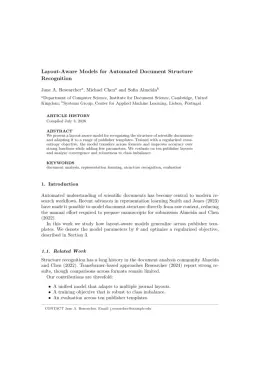
Journal of Experimental Nanoscience template — frequently asked questions

How do I write a paper in the Journal of Experimental Nanoscience format?
In DocuGuru you write your manuscript in a normal editor — no LaTeX setup required — and select the Journal of Experimental Nanoscience template. When you export, DocuGuru compiles the paper into the official Taylor & Francis format and hands you a submission-ready PDF along with the editable LaTeX source.
What reference style does Journal of Experimental Nanoscience use?
Journal of Experimental Nanoscience uses Numbered (Vancouver/NLM) references, shown as numbered [1], [2] markers in the text. DocuGuru formats every in-text citation and the reference list in this exact style automatically. A reference appears like this: 1. Smith A, Jones B, Lee C. A representative article title. Journal of Experimental Nanoscience. 2023;12(3):45–58.
Do I need to know LaTeX to submit to Journal of Experimental Nanoscience?
No. DocuGuru generates the interact LaTeX class and compiles the PDF for you in the background, so you get a Taylor & Francis-ready Journal of Experimental Nanoscience document without writing any LaTeX. If you do want it, the LaTeX source is included in the export.
Can I import an existing draft into the Journal of Experimental Nanoscience template?
Yes. Paste or upload your current manuscript — Word, LaTeX, Markdown, or plain text — and DocuGuru reflows it into the Journal of Experimental Nanoscience format with correct headings, figures, tables, and numbered citations.
Who publishes Journal of Experimental Nanoscience?
Journal of Experimental Nanoscience is a multidisciplinary journal published by Taylor & Francis. DocuGuru's Journal of Experimental Nanoscience template matches Taylor & Francis's official submission format.
Can I export a submission-ready Journal of Experimental Nanoscience PDF?
Yes — DocuGuru produces a PDF built with the official Journal of Experimental Nanoscience template (the interact class) that is ready to submit to Taylor & Francis, together with the matching LaTeX source files.
How much does the Journal of Experimental Nanoscience template cost?
You can start writing in the Journal of Experimental Nanoscience template for free. Exporting the final submission-ready Journal of Experimental Nanoscience PDF and LaTeX source is part of DocuGuru's paid plans — see the app for current pricing.
Use the Journal of Experimental Nanoscience template