Taylor & Francis

Hemoglobin Template

Write in a clean editor, then format for Hemoglobin in one click — DocuGuru applies the official Taylor & Francis template with author–year references and exports a submission-ready PDF plus the editable LaTeX source. Free to start.

About the Hemoglobin format

Hemoglobin is a peer-reviewed journal published by Taylor & Francis, covering Hemoglobinopathies and Related Disorders, Iron Metabolism and Disorders, Hemoglobin structure and function.

PublisherTaylor & Francis
Reference styleAuthor–year (Chicago, T&F)
Author–year — (Smith, 2023) in the text
Smith, Ada, Ben Jones, and Cara Lee. 2023. "A Representative Article Title." Hemoglobin 12 (3): 45–58.

Formats any DOI in Hemoglobin style. No sign-up.

Publishes research inHemoglobinopathies and Related Disorders Iron Metabolism and Disorders Hemoglobin structure and function Blood groups and transfusion Erythrocyte Function and Pathophysiology
ISSN0363-0269
Citation impact (2-yr)0.76
h-index60
i10-index1,226
Total citations37,492
Top institutions publishing hereAugusta University
Journal websitewww.tandfonline.com
You getA submission-ready PDF and the editable LaTeX source — ready to submit.

Papers published in Hemoglobin per year

88
2014
109
2015
82
2016
74
2017
89
2018
130
2019
94
2020
76
2021
71
2022
41
2023
69
2024
75
2025

Citation impact of Hemoglobin by publication year

1.2K
2014
1.1K
2015
579
2016
640
2017
594
2018
435
2019
520
2020
362
2021
425
2022
138
2023
96
2024
35
2025

Citations each year’s papers have accumulated so far — the most recent years are still building up.

Most-cited papers in Hemoglobin

Construction of Human Gene Libraries from Small Amounts cf Peripheral Blood: Analysis of β-Like Globin Genes

Mortimer Poncz, D Solowiejczyk, Barbara M. Harpel et al. · 1 Jan 1982

We describe a rapid procedure for constructing cloned human genomic libraries from small amounts of peripheral blood. High molecular weight DNA is isolated from 5-20 ml peripheral blood, partially cleaved with Eco R1, and 8-22 kb fragments are cloned using bacteriophage Charon 4A and suitable E. coli host. Using the approach we have isolated and…

Hemoglobinopathies in Southeast Asia

Suthat Fucharoen, Pranee Winichagoon · 1 Jan 1987

Cet article etudie successivement la frequence de la thalassemie α, de la thalassemie β, des variants genetiques de la chaine α et de la chaine β, de l'hemoglobine constant spring et de l'HbE

Separation of Human Hemoglobins by Deae-Cellulose Chromatography using Glycine-Kcn-Nacl Developers

E.C. Abraham, A. L. Reese, M. Stallings et al. · 1 Jan 1976

This chromatographic procedure uses DEAE-cellulose as ion exchanger and glycine-KCN-NaC1 solutions as developers. Blood samples from several adults and newborn infants with alpha, beta, delta, or gamma chains variants have been analysed. The hemoglobins are eluted as compact and symmetrical zones, and the separation of many hemoglobin types is greatly improved. The procedure is relatively…

The Role of Zinc, Copper and Iron in the Pathogenesis of Diabetes and Diabetic Complications: Therapeutic Effects by Chelators

Yang Zheng, Xiaokun Li, Yuehui Wang et al. · 1 Jan 2008

Zinc (Zn), copper (Cu) and iron (Fe) are essential minerals that are required for a variety of biomolecules to maintain the normal structure, function, and proliferation of cells. These metals can be toxic in excessive amounts, especially in certain genetic disorders. The homeostasis of these trace elements results from a tightly coordinated regulation by different…

Hemoglobinopathies in Southeast Asia: Molecular Biology and Clinical Medicine

Suthat Fucharoen, Pranee Winichagoon · 1 Jan 1997

AbstractThalassemia (thal) and hemoglobinopathies are widespread, recessive inherited diseases. Approximately 250 million people (4.5% of the world population) carry abnormal hemoglobin (Hb) genes. Southeast Asia consists of 10 countries, i.e. Brunei, Cambodia, Indonesia, Laos, Malaysia, Myanmar, the Philippines, Singapore, Thailand, and Vietnam, with a total population of more than 400 million. In most of these…

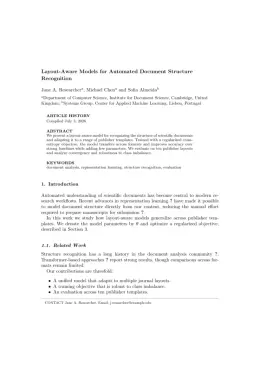
Hemoglobin template — frequently asked questions

How do I write a paper in the Hemoglobin format?
In DocuGuru you write your manuscript in a normal editor — no LaTeX setup required — and select the Hemoglobin template. When you export, DocuGuru compiles the paper into the official Taylor & Francis format and hands you a submission-ready PDF along with the editable LaTeX source.
What reference style does Hemoglobin use?
Hemoglobin uses Author–year (Chicago, T&F) references, shown as author–year markers such as (Smith, 2023) in the text. DocuGuru formats every in-text citation and the reference list in this exact style automatically. A reference appears like this: Smith, Ada, Ben Jones, and Cara Lee. 2023. "A Representative Article Title." Hemoglobin 12 (3): 45–58.
Do I need to know LaTeX to submit to Hemoglobin?
No. DocuGuru generates the interact LaTeX class and compiles the PDF for you in the background, so you get a Taylor & Francis-ready Hemoglobin document without writing any LaTeX. If you do want it, the LaTeX source is included in the export.
Can I import an existing draft into the Hemoglobin template?
Yes. Paste or upload your current manuscript — Word, LaTeX, Markdown, or plain text — and DocuGuru reflows it into the Hemoglobin format with correct headings, figures, tables, and author–year citations.
Who publishes Hemoglobin?
Hemoglobin is a multidisciplinary journal published by Taylor & Francis. DocuGuru's Hemoglobin template matches Taylor & Francis's official submission format.
Can I export a submission-ready Hemoglobin PDF?
Yes — DocuGuru produces a PDF built with the official Hemoglobin template (the interact class) that is ready to submit to Taylor & Francis, together with the matching LaTeX source files.
How much does the Hemoglobin template cost?
You can start writing in the Hemoglobin template for free. Exporting the final submission-ready Hemoglobin PDF and LaTeX source is part of DocuGuru's paid plans — see the app for current pricing.
Use the Hemoglobin template